copyright 2007-2020
I like a lot of different styles of painting. I have had an active interest in art for the past few years, and my tastes are still evolving as I learn and live with my growing collection. I do not collect as an investment but for the fun of it and to feed my enjoyment for doing research and learning. Here are some of my favorites. By the way, I am NOT the wildlife artist of the same name.
Pennsylvania Artists Texas Artists New England Artists Other Artists
UK Artists Canadian Artists South American Artists Asian Artists European Artists
Unknown Artists Unknown Artists 1 Unknown Artists 2 Unknown Artists 3
HOME

"Pennsylvania farm house", George W. Muro, 22" x 19", watercolor on heavy watercolor board, 1951
George W. Muro was
born on 2 August 1929 in Atlantic City, NJ, a son of
James Wakamatsu and Alva Lockhard Muro. James W. Muro
was born in Tokyo, Japan and Alva in Rhode Island.
George was married to Anita M. Calligaris about 1953 in
Italy, where she was born in 1935. George attended
Atlantic City High School and then attended and
graduated from the Philadelphia Museum School of Art.
After graduation, he joined the US Army and served in
Italy, where he met his future wife.
He is sometimes confused with George
P.eter Muro 1925-2005 who was the chair of the art
department at Allan Hancock College in Santa Maria, CA.
George P. Muro was the son of Mexican immigrant Tomas
Muro and Mary Brechta.

unnamed, George W. Muro,
22" x 19", watercolor on paper
Little is documented
about Muro's work as an artist and it appears that he
was primarily a commercial artist, but also did fine art
in watercolors and oils. Atlantic City directories show
that in 1956 he was employed as a commercial artist and
in 1957 as a draftsman for Bell Telephone where he later
worked for 35 years. Some of his works have been
described as California scenes, but are more likely
works done in Italy where the Muros resided part
of each year in retirement. There is a mention of a one
man show of his work in his obituary in 1959 so he may
have exhibited his work elsewhere, too.
The Muros did not have children and
at the end of their lives lived in a retirement home.
After their deaths, a niece sold their possessions and a
large quantity of Muro's works were sold on ebay in
April of 2018, the source of the works shown above. The
images of his work shown above were manipulated from the
ebay seller's images. Better images will be posted when
they are available.
George's obituary
appeared in the Atlantic City Press on 2 November 2015:
George W. Muro, 86, passed away Tuesday October 27, 2015 at his home in Somers Place in Egg Harbor Township after a long illness. George is predeceased by his wife Anita of 62 years.
He was the son of the late James and Alva (Lockard) Muro. George was born and raised in Atlantic City and attended Atlantic City High School and graduated in 1949. He then attended the Philadelphia Museum School of Art. After graduation he went into the Army and was stationed in Trieste, Italy where he met his wife Anita. Upon returning he worked at New Jersey Bell Telephone Co. as a draftsman for 35 years. George was a very talented artist and specialized in watercolors. In 1959 he had a one man art show at the Marlborough-Bienheim in Atlantic City. As the years went by he became very interested in Photography and his artistic ability was devoted to taking pictures. George was a member of NJ Bell Telephone Pioneers. After retiring he and his wife would spend six months of the year in their condo in Trieste, Italy. These were very happy times for them. Source: The Press of Atlantic City 02 November 2015
George and Anita are
buried in the Atlantic City Cemetery. They died a few
months apart in 2015.

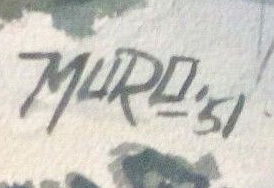
Examples of Muro's signature

"Evening Light", Alex Poplaski, 8 x
10", oil on commercial canvas board
I have
slowed my collecting down, due to lack of display and
storage space, but have had Alex Poplaski on my list
of artists to add to my collection for several years
and found this one on ebay for about a quarter of what
similar sized works by Poplaski normally sell for so
couldn't resist it. It is also a small painting, which
is a requirement for me nowadays. My favorite size
painting is actually 9 x 12 inches, but it is very
difficult to find used frames in that size! The
seller, in New Jersey, noted in 2017 that they
purchased this painting at an estate sale "at least 30
years ago". I was the only bidder on this painting.
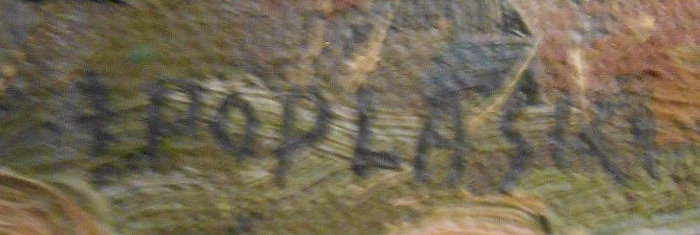
Alex Poplaski signature
The seller read the signature as
"L. Poplaski" as other potential buyers probably did,
but it looked to me as if the left leg of the
initial "A" had either flaked or been scraped
off. The last name is signed identically to many
Poplaski paintings that I have looked at for
reference. Poplaski also seems to have painted in two
distinct styles, rough, colorfully and loosely, like
this painting, and very precisely with fine detail and
somewhat more subdued but deep, rich colors. I am not
sure if this reflects two chronologically different
periods in his career or if it depended on his mood
and purpose. He may have been "paying the bills" with
these small loose works. I have noted that I most
often see this style in his smaller works. I once read
somewhere that his works had a vibrancy due to his use
of a particular type of under painting (orange?) that
he used.

After I receive the painting, a
little spit on a Q-Tip rolled across the initial
removed a bit of schmutz and showed that it was indeed
the letter "A".
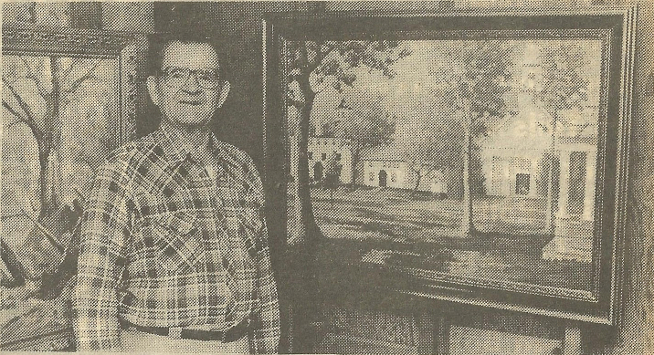
Alex Poplaski 1985
Alexander "Alex" Poplaski was born July 4, 1907 in
Harmonovka, Russia (the Ukraine), according to his
Connecticut Federal Naturalization Record. His birth
date is also give as 6 July 1906, but this is probably
the most reliable source since Poplaski actually
signed this document and swore to its accurateness. He
was reportedly a son of Anthony and Alice Poplaski
(?). One source also gives his parents' names as Mr.
and Mrs. Joseph Poplaski. I haven't able to find a
good source in primary records to confirm either
parentage claim, yet. According to his naturalization
papers, he entered the United States on 18 May 1914 on
the ship Rotterdam at New York City. He probably
entered through Ellis Island. His name was given as
Aleksander Poplawski at the time that he entered, but
the spelling had changed by 1939, the date of the
petition, to Poplowski. His occupation was given as
"automobile mechanic". He swore that he had lived in
New London County, CT continuously since 15 July 1933.

Naturalization record signature, 1939.
Poplaski enlisted in the US Army in
1944. He married Anna Klemark on 22 September 1928
in Colchester. He was a well known Colchester,
Connecticut landscape artist, and is associated with
the Old Lyme School of painting. Because he lived
in the vicinity of Old Lyme, he knew and was
influenced by many of the artists associated with that
area and that school of painting. He reportedly studied under James Goodwin
McManus and Bertram George Bruestle, two well known
Old Lyme school artists. Poplaski was a member of the
Old Lyme Art Association and served as its Vice
President from 1976-1979. I would appreciate hearing
from anyone who has documented facts about the life of
Alex Poplaski!

I am using the
seller's images of the framed work but they were very
distorted, almost triangular in shape from lens
distortion. I used GIMP to square this one off. The
image is a bit of an odd composition, I think. To me, it
looks like a roadside view of a farm on a hill with an
outbuilding in the foreground and a farmhouse just in
front of it, with just a portion of a church visible
over the hill. Close to downtown Colchester? If anyone
is familiar with this scene, I would appreciate hearing
from them.

Verso of frame with
masking tape label
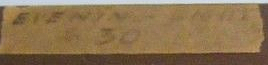
Label
The framing is a classic Poplaski
frame for a small work like this, probably a cheap
thrift shop frame. I think the frame is original to this
painting as the nails are old and rusted and have
obviously been holding the painting in the frame for
many years. There is a piece of masking tape on the
frame that bears the indistinct title of "Evening Light"
and a price of $30, so it was likely exhibited in this
frame. I have seen another Poplaski painting that has a
piece of tape in exactly the same location.
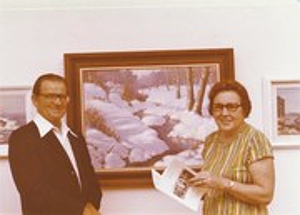
Alex and Anna Poplaski 1978
Poplaski died on 5
February 1988. He owned his own auto body shop but later
sold it to manage another auto shop. At the time of his
death he had been retired since 1963. He was last
employed as an auto body mechanic at Hill Top Motors in
Colchester. Anna was born on 15 May 1910 in Jersey City,
New Jersey and died on 10 June 1989 in Norwich,
Connecticut. Anna was last employed as a seamstress at
Aaron Dress at the time of her death. Alex and Anna are
buried in the St. Mary Old Ukrainian Cemetery in
Colchester.

Richard Eugene
"Gene" Barbera was born about 1964 and is a native of
Maine who currently lives in Stamford. CT. Barbera
studied at the University of Southern Maine, Portland
School of Art (Maine) and the University of Hartford
Art School (BA Art/Design). He has worked commercially
as an art director and designer, including for the
National Hockey League. His commercial work may be
viewed here.

"Woodland brook", Stacy Youngs, 11" x 14", oil on wooden board
Trenton Forster
"Stacy" Youngs was born about 1962 and is the son
artist Shirley Caen Youngs. Both live in Bozrah, CT. A
1989 newspaper article about his mother identifies
Trenton as "Stacy" and an inscription verso on this
painting identifies this artist as "Trenton Stacy
Youngs", though the origin of this inscription is not
known. The newspaper article notes that Stacy was
working as an artist at the time. Most of the work I
have seen by this artist is signed "T Youngs", so not
sure why the artist signed this piece "S Youngs". This
may be an example of an early signature by this
artist.
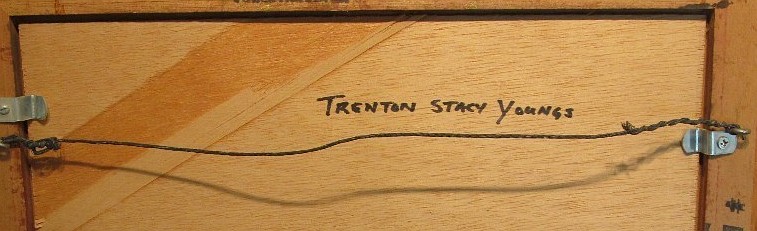
Verso
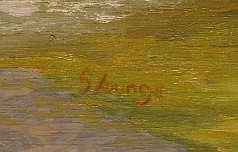
Youngs signature

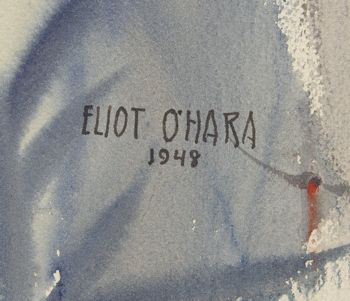
unnamed, Eliot O'Hara, 18" x 13", watercolor
For some time I was uncertain
that this painting was the work of well known artist
Eliot O'Hara (1890-1969), as most work by O'Hara that I
have been able to examine is signed in capital block
letters. After considerable research, I have determined
that this is indeed the work of O'Hara. I have located a
few examples of notations on the backs of other
watercolors signed in O'Hara's typical block letter
style on the front, that contain this signature verso. I
have also found some etchings by O'Hara held by the
Smithsonian that bear this same signature on the front.
To make this identification more difficult, examples of
portraiture work by O'Hara seem to be scarce compared to
his other work. I finally located a work by O'Hara
called "Portrait of Raymond Dale", signed in O'Hara's
normal manner that is very similar in size, palette and
composition to the work in my collection. Why O'Hara
signed in this cursive manner in this instance is not
known, but I now have no doubt that this is his work.
One observation I will make is to note that this
signature is much less noticeable than his normal
signature, which may be why he used it. I have not
removed my painting from the frame, as it is so
beautifully framed and sealed, as I explain in more
detail below. It is possible that the duration of my
research might have been much shorter if I had, as
O'Hara seems to have frequently made notations on the
backs of his watercolors. Someday....

"Portrait of Raymond
Dale", Eliot O'Hara, 19.5" x 14", watercolor on paper
This painting was sold at an
Aspire Inc. auction in September 2005. It was noted that
the work had been de-accessioned from an "important
Midwestern museum collection". Note the similarities to
the painting in my collection.


Closeups of "Portrait of
Raymond Dale" by Eliot O'Hara
I bought the painting in my
collection because I think it is a really amazing
painting. I like the artist's use of light and shadow
and the way that the artist captured the subject's eyes.
I like the subdued colors and general mood of the
painting, too. I also got an amazing deal on this work,
probably because it is not signed in O'Hara's normal
manner. The frame, alone, is worth many times what I
paid for this work. The painting was purchased on ebay
from a dealer in Bothell, Washington, but has the
framing label of "Herbert W. Keeble, Picture Framing,
441 El Camino Real, Menlo Park, California". The frame
is extremely well made and incredibly beautiful, marked
"Made in Belgium", and the framing and matting are
exceptionally well done. I am working on an image of the
framed painting.
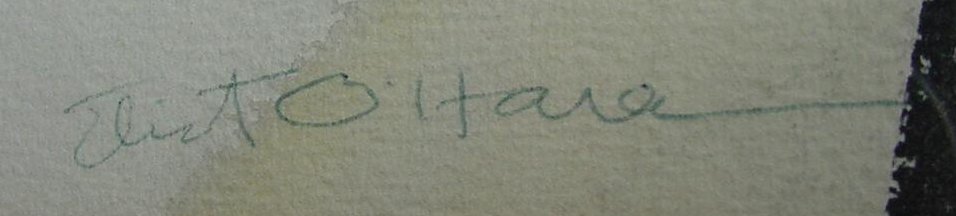
Signature on my painting
O'Hara's typical
signature
As part of my research, I am
became intrigued with the life of this framer and am
including what I discovered about him. Herbert Walter
Keeble was born 2 July 1907 in New Jersey, a son of
Edgar David and Adelaide Annie Cummings Keeble, English
immigrants. Edgar was employed as a "salesman, wholesale
furniture" in Baltimore in 1910, as an "interior decor,
furniture store" in San Pedro, CA in 1920, and as a
"merchant, art store" in Palo Alto, CA in 1930. Herbert
was still at home, working as a "framer, art store" in
1930, possibly working for his father. I also found a
record of another version of this label, "Keeble and
Barbour Picture Framing", at the same Menlo Park address
as that on the label on my painting.The painting that
bore that label was dated 1954. Herbert died on 30
December 2007 in Palo Alto, CA. His memorial appeared in
a local newspaper:
Herbert Walter Keeble July 2 1907-December 30, 2007 Bertie boy told his last story on Dec. 28th, recited his last poem on the 29th, and breathed his last breath on the 30th. Bert was born in New Jersey shortly after his parents, David and Adelaide, emigrated from England. The family traveled west by train to settle in Montara, CA, a small coastal town provided Bert with memories of collecting driftwood for the kitchen stove, milking his cow, and trading salvaged alcohol from shipwrecks for a bucket of abalone chowder at Charlie Nye's. The Keeble family moved to Palo Alto in the early 1920s where David opened an interior decorating store on University Avenue, carrying on a family tradition that began in London in 1668. After graduating from Paly High in 1926, Bert honed his skills as a master woodworker at the family store before opening his own picture framing shop in Menlo Park. Keeble Framing was an icon of quality and craftsmanship, and a good place to stop in for a four o'clock sherry. Bert's marriage to Anna Fay was the culmination of a courtship full of transbay visits by canoe, bike rides to the coast, and ski trips to Badger Pass. Bert and Anna settled in their first home on Seale Avenue in a family compound built along with his parents and his brother Dick. Their marriage was fueled by devotion to family and fun. After Anna's death in 1989, Bert took to the hills on foot and bicycle. His passion for open spaces led him to the headwaters of every creek in the bay area, to abandoned apple, walnut and chestnut orchards, and to some of the sweetest picnic sites on earth. Low tides and rainstorms would find him gathering mussels and mushrooms- always with a passel of wet and happy companions who would be treated to a feast at his house. This was Bert: creative, inventive, mischievous, and funny; a story telling, song- singing, poetry-spewing, rock-skipping trail guide; a bird watcher, a botanist, a squirrel-teaser, and friend to Blue Jays. He slept outside and loved waking up. He was a mixture of Edward Abbey, John Steinbeck and Bilbo Baggins, and he will be missed beyond measure by his four children, six grandchildren, four great-grandchildren, in-laws, adoring nieces and nephews, friends too numerous to count. He loved us all. He was our hero. Please raise a glass of 2 Buck Chuck to dear Uncle Bert, Plenty Dead.
Mr. Keeble's formal obituary appeared in a Palo Alto
newspaper:
Bert Keeble, 100, a longtime resident of Palo Alto, died Dec. 30. He was born in Camden, N.J. He moved to Palo Alto in 1921 and built, with his father and brother, a family compound on Seale Avenue. He graduated from Palo Alto High School in 1926. He was a picture framer/woodworker who framed and hung artwork in some of the grand estates in the area, including Filoli (when it was still a family home). He rode his bicycle all over town and, on his 100th birthday, led a bike parade around the block, followed by friends and loved ones. He researched and hiked to every watershed in the Palo Alto foothills. He is survived by his children, Karen Keeble of Santa Cruz, Tony Keeble of Palo Alto, Suzy Cortes of Berkeley and Tom Keeble of Saratoga.

Lester Grover Chapin was born
on 23 December 1885 in Springfield, Massachusetts, a
son of William Grover Chapin and Janette M.
Alexander. William graduated from Yale University
and was employed as superintendent of a Paper
Manufacturing company in Brooklyn, NY in 1910 and
1920. Lester attended the Pratt Institute and
Cornell University from 1904-1908 and graduated with
a Bachelor degree in Architecture. Lester was
affiliated with the YMCA and in 1910 traveled to
Japan as a missionary. Lester married
Marian Collins Ladner on 16 September 1914 in
Springfield, Massachusetts. (Biography in
progress).
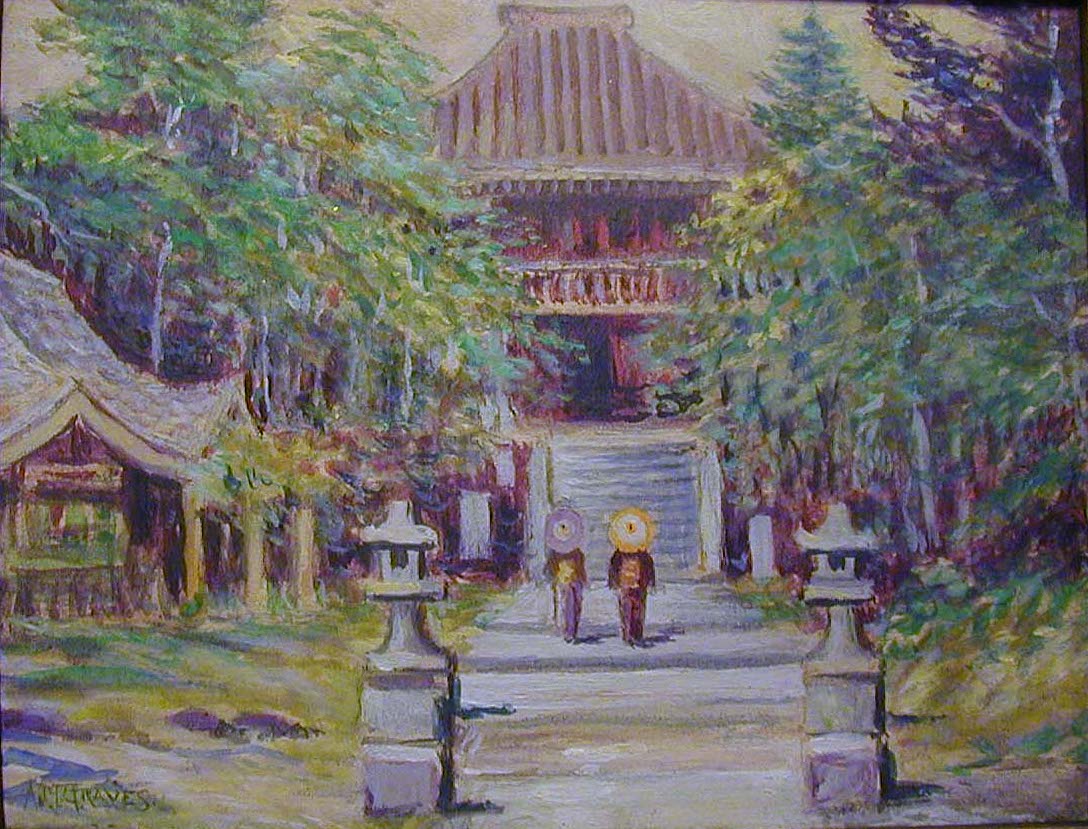
"Kamakura", Albert Melville Graves, 5.5" x 7", oil
Albert Melville Graves was born
on 10 Nov 1860 in Chicopee, Hampden County,
Massachusetts a son of Albert Kinney Graves and Lydia
Ellen Kennedy. He was a landscape and portrait painter.
Graves was educated in local schools and then spent four
years studying at the Massachusetts Normal Art School in
Boston where he graduated in 1883. Graves undertook an
additional year of study in various art schools and
studios in Boston. Graves was first listed in the
1887/88 Holyoke City Directory as an artist living at 95
Cabot Street. By 1901, his residence was 302 Springfield
Street in Chicopee until his move to Springfield in
1920. In 1930 Graves moved to 75 Dover Road, Longmeadow,
and resided there until his death. There have been
claims that Graves spent the greater part of his life
traveling the world with his niece, Eunice Harriet
Avery, a well-known traveler and lecturer on current
world events. This relationship is not supported by
census and genealogical records, though. The exact
relationship between these two persons is not clear.
Three weeks before his death at age
89, Graves returned from a tour of Japan and the
Philippine Islands. As the result of travels in Europe,
Asia and Africa, Graves discovered subjects for his
paintings. It does not appear that Graves regularly
exhibited and sold his art work, though several of his
paintings were sold at J.H. Miller's 7th Annual Exhibit
in 1917. One of his paintings is in the collection of
the Holyoke Art Museum in the Holyoke Public Library and
another in the Springfield Museum of Fine Art. Graves
also created illustrations of automobiles for the
Stevens-Duryea Company. Graves was reportedly married
twice, first to Lillian Emma Pratt and second to Frances
E. Haggart.
Graves died in 1950 in Longmeadow,
MA.
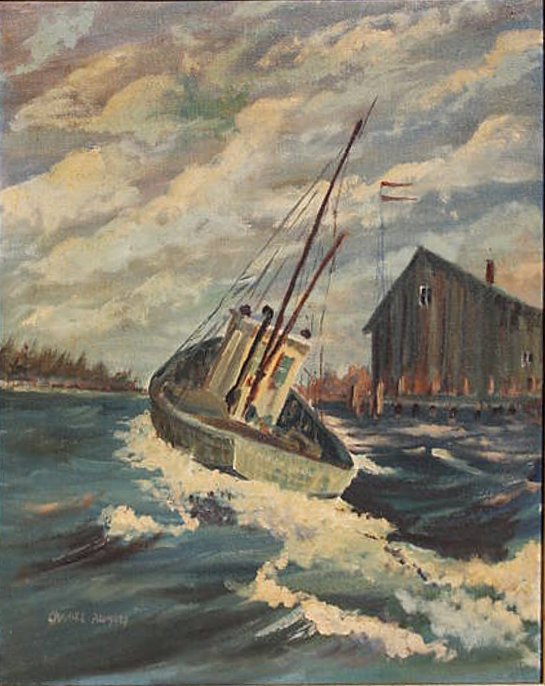
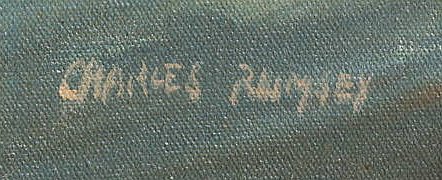
unnamed, Charles Rumsey, 23" x 18", oil
Charles Russell Rumsey was
born about 1922 in Philadelphia, PA, a son of John
and Martha Coleman Rumsey. John Rumsey was a cabinet
maker. Charles Rumsey attended Lasalle College,
later Lasalle University in 1942, where he studied
business administration. His studies were
interrupted by WWII and he completed a B.S. in
Business Administration in 1948 and later received
an MBA from the Drexal Institute. Rumsey studied art
at the Fleisher Art Memorial in Philadelphia. Rumsey
relocated to Erna, New Jersey where he became a well
known local artist. Rumsey painted in watercolors
and oils. An interesting article about him appeared
in a 1998 publication called the Lighthouse Digest.
From the top of the lighthouse he can see the world
Twice a week, a thoughtful yet happy man, a man
awakes to the wonder and opportunities of the world
around him, a man with a keen sense of past and
present, mounts the 199 steps of the Cape May Point
Lighthouse and experiences what is perhaps the
greatest kick of his adventurous and varied life.
Charles Russell Rumsey, 76, a
Philadelphian by birth, has seen much of the world -
from the waters of the Amazon to the volcanic shores
of Iwo Jima. But in his opinion, the sweep of this
139-year-old watchtower by night, and the view of
the sunlit beacon by day, surpasses them all. One of
three sons of John, a cabinetmaker, and his wife,
Martha, nee Coleman, Charles was introduced to the
wonders of the Point's Lighthouse in 1988 by his
brother Robert, owner of the Sea Breeze Motel, Cape
May. He had grown up in the tower's shadow. As a
young boy, he visited his maternal grandmother,
Martha Coleman, who summered there. But as a child,
Charles was busy with something else at the shore.
He liked to draw - a gull, the sea, the wetland
grasses. He would eventually work in watercolors.
Now, however, he is in his 10th
year as a lighthouse guide. During his four-hour
shifts he welcomes many of the 700,000 men, women,
and children who visit the Cape May State Park where
the lighthouse stands. Before each shift he
ceremoniously dons the cap and apron of the late
Harry Palmer, the last lighthouse keeper to tend the
great beam by hand. Mr. Rumsey's sense of wonder,
breadth of view and history is - as the French would
put it - a fait accompli. No seagull is happier.
An automatic electric aviation
beacon was installed in the tower in 1945.Cape May
Point Lighthouse has just been restored by the
Mid-Atlantic Center for the Arts - to the tune of
approximately $10 million - and is now open to the
public.
Livelihood is an important factor
in life, and John and Martha sent their fledgling
artist to LaSalle College, now a university, in
Philadelphia, to study business administration. War
broke out shortly thereafter, and in 1942, 20-year
old Charles, a member of the U.S. Naval Reserves,
enlisted in the Navy. After receiving radio
transmission training, he sailed as Radioman 1/C for
Brazil to hunt German submarines along the Amazon
River and search for "wolf packs," clandestine enemy
radio stations along the coast. Next, with 65
others, he entered the Naval Training School in
Seattle to study the Japanese wireless code and
operate a typewriter with a 65-key Japanese language
keyboard. Charles rolls his eyes recalling the
assignment: "It was difficult," he admits. But he
made it. He was then dispatched to Hawaii and Iwo
Jima for service in radio interpretation among the
many islands of the South Pacific. It wasn't like
the musical comedy.
World War II was over in 1945,
but realizing the importance of national defense,
Charles again joined the Naval Reserves. He returned
to LaSalle, and by 1948 had completed his B.S. in
business administration.
Charles married Jane DeVine that
year, a beautiful girl with a calm manner. They had
met at a St. Patrick's Day dance. The bands were
playing "How Are things in Glocca Morra?" in those
days. The Rumseys will celebrate their 50th wedding
anniversary November 23.They have two children,
Charles III and Mary Ann. Colonel David W. Rumsey,
U.S. Army (Ret.) is also a brother of Charles.
Charles was called to the Korean
War in 1949, to engage in tracking down Russian
military and diplomatic codes, a deterrent to
Russian aid to Korea. Returning home at war's end,
he got his master's degree in business
administration at Drexal Institute. He also studied
at Fleisher Memorial Art, an art academy in
Philadelphia.
In 1960 Charles returned to the
William J. Laughlin bookbinding supply house, where
he had worked briefly before going to war. He rose
to treasurer, retiring only this year, having spent
the last months as a consultant.
In 1978, the Rumseys bought a
small house in Erma, N.J. Charles restored it from
scratch and built several extra rooms. It stands on
about an acre of ground with pleasant shade and a
handsome ornamental wooden fence. On the back lawn i
s a much smaller building, headquarters for Charles
Rumsey's amateur radio operation, licensed by the
Federal Communication, as AA 2FA.
He had traveled too far to settle
down and limit his view and interest to a single
town. In the little house on the lawn he is in touch
with the world by wireless telegraphy several hours
a day.
"I've met people from Italy,
Germany, France, Russia, Switzerland and other
countries," he says a bit proudly, "and gotten to
know some of them personally. We've written and
communicate with some regularly."
Thus the air of Charles'
retirement is a very populated place, more varied
even than war adventures. It's cordial, sociable,
informative association of peace, not war.
Nevertheless, he is not detached
from the country and county where he lives. His
paintings embrace it.
A recognized and successful
artist, Charles' work had been widely shown, and
cited, in area galleries. Currently, the Mariner Art
Gallery in Wildwood Crest is offering his
"watercolors of nautical and rustic Cape May County
scenery in a marvelous freehand style."
It's time for lunch. Charles
comes in from his wireless office. Jane, who has
just finished the local paper, is waiting for news
of that larger world. "Just heard from Erico
Santiago in Naples," Charles reports, "he's had his
fifth grandson." Jane smiles looking around with
pleasure at their menage hung with a few of her
favorite paintings by Charles: "What's new in
Paris?" she asks.
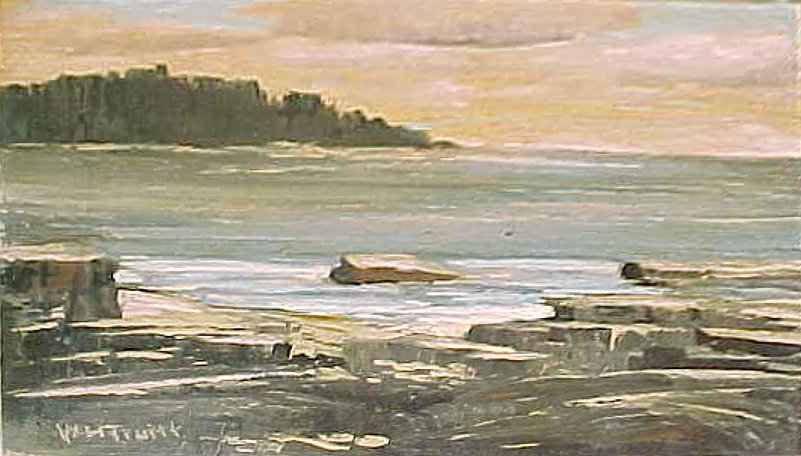
unnamed, W. H. Truitt, 8" x 10", oil
(better image on the way)
William Harrison Truitt was
born on 15 September 1886 in Trinidad, Colorado, a
son of Samuel and Julia H. Welch Truitt. Samuel
Truitt was a mason. The Truitts relocated to
Guthrie, Oklahoma by 1910. According to the 1910 and
1920 censuses, William was working as a painter. On
his 1917 WWI draft registration card his occupation
was given as "Manufacturer, Potho" and he was living
in Jersey City, New Jersey. He married Maisie S.
(Strout?) about 1923 and they were living in
Bloomfield,New Jersey in 1930 where William was
working as a "craftsman". Maisie was employed as a
teacher. The Truitts relocated to Bar Harbor, Maine
by 1935 where William and Maisie operated the Gray
Elf Studio Shop. Maisie started the Down East Fair,
a crafts fair, in Bar Harbor in 1959. William
appears to have worked primarily in oils painting
Maine coastal scenes and landscapes.
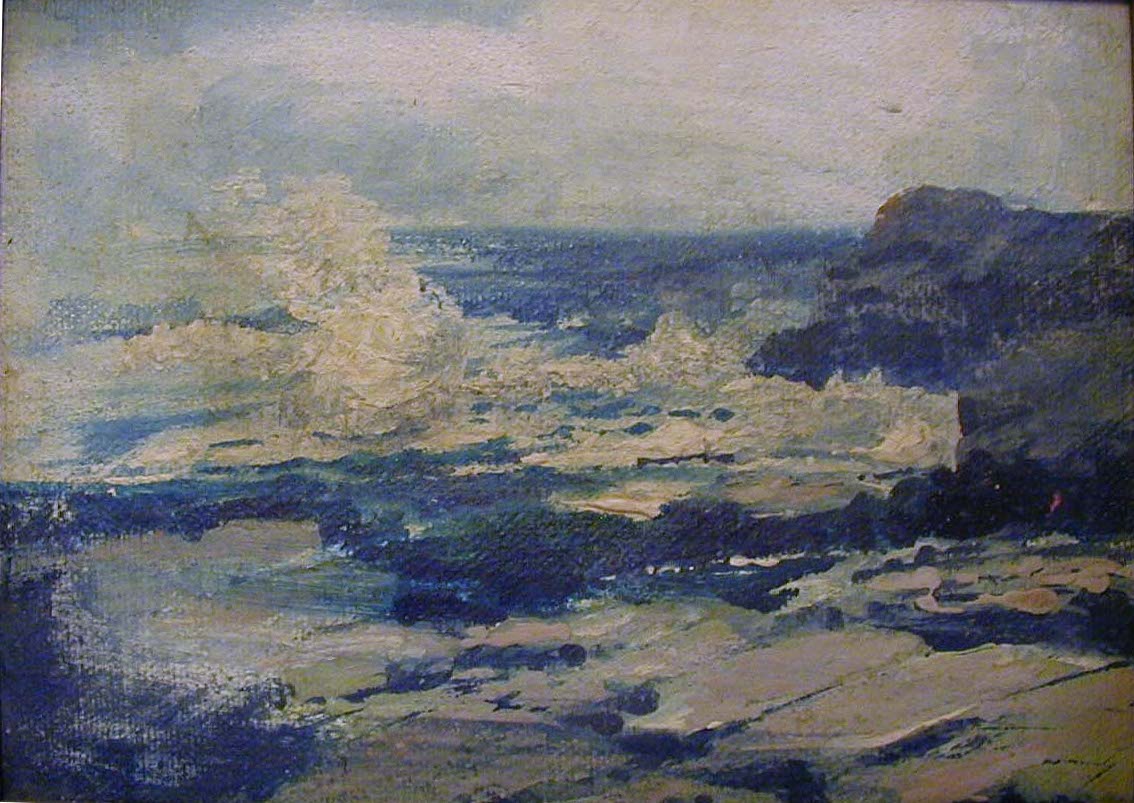
unnamed, William
Harrison Truitt (attributed), 6" x 8", oil
(better image coming)
This painting is not
signed, but was purchased at the same estate sale
as the first painting, is in an identical frame,
and has uses a similar color palette and style. I
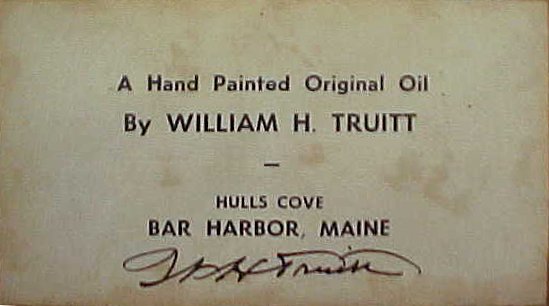
am attributing it to Truitt. Some of Truitt's
paintings included his signed shop label, shown
below.
It is not known where
Truitt studied art, but he seems to have been
engaged as an artist from an early age, so may
have studied in Colorado or Oklahoma. Truitt is
listed in the Biographical Dictionary of Kansas
Artists (active before 1945) by Susan V.
Craig and Davenport's Art Reference and Price
Guide.
William Truitt died in
September 1968 in Hull's Cove, Maine. Maisie died
there on 3 November 1997 at the age of 101.
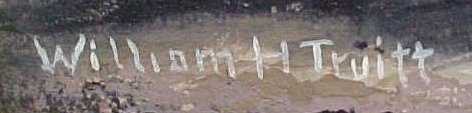

Examples of Truitt's signature
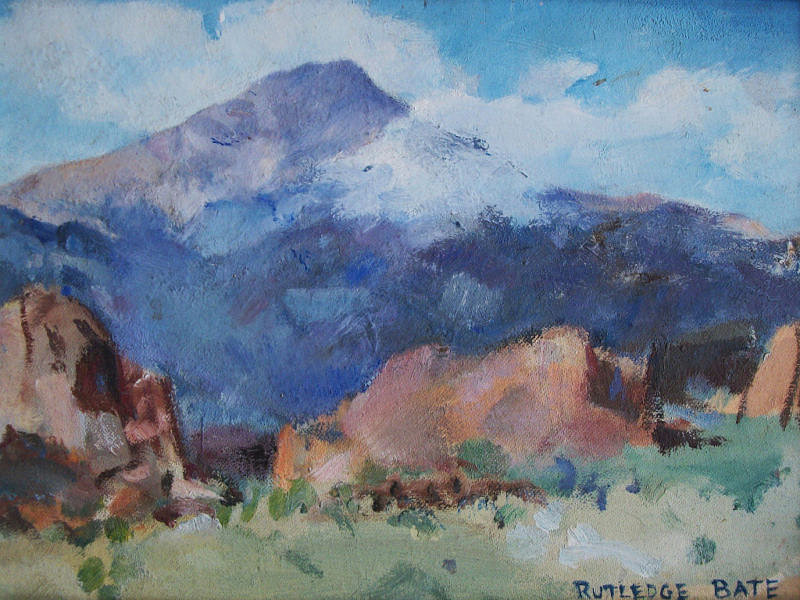
unnamed, Rutledge Bate, 9" x 12", oil
Rutledge
Bate was born on 2 February 1891 in Brooklyn, New
York, son of Mortimer S. and Irene S. Bate. Mortimer
was employed as a "Commission, Merchandise" in 1910
in Brooklyn, NY. Rutledge was a painter and teacher.
Bate studied at the School of the Boston Museum of
Fine Arts (BMFA) and with Abbott Thayer. Bate was
Page Fellow in Painting at the BMFA. Bate married
Virginia Edith Clark. The Bates lived and worked in
Boston and Brooklyn but eventually settled in
Rockport, Massachusetts. Bate taught at the Pratt
Institute and conducted the Rutledge Bate Summer
School in Rockport. Bate was a member of the
Rockport Art Association.
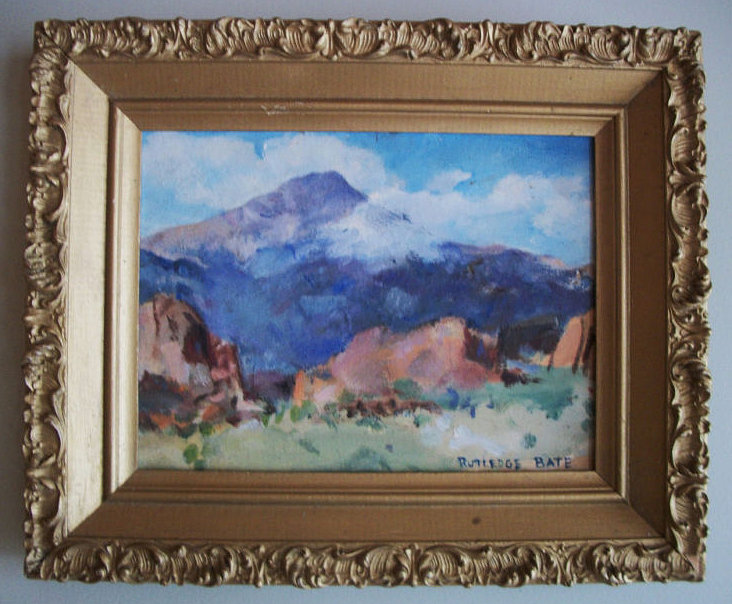
I suspect that this is an
early work by Bate, possibly a sketch for a bigger,
more defined painting. Most of the work by Bate that
I have seen is more finely detailed, though not
greatly more defined. A few pieces that I have seen
were fairly loose, but nothing like this piece. The
frame appears to be original and possibly 1920s of
1930s vintage, which supports my hypothesis.
Bate died in October 1964 in
Rockport, MA.
UPDATE: I was contacted by Mr. Bate's
granddaughter and later his son in 2011 and learned
some interesting information.
My daughter Gabby, who has been doing genealogical research, alerted me to the fact that you have a painting by my father on your web site.
That's great! I was really glad to see it there.
But I think you are wrong in your dating of this painting. I believe that it was painted in 1962, toward the end of his life, when he and my mother visited me in Colorado Springs. The painting appears to be of Pike's Peak with the Garden of the Gods in the foreground. At that point in his life, he had, very sadly, lost much of his memory, and essentially could not function without my mother's supervision. I recall driving him to a couple of places where he could paint.
I don't think my father ever traveled West at any other time in his life. As you know, he had studied extensively in Europe.
I'd be curious to know how you obtained this painting. He had no gallery exhibits that I know of this late in life. Quite possibly my mother gave it to someone who later sold it. You said that you have seen other work by my father and I would be curious about that, also."


unnamed, C. Selmi, 9" x 12", acrylic
Mr. Selmi passed away in Scottsdale, Arizona in May 1994.
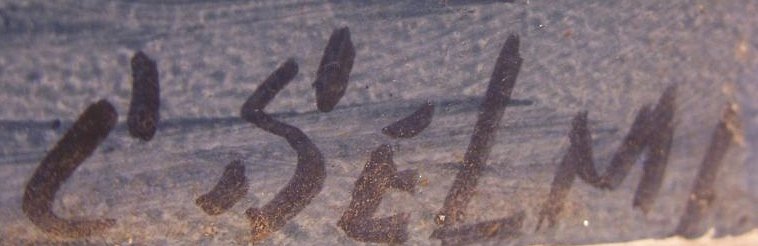
Charles Selmi signature
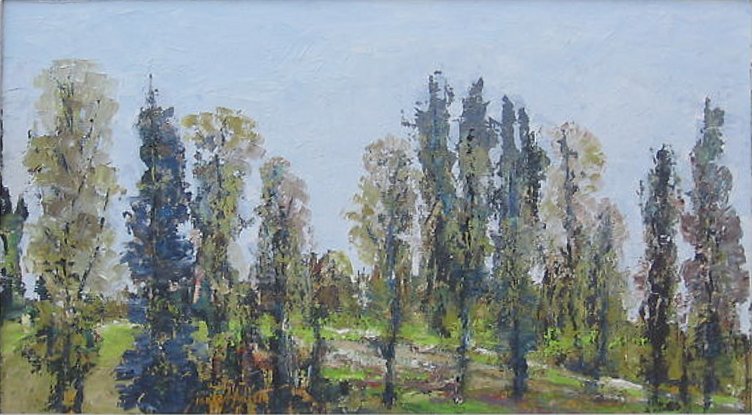
"Field Edge", Stanley Hallett, 10" x 16", oil, 1974
Francis Stanley Hallett was
born 19 October 1905 in Newton, Massachusetts, a son
of Edward Merrihew and Blanche May Stanley Hallett.
Blanche was the daughter of Francis Stanley, the
inventor of the Stanley Steamer. Edward was working
as a "purchasing agent, auto co." in 1910 and as a
"manufacturer, automobiles" in 1920. There were
servants living in the Hallett home in 1910 and
1920, so the family was apparently fairly wealthy.
Stanley went by either F. Stanley or just Stanley.
He is only identified as Francis in two easily found
primary records, both before 1930. He was identified
as Stanley in the 1910 census, Francis in the 1920
census and F. Stanley in the 1930 census. Stanley
married a woman named Esther C. about 1929 and they
were living in Newton, Massachusetts in 1930 where
his employment was reported as "agency,
advertising". Stanley married next Eleanore May
LaMarche on 7 June 1941. The Halletts moved to
Wilton Centre, New Hampshire by 1947.
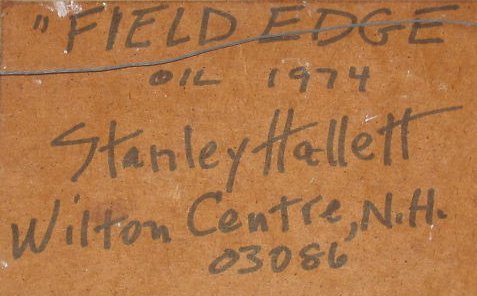
Inscription, verso
Hallett studied the violin for 20
years with teachers of, and at, the
New England Conservatory of Music. He was a member
of the first University World Cruise, sponsored by
New York University, in 1926. He worked as a concert
violinist and orchestra conductor until the age of
51 when he switched to painting, first working in
watercolors, but soon changing to oils. He studied
with Rosmond DeKalb and was advised by Sante
Graziani, but was largely self taught. He was an
expert in painting with a putty knife instead of
brushes and was much sought after to speak on,
demonstrate, and teach this technique. He became a
member of the New Hampshire Art Association in 1958
and was appointed Director of the Association two
years later. He later held several other offices
with the Association, including President in 1969
and 1974. He was also a member of the Copley Society
of Boston and Academic Art Association of
Springfield, Massachusetts. He exhibited widely in
New England and also had several one man shows. His
work was shown with the New Hampshire exhibit at the
1964 World's Fair and at a New Hampshire State
exhibition that followed. He won numerous prizes and
awards for his work. He was mentioned in Who's Who in
the East in 1964 and Wilton, Temple
& Lyndeborough by Dell'Orto.
Surprisingly, Hallett is not mentioned in any art
reference resource.
Stanley Hallett died on 14
November 1987 in Wilton, Hillsborough County, New
Hampshire.
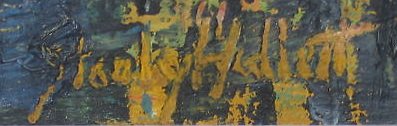
Stanley Hallett
signature

"Nahant", George Gardner Phipps, 6" x 9", watercolor
Bio coming....
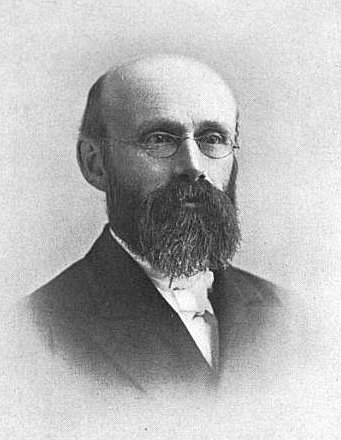
George Gardner Phipps

Phipps' signature

"Wash Day", Al Barker, 2.5" x 8", watercolor
Al Barker was born in New
Jersey and grew up in the Metropolitan New York
area. He earned a bachelors and masters in Forestry.
He is a largely self taught artist, but well known
for his miniatures. I have a thing for laundry
hanging on a clothesline, flapping in the wind, so I
love this painting. It hangs just inside my back
door and it is the first thing I see when I get home
every day. I am generally not a huge fan of
miniatures, but this one is an exception.


"Lincoln Cabin, Milton, Mass.", Minna G. Webb, 12" x 9", oil
Minna Hilde Grumbt Webb was
born June 1885 in Germany, a daughter of Hermann and
Wilhelmina "Minna" Grumbt. Herman came to America in
1890 and returned to Germany bring his family to the
US in 1891, first settling in Rhode Island, and
later in New Bedford, Bristol County, Massachusetts.
Herman was working as a butcher in 1900 and was
listed as a butcher in an 1890s New Bedford city
directory. Minna married Edward Orlville Webb, an
English immigrant or son of English immigrants,
about 1907, probably in New Bedford and they settled
there. Edward was employed as a "driver, laundry
wagon" in 1910 and as a "mechanic, automobile
repair" in 1920. His WWI draft registration gives
middle names for him and his wife. The Webbs appear
to be absent from the 1930 census. The Webbs did not
have children in 1910 or 1920. Minna worked as an
artist and decorator for the Pairpoint Glass Company
of New Bedford. She studied at Swain Free School of
Design in 1929 and exhibited at the Swain Free
School of Design and also at the Easy Street Gallery
in Nantucket in 1940. Webb is listed in Davenports Art
Reference and Price Guide and Who Was Who in
American Art by Falk.
Minna Grumbt Webb died in 1969
and is buried in the Rural Cemetery, New Bedford,
Massachusetts.
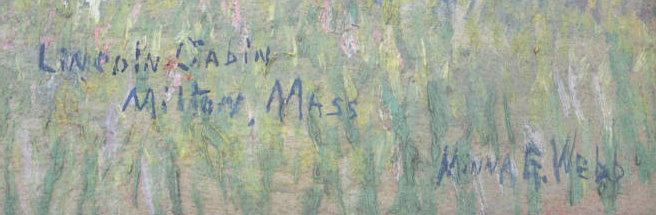
Inscription and signature

"Harbor Master", Martha S. Nickerson, 18" x 14", oil
I am still researching this
artist, as information about her personal life is
scarce and her name is fairly common, particularly
in New England where she lived. Luckily, an
extensive professional biography was attached to
this painting, along with a tag from a Rockport, MA
art exhibition. I believe that she is the Martha
Nickerson whose dates of birth are given in the
Social Security Death Index as 16 January 1914 and
11 March 2002. Her social security number was issued
in New York and she died in Needham Heights, MA.
Martha Nickerson lived at various addresses in
Rockport, MA, and I believe that Nickerson was her
married name and that her husband's name was Lewis.

Nickerson biography
An
extensive professional biography was
attached to the back of the painting.

Tag from painting
A
tag attached to the painting showed that this
painting was exhibited at a 1995 Rockport Art
Association exhibition. A couple examples of
Nickerson's work that I have seen are in a much more
impressionistic style, and better than the painting
in my collection, in my opinion. Nickerson would, I
think, have been in her early 80s when this painting
was created.

Nickerson business
card
This is an example of Nickerson's business card from
another on line auction. The address agrees with
some city directory entries that also give the 16
January 1914 birth date, which I think is strong
evidence that the Social Security Death Index entry
is for Martha. A Massachusetts death record that
gives her spouse's name as Lewis also includes the
same birth date for her.


"Picket Mt.", M. A. Safford, 7" x 13.25", oil, Sep 1909
The painting above and the
painting below were sold together at a Vermont
estate auction. Each has a similar price tag from a
much earlier sale and appear to be by the same
artist. The first painting is on an unmounted canvas
and is noted to be a sketch of Picket Mt., which is
in Maine. It is also signed twice, M. A. Safford.
The second painting is an oil on board and is
unsigned. Unfortunately, the seller of these
paintings was negligent in packing them and both
were badly damaged in the mails. I kept them anyway,
so they would at least be preserved, since this
artist's work appears to be scarce, and because I
had spent a significant amount of time and effort in
researching this artist.

unnamed, unsigned, 8.25" x 12.25", oil
I believe that both paintings are
possibly the work of Martha Ann (Hayes) Safford, a well
known New Hampshire artist, who, in 1909, was living in
Rochester, New Hampshire 35 miles from Picket Mountain,
Maine. Since Mrs. Safford is not well documented, I am
including information about her that I have compiled.
Mrs. Martha A. Safford was born on 8
August 1850 in Farmington, Strafford County, New
Hampshire, a daughter of Israel and Anne Freeman Edgerly
Hayes. Israel was a shoemaker. Martha married James
Fearing Safford about 1868. He was an optician and
jeweler, and, with their son, Percival, was owner and
proprietor of J. F. Safford and Son Jewelers in
Farmington, NH. The earliest reference that I have found
to Martha's work as an artist is in her biography in New Hampshire
Women by Batterson, 1895:
Granite State, who are worthy representatives of their sex in the various walks and conditions of life., published by The New Hampshire Publishing Co., J.G. Batterson, Jr., President,©1895, page 167.
SAFFORD, Martha A. Hayes
Not often are towns able to retain the more distinguished of their daughters to the years of their womanly prime, but this good fortune is given to Farmington by Mrs. Safford, the well-known artist. She is a daughter of Israel and Anne (Edgerly) Hayes, and descended from notable people of whom one was Col. Thomas Tash of the Revolution. At the age of eighteen she was married to James Fearing Safford, formerly of Maine, a veteran of the Civil War. One son, now arrived at manhood, blesses the happy union. Inheriting refined and artistic tastes, and encouraged by her husband, she devoted close attention to painting and crayon portraiture, under excellent teachers, for the years succeeding her marriage, and has become one of the best instructors in her specialties, in New Hampshire, and one of the Granite state. She sketches from nature almost invariably, and adds to her unusually correct drawing a fine sense of the fitness of things, and an enviable eye for color.With the magic of her brush, a scene which has pleased us is set again before us, in outline true, and in its own beauty of tint; still may we feel the charm of flower and leaf, the glowing sphere from the willing tree, and the lesser globe and oval, from shrubs here and there invite us, and still does the fruit of the vine hold the delicacy of its virgin bloom; while every accessory of a picture has received its meed of attention from the conscientious artist. Yet not through all these comes her chief pleasure, for more than the simple delight of the eye is the recalling of the features of those whom we "have loved long since, yet lost awhile," in which Mrs. Safford is especially gifted, working often from the faint shadows of some old and imperfect portrait, and completing a likeness which is priceless. Any good artist may portray well from life, but one whose intuition of the spirit is allied to the skill of eye and hand offers to us the gift of
genius.
It is obvious, from this
biography, that Martha was well established as an artist
by this time, 1895, when she was about 45 years old.
Despite this, I have not found any indication of where
she studied or taught art, or any mention of her showing
her work. Her occupation is given as artist in
Farmington city directories, from 1900 until 1905, when,
after the death of her husband, she and her son,
Percival, relocated to Rochester, NH. Percival retained
the name of J. F. Safford and Son for his business for
decades after the death of his father. Martha is
described as "artist in oil, crayon, and portrait" in
Rochester city directories. She is mentioned in Davenport's Art
Reference and Price Guide.

Martha died on 9 October 1912
in Rochester, New Hampshire, according to the 1917
Rochester City Directory.

M. A. Safford signature, verso

"Sanctuary Shade", Dewitt Hardy, 11" x 10.5", watercolor
Clarion Dewitt Hardy was born
in June 1940 in St. Louis, Missouri a son of Clarion
Dewitt Hardy II and Jane Upchurch. Clarion Dewitt
Hardy II was a professor at the University of Maine,
a son of Clarion Dewitt Hardy I who was a professor
at Northwestern University. Dewitt Hardy attended
Syracuse University. He was a well known Maine
watercolor artist, art appraiser, set designer and
teacher. He was married first to artist Pat Hardy
and second to Deirdre Williams.
Hardy was president of the
Ogunquit Art Association at the time of his death
and had been the curator of the Ogunquit Museum of
Art earlier in his career. He worked as a set
designer at Hackmatack Playhouse in Berwick, Maine
for 35 years. He was a student of Ed Betts. He
taught for many years at the Sanctuary Art Center in
Eliot, Maine, the subject of my painting.
Hardy exhibited widely, including
17 one man shows in New York City, and his art is in
many collections, including 42 museums, for instance
the Smithsonian, the British Museum, the Cleveland
Museum and the San Francisco Museum. Hardy's web site is.
Dewitt Hardy died
on 8 July 2017 after attending an event at the Barn
Gallery in Ogunquit, Maine. His work was among that
of other artists being highlighted in the event.

"Winter winds ...", Arnold W. Knauth, 6" x 10", oil
This is more of a pleine aire
sketch, perhaps a study for a larger painting. This
painting is not signed, but the frame is signed and
titled, along with a price of $45 on the back. The
signature is in pencil and very faint, and the title
is too faint to make out, but appears to be "Name:
Winter (illegible)". I messed with the images using
gimp but was not able to make much out of them. It
may be logical that he wrote on the frame, as the
painting is on a rough board that could not be
written on. The board is similar to a couple of
examples of board used for other paintings by Mr.
Knauth. Mr. Knauth is still living at age 91, so I
sent him some images of the painting, in an attempt
to see if he could confirm that this is his work and
maybe get some history for it. He responded to my
letter and informed that this is his work, "it is
exactly right". He could not, unfortunately,
remember when he painted it, or the title, not
surprising since it was painted perhaps fifty or
sixty years ago. Love this painting!


Signature and title in pencil on back of frame.
Arnold Whitman Knauth II was
born on 18 October 1918 in New York, New York, a son
of Oswald Whitman Knauth and Anna Dixwell Clements.
Oswald Knauth reported his employment as "Asst.
Prof. Economics, Princeton University" in his WWI
draft registration. He was employed as an
"Executive, Department Store" in 1930. Arnold Knauth
attended Harvard University, the National Academy of
Design, the Hibbard Summer School of Painting, the
Wellfleet Art School, and he studied with Xavier
Gonzalez. He was a member of the Salmagundi Club,
the American Watercolor Society, Philadelphia
Watercolor Club, Audubon Academy, Guild of Boston
Artists, Northshore Artists Association, and
Rockport Art Association. He exhibited widely,
including at the National Academy of Design,
Pennsylvania Academy of Fine Arts, John Herron Art
Institute, and Boston Museum of Fine Arts. He won
numerous awards for his work. He is listed in
several editions of Who is Who in American Art, Who Was Who in
American Art by Falk, and Davenports Art
Reference and Price Guide.


Knauth framed and
verso

"Pleasant Street", Anne B. Stevens, 12" x 16", oil, July 1952
This was an ebay find.
Several paintings by this artist were offered by a
seller in Claremont, NH. As far as I can tell this
artist, though seemingly accomplished, is not listed
in any art reference book and I could find no
information about her work as an artist. I did,
however, locate records that I am now confident is
for this woman, based on information found on the
backs of these paintings.
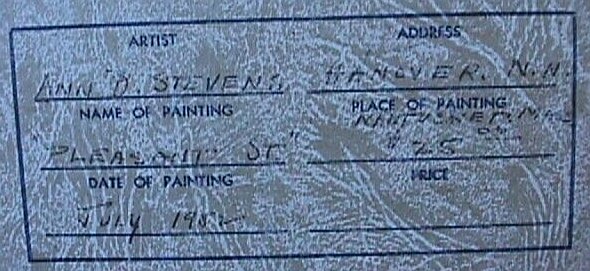
Label verso
Anne B. Stevens was born 6 July
1903 in Glen Ridge, New Jersey, a daughter of George
and Mathilde Maus Baumler. George was working as a
baker in 1910, a route driver for a milk company in
1920, and as a clerk for a retail milk business in
1930. Census records for 1910, 1920, and 1930 give
Ann's name as Anna. The 1910 census gives her middle
initial as "F". She married William R. Francis about
1925. They were living with her parents in Glen
Ridge in 1930. Anna was working as a bank clerk and
her husband as "machinist, electrical mfg." in 1930.
This marriage apparently did not last as she was
married to Dr. Wayne Edson Stevens, a Dartmouth
professor, in 1933. He died in 1959. She was living
in the Brookside Retirement Home in Hartford,
Vermont at the time of her death, according to her
death record, but her burial place was listed as the
Pine Knoll Cemetery, Hanover, New Hampshire, the
same cemetery where Wayne Edson Stevens is buried.
Her occupation was listed as homemaker and her last
address as 4 North Park St., Hanover, NH 03755. Her
education was given as 12 years of
Elementary/Secondary, probably meaning she was a
high school graduate. She graduated from the
Montclair Secretarial School in Montclair,
NJ in 1922 and worked as the secretary of
the summer Russian Language Institute at Dartmouth
1960-1967. Sarah Hartwell, the Reading Room
Supervisor at Rauner Special Collections Library at
Dartmouth, searched the records available to her
including the 1949, 1952, and 1954 Hanover City
Directories, and the only Ann Stevens listed was the
wife of Wayne Stevens, both living on North Park St.

Ann Stevens was the President
of the Dartmouth-Hitchcock Medical Center Auxiliary
from 1941-1947, and highly praised for her
performance during this period. The image above is
from a history of this organization.
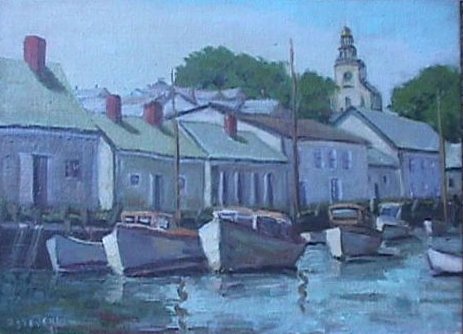
Another Stevens painting, 1951
A second painting by this
artist was offered along with my painting, but I did
not bid on it. Both works are very nice, so it may
be assumed that she had worked as an artist for some
time, whether as an amateur or in some other
capacity. Looking back in the seller's history, I
determined that he offered a third signed painting
and a lot of unsigned paintings, a watercolor and
five oils, that were purchased together with the
first two paintings, and assumed to be by the same
artist. The seller speculated that the unsigned lot
was composed of preliminary sketches for larger
works. The unsigned lot of paintings is much cruder
in nature, but uses the same color palette as the
first two paintings, so I think the seller is likely
correct. I am including images of the other
paintings at the bottom of this biography, since so
little is known about this artist.
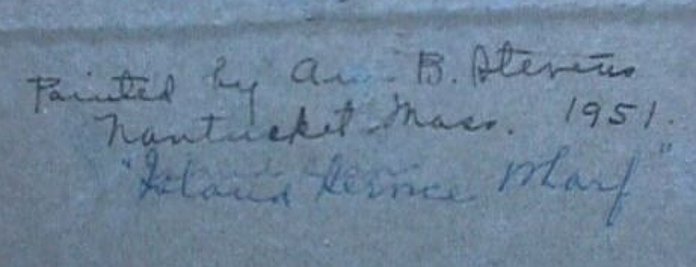
Both paintings are apparently
Nantucket, MA scenes, painted in two different
years, so she was apparently serious enough about
her art to spend time traveling to locations where
she could find scenery she felt significant enough
to paint.

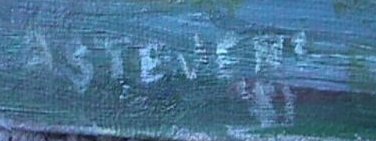
Signatures
Ann B. Stevens signed her
paintings almost illegibly, so it is lucky that she
wrote more clearly on the backs of them. I'll update
this biography as I discover more about her.

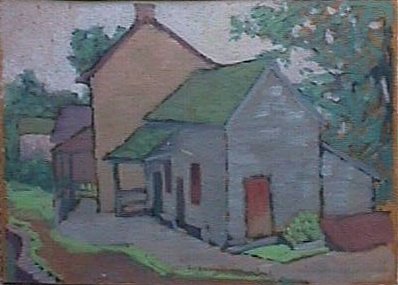
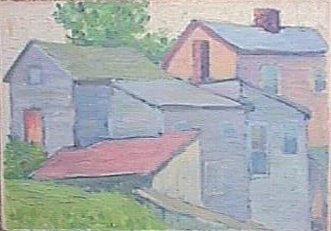

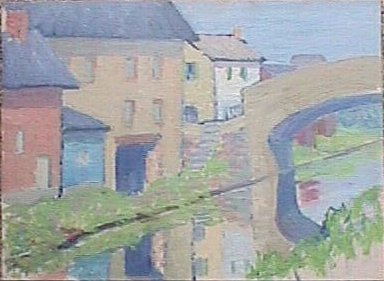

unsigned
lot, watercolor upper left, all 10" x 14"
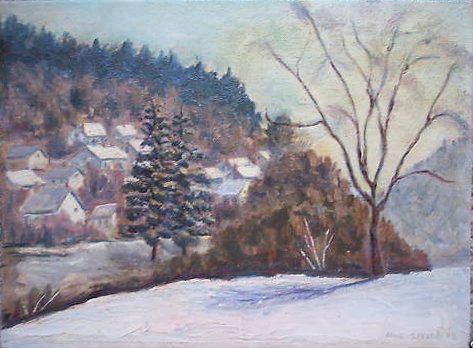

Russel Whitten is a Maine
artist who was born 7 June 1962. He studied at the
Maine College of Art, the Art Student's League, and
with DeWitt Hardy, Norman West and Richard Brown
Latham at Heartwood College of Art in Kennebunk,
Maine. He has a web site.

"Dancer at the Barre", Jan Gendron, 14" x 11", oil, 2009
Jan Gendron was born on 11
November 1949 in New York City. He studied at the
Vesper George School of Art in Boston, with Henry
Henche at the Cape School of Art, and with Robert
Cormier. Gendron is mentioned in The New
Renaissance, Volume 6 by Louse T. Reynolds.
Jan has a blog.
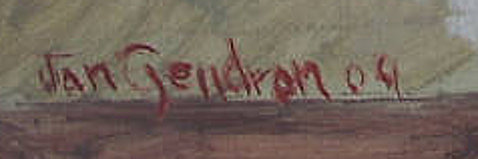
Jan Gendron signature

unnamed, Olin F. Vought, 8" x 6", watercolor
Olin Farrell Vought was born
in February of 1870 in Dover, Morris County, New
Jersey, the only child of William Allen and Emily
"Emma" Farrell Vought. Allen, as he seems to have
preferred using his middle name, was a druggist. He
died before 1894 and Olin was living with his mother
in Dover, Morris County, New Jersey 1900-1920. Emma
probably died before 1930, as Olin was living alone
in Roxbury, New Jersey in 1930. His occupation in
each census was given as artist, though the type of
artist varied from just plain artist, to " artist,
watercolors" and "artist, paintings". His name is
sometime spelled "Vaught" in census records. He is
listed as an artist in various Morris County, New
Jersey directories as early as 1894. There is a
permanent exhibit of his art at the Silas Riggs
Saltbox House Living Museum in Roxbury, NJ. Vought
was a well known local artist who worked in glass
plate photographs, drawings, pen and ink sketches,
and watercolors of the canal area in northern New
Jersey. He focused on the area from
Rockaway-Hibernia to Phillipsburg. His photographs
are prominent in the local histories of the canal,
including "The Morris Canal: across New Jersey by
water and rail" by Robert R. Goller, which is
available, in part, on Google Books. His photographs
were also used extensively in books by James Lee, a
New Jersey historian who specialized in the Morris
Canal. Vought was a member of the Dover Camera Club
in 1899 and exhibited his photographs at the Club's
exhibitions.
I do not know where Vought
trained as an artist. It is peculiar that an artist
so well known is not listed in any art reference
book, except for Mallett's Index of
Artists and Davenport's Art Reference and Price
Guide, where he is misidentified as "Olif"
Vought. His death was reported in the New York Times
on 12 July 1940:
Olin F. Vought
Succasunna, N.J.,
July 12 (AP) - Olin F. Vought, landscape and floral
painter, died at his home here today of a heart
ailment at the age of 70. He had been ill since
February.

Vought's
signature

"Sunset at Andrews Point, Cape Ann, Mass", Peter Koster, 9" x 12", oil
Peter Koster was born on 31
May 1891 in the village of Zaamslag, in the
Netherlands. He immigrated to the US in 1910, but
does not appear in the 1910 US census. His first
appearance in US records is the record of his
arrival in New York on the ship Potsdam from the
port of Rotterdam on 21 May 1910. He was apparently
traveling with two other men as all three were from
Holland and their destination was Grand Rapids,
Michigan. The other men were Cornelis A. Kaag, aged
16, a baker, and Johannes van Herp, aged 25, a
painter. Koster gave his occupation as "painter" and
his father's name as J. Koster. On 5 June 1917, he
supplied information for his WWI draft registration.
He was working as a sketch artist for Myercord Co.
in Chicago at the time, but residing in Grand
Rapids, Michigan. He was married, but did not give
the name of his wife. The 1930 census indicates that
Koster married about 1913. His status was given as
"Alien - First papers". Koster was still living in
Grand Rapids in 1920, working as an artist in a
furniture studio. The census that year reported that
he had become a naturalized citizen in 1917, but I
have not been able to locate his naturalization
papers. He was married to a woman named Nellie who
was born in Michigan of Dutch parents. They had a 1
1/2 year old daughter, Vivian. This marriage
apparently did not last as Koster was living as
lodger in a boarding house in Grand Rapids working
as an artist "at home" in 1930. His marital status
was reported as single. His ex-wife, Petronella E.,
had remarried to a man named Peter Bajema and they
were still living in Grand Rapids. Vivian J. Koster
was listed as Bajema's step-daughter. Peter Koster
traveled to the Netherlands and his arrival was
reported in New York City on 14 September 1930, on
the ship Rotterdam which had departed from the port
of Rotterdam on 6 September 1930. The address
recorded on the passenger list was 159 Bostwick St.,
Grand Rapids, Michigan, and once again gave his
naturalization year as 1917 in Grand Rapids. This is
also the same address he was residing at during the
1930 census. According to Koster's WWII draft
registration card, he was a resident of Bearskin
Neck, Rockport, Essex County, Massachusetts. He was
self employed in Rockport and then married to a
woman named Lena.

Notation, verso
Koster's biography appears in American Landscape and Genre Paintings in the New York Historical Society by Koke. I have not yet been able to examine this book, but the snippet view on Google Books reveals that Koster received his training as an artist in the Netherlands. Koster was a member of the Rockport Art Association and North Shore Art Association. He is not listed in any art reference book that I have examined, though I suspect he appeared in one of the pictorial histories of the Rockport Art Association that this society periodically generated. A P. Koster, a 20th Century Gloucester, Massachusetts artist, is listed in Davenport's Art Reference and Price Guide. As this is the only artist I have encountered with this first initial and last name, I suspect they may be the same artist. Koster worked in oils and my paintings appear fairly typical of his work.

Koster biography and
RAA application
A copy of Koster's biography
and application to the Rockport Art Association were
taped to the back of the Cape Ann painting.

"Bayshore", P.
Koster, 9" x 12", oil, 1975
The second painting is
likely Koster's work, as well. The signatures are
very similar, though the second painting is signed
"P. Koster". The painting is inscribed verso
"Bayshore 1975". Bayshore (Gardens) is in Sarasota,
Florida. Peter Koster died on 18 July 1978 in
Sarasota, Florida, so this is a very late work for
him.

Peter Koster signature

"Revolutionary Church, Springfield, N.J.", Helen Stockton, 12" x 9", oil
Helen Marie Stockton was born on 18 April 1889 in
New Jersey, a daughter of John Potter and Lynda
Thorndyke Low Stockton. John was a lawyer and son of
a US Senator. John was a descendant of Richard
Stockton, a signer of the Declaration of
Independence. Helen graduated from Columbia
University Teachers College with a Special Diploma
in Fine Arts in 1908, and in 1912 with a Special
Diploma in Education. I have found several
references of her contributions of articles
to various art and educational journals,
the earliest in 1914. Helen was living with her
mother and sisters in Westfield, New Jersey during
the 1920 census. Her occupation was given as
"Supervisor of Training, Westfield Schools". Her
sister Margaret was occupied as "Supervisor of
Domestic School, Woodbridge, N.J.". Helen
contributed several articles to Industrial Arts
magazine in the 1920s. She was described as
Supervisor of Fine and Industrial Arts at the State
Normal School of Trenton, New Jersey in the credits.
Helen was living with her widowed mother in 1930 in
Westfield, New Jersey, employed as a school teacher.
Her occupation is listed as “artist" in the 1938
Polk's Directory of Westfield, New Jersey. She
contributed several articles to American Artist
magazine in the 1950s. She also wrote several books,
for instance one called Drawing and
Picture Making. She also collaborated on
several books intended for children and students.
Her younger sister, Janet, was also an artist who
painted in oils, and was a member of the Westfield
Art Association. Her sister, Edna Margaret,
graduated from the Columbia Teachers College in 1908
with a BS degree in Teacher of Household Arts.
The December 1920 edition of the
New Jersey Education Bulletin reported:
To
succeed Miss Taylor, Miss Helen M. Stockton has been
appointed. Miss Stockton's special training was
taken at the New York School of Fine and Applied
Arts; at Teachers College, Columbia University; at
New York University, and through extension work at
Rutgers College. She has held the positions of
supervisor of art at Morgantown, West Virginia;
supervisor of art and hand work at Westfield for the
past eight years, and director of fine and
industrial arts at Rutgers College summer session
for the last five years. Miss Stockton has also been
engaged in various activities in the field of art
outside the schoolroom, having served as director of
a base hospital craft club, and president of the Art
Teacher's Association, and the Manual Arts
Association, of Union County.
(Note: “Miss Taylor” was instructor in the art department at the Trenton State Normal School. The New York School of Fine and Applied Arts was founded by William Merritt Chase and is now known as the Parsons school.)
She is mentioned several times for her work as an artist in the local Westfield newspaper. From The Westfield Leader, 8 December 1955:
Helen Stockton's Landscapes Exhibited
Several of the landscapes of Miss Helen M. Stockton of 117 North Euclid avenue, artist and author, will be among a display of her works this month sponsored by the Verona-West Essex Art Association in the Verona Public Library.
The Westfield artist recently exhibited her paintings in the Paper Mill Playhouse, Millburn. Several art centers in New Jersey and New York have presented her awards.
Miss Stockton also has written and illustrated a number of children's books and has taught at several art schools in the state.

She
was member of the Westfield Art Association. I have
found several mentions of showings of her work. One
reference also describes her as an illustrator, and I
have found one mention of a children's book illustrated
by Helen M. Stockton. I have not located her in any art
reference book and she does not appear to be listed as
an artist. She is mentioned and misidentified as Helen
R. Stockton on artprice.com and askart.com. She was
listed in the 1929 edition of Who's Who Among North
American Authors, and Who Was Who Among North American
Authors, 1921-1939.

A
book by Helen M. Stockton, 1930
Helen Stockton died in September
1981 in Westfield, New Jersey. She is buried in the
Fairview Cemetery in Westfield, New Jersey.

Stockton's signature

"Gray cottage at Bluff Point", Katherine M. Mallett Howe, 10" x 14", watercolor
Katherine M. Mallett Howe was
born in Norwich, Connecticut in February 1895 a
daughter of James W. and Jennie A. Mallett. James
was employed as a sign painter in 1900-1910. Though
aged 63 in 1920 and 73 in 1930, his occupation was
listed as "Awning Maker, Awning Shop" and
"Manufacture, Awnings". James was born in Nova
Scotia and Jennie in Maine. James was a naturalized
US citizen who came to the US in 1860. Katherine's
name is sometime spelled with a "C" in census
records and her middle initial is consistently given
as "M.", though it appears as "L." in other records.
She was an artist, illustrator, and author. She
studied at the Norwich Academy Art School, the
Boston Museum Fine Arts Academy School, the Art
Students League and with Philip Hale, Henry Hunt
Clark, George Brant Bridgman, and John Bindrum.
Katherine received a scholarship from the Boston
Museum Fine Arts School in 1915. It was noted that
she resided in Norwich. Her occupation in 1920 was
"Art Teacher, Public School". She was a teacher at
the Norwich Art School in 1928. Katherine married
Marshall Victor Howe on August 25, 1928 in Norwich.
The Howes were living at 504 West 136th Street in
New York in 1930. Marshall's occupation was "Artist
Designer, Stained Glass" and Katherine was not
employed. Both later worked as artists and designers
for the Norcross Company, a New York City greeting
card company. Katherine also authored and
illustrated children's books. I have found
numerous references to Katherine's work as an
illustrator and watercolor artist. One reference
notes that her work is part of the permanent
collection of the Slater Museum, Norwich.
Howe was a member of the National
Association of Women Artists and the Mystic Art
Association. She is mentioned in Who's Who in
the East (1962), Who's Who in
America (1950), Artists
Directory (1928), Who Was Who in
American Art by Falk, Artists as
Illustrators by Castagno, and Davenport's
Art Reference and Price Guide. Falk cites
Mallett as a reference, but I could not find
Katherine listed under either her maiden or married
name.
Katherine died on 23 September
1957 and I have found a reference to her obituary in
the New York Times, though I have not been able to
locate it.

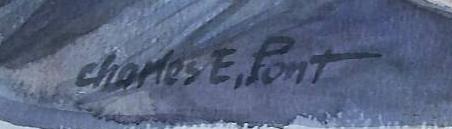
"No. 203, 75, Oyster Boat", Charles E. Pont, 19.5" x 26", watercolor
Charles Ernest Pont was born on 6 January 1898 in St. Julien, France the son of Francoise Pont and an unknown father. His mother came to America with him on 16 May 1898 on the ship SS La Gascogne. She gave her nationality as Swiss, her occupation as teacher, and it was noted that her father had paid for her fare. Francoise reportedly abandoned her son to a German couple shortly after her arrival and in 1900 was living in Tuxedo, New York working as a "ladies maid" for a "Capitalist" couple named Walker and Maude Smith. She was born in Dec 1874, according to the census. Charles Pont was raised by the German couple until the age of 17 when he was told of his adoption, at which time he returned to using his birth name. There is an extensive biography of Pont on Wikipedia, though I have not been able to confirm all of it. It contains numerous citations of source information, though.

"No. 52, 100, Conn", Charles E. Pont, 19.5" x 26", watercolor
I am not sure what the
notations on the back of Pont's paintings mean. Of
the three fields he used the third is obviously the
title, though in the case of the painting above the
first two fields may have provided more helpful
description information. He obviously had a system
for cataloging his work.
Both of these paintings came from
a seller on ebay who purchased them at an auction in
Plainville, CT. They were among several lots from
the estate of Joan D. Pont, the daughter of Charles
Ernest and Dorothea Ford Pont. She apparently did
not marry and died in the home her father built in
Wilton, CT. Charles Pont died


Frances Ruth Keating Buell was
born on 10 June 1900 in Buffalo, New York. She was the
daughter of Francis Root and Grace H. Brayley
Keating. Francis' occupation in 1900 was "Manufacturer".
He was a prosperous businessman in Buffalo, NY as shown
by the 8 servants in his household that year. He died in
1901. His father and grandfather were also successful
businessmen in Buffalo. Keating's wife,
Grace H. Brayley, too, came from a family of successful
Buffalo manufacturers. The advantages of her birth
likely gave Frances the ability to pursue her work as an
artist. She had no occupation in 1920, but was listed as
head of her household in 1930, which included her mother
and sister, and was occupied as a "Decorator,
Interior-Artist". Caryl was employed as a "Teacher,
Montessori Method". Frances and Caryl hosted a speaker
on the Montessori Method, Anna Eva McLin, in their home
in Buffalo in 1922, and Caryl was employed as a
"Teacher, Montessori-Kintergarten" in 1920. Frances
traveled with her sister Caryl (born Mary Carolyn) to
Italy in 1930 and France in 1931. Coincidentally Caryl
had the same birthday as her sister, though she was born
in 1898. Neither woman was married as late as 1931.
Frances attended the Rochester Art School, probably in
the 1920s and later the Paris Conservatory.

unnamed, Frances K. Buell, 12" x 18", watercolor
Frances married Fisher Ames Buell
between 1933 and 1939. He was already married in 1930
and traveled abroad with his wife in 1933. Frances
traveled extensively, including Europe and South
America, both before and after her marriage. She and her
sister opened a playhouse in Madison, Connecticut, and
she worked as a set designer in New York, and in summer
stock theater. She is mentioned in Davenport's Art
Reference and Price Guide and Who Was Who in
American Art by Falk.
I think these paintings came from the
estate of a friend or relative of Buell's and were not
among the better works offered. I did not spot these
until the seller was at the bottom of the barrel. These
were probably practice or preliminary works for more
finished works. Still interesting to see. I have two
more that are really not worth including, one on the
back of the scene of the creek, another but different
creek scene. It looks as though Buell did plein air
watercolor work.
Frances Keating Buell died on 5
January 1980 in Stonington, Connecticut. Fisher Ames
Buell died on 1 August 1956 in Middletown, Connecticut.


unnamed, Serge Rossolowsky, 14" x 11", oil
Serge E. Rossolowsky was born
18 August 1895 in St. Petersburg, Russia. He arrived
in New York City in October of 1951 aboard the USNS
General W. G. Haan. Though technically a US Navy
ship, the Haan was operating under control of the
International Refugees Organization from 1950-1953,
carrying displaced East Europeans from northern
European ports to the U.S. Rossolowsky gave his
destination in New York as 150 5th Avenue, as did
several other passengers. This was probably some
kind of temporary housing for refugees. Rossolowsky
became a naturalized U. S. citizen on 8 November
1957. He was residing at 1412 Wilkins Avenue, Bronx,
NY at the time. Sometime after this date Rossolowsky
moved to Portland, Maine.
Photographs of four of Mr.
Rossolowsky's paintings are part of the collection
of the Photographic Archives of the Smithsonian
American Art Museum. One of these paintings is
untitled but the other three are titled, "Old City -
France", "Old Street - France", and "France - Am
Rheine". This may indicate that Rossolowsky traveled
to France before or after coming to the U. S.
Rossolowsky is one of only two Russian artists
mentioned as examples of prominent Russian-American
artists in Russian Americans by Paul
Robert Magocai. This book was part of the Gale
Encyclopedia of Multicultural America and was
published 14 years after the death of Rossolowsky.

unnamed, Serge Rossolowsky, 9.25" x 12.25, oil and acrylic
Rossolowsky overcame a very
tragic life to become a prominent New York and
Portland, Maine artist, though largely forgotten
today. A story about his life was published in The
Portland Evening Express on 11 February 1964:
Peeks
At People...
Russian-Born
Portland Artist Has Exhibit Here
by
Harrison Brown, Staff Reporter
A
new art media is fascinating traditionalist old
timer Serge Rossolowsky, 69-year-old Portland
artist who opened a showing of about 55 of his
works yesterday at the YWCA on Spring St.
The exhibition will be open to
the public from 2 to 8 p.m. daily through Sunday.
Acrylic polymer pigments
recently developed paints similar to those applied
to do large surfaces by do-it-yourself
householders are what is exciting Rossolowsky
these days and several of the works he is showing
are in this medium. Others include oils,
watercolors, black-and-whites and mixed media.
ROSSOLOWSKY likes his
water-soluble acrylic polymers because he can use
them in three ways - transparent like watercolors,
opaque like tempera and they can be laid on
heavily with a knife like oils. For sketching they
are no messier than oils, once you get used to
them, according to Rossolowsky, and they dry
quickly, saving the painter the trouble of having
to get home with his wet canvas intact.
An exhibitor for eight seasons
at the Washington Square Outdoor Art Exhibition in
New York, Rossolowsky has won a first and other
prizes there and other shows. There's a weather
hazard in outdoor exhibits, he said. He watches
the barometer closely and has never had a painting
ruined by rain. But other and "more optimistic"
artists have not been so lucky.
Born in St. Petersburg, now
Leningrad, Russia in 1895, he studied at the
Imperial Academy of Fine Arts there from 1914 to
1917 and finished up in Moscow. He also studied in
Germany.
ROSSOLOWSKY has spent much of
his life as a political prisoner. From 1918 to
1921 the Bolsheviks put him to work on the White
Sea-Baltic canal project. He was rearrested in
1935 an spent three and one half-years at hard
labor in the Murmansk area. From 1941-1945 he was
in concentration camps under the German occupation
and after the liberation he finally went to work
as a free man for the U. S. Army in a Heidelberg
post exchange. His wife, a piano teacher at the
Moscow conservatory, and his daughter both died in
concentration camps. But despite his sorrows and
long hardships Rossolowsky is not an embittered
man.
Rossolowsky came to the United
States in 1951 and settled in New York as a
commercial artist. He had been in this country for
several years when he got in touch with a
Russian school classmate, Dr. Nikolai Sergeff of
the Augusta State Hospital, who urged him to come
to Maine. Rossolowsky finally did that last
November and now has an apartment at 105 West St.
He loves Maine, he said. The
air, he explained, is much better than New York
and easier on the lungs. And despite his long
experience as a prisoner with the cruel Russian
winters he still loves winter in Maine.
"No more moving for me."
Rossolowsky said. "I finish my life in Maine."
He looks forward to spring and
summer outdoor sketching and also to photography.
He has five cameras and his work keeps him happily
busy, he said, "about 15 hours a day".

unnamed, Serge Rossolowsky,12.25" x 9.25", oil and acrylic
Serge Rossolowsky died on 10 October 1976 in Bath, Maine. His obituary appeared in the Portland Evening Express on 12 October 1976:
Serge E
Rossolowsky
Serge
E. Rossolowsky, 81, of 463 Cumberland Ave., died
Sunday in a Bath hospital after a long illness.
He was born in St. Petersburg,
Russia, Aug. 18, 1895, the son of Evgeny and Maria
Rossolowsky. he studied classical languages and
literature at the Historical Philology Institute in
St. Petersburg. At the same time he studied art. In
1914 he married Princess Elizabeth Gagarin, the
daughter of a wealthy wine merchant. They had a
daughter, Marina.
During the Russian revolution he
was arrested for opposition to the Red Army and spent
four years in Butryski Political Prison in Moscow.
Following his release, he and his family made their
home in Moscow. During the Stalinist purges in the
1930s, he was again arrested for his opposition to
Stalin and was sentenced to hard labor on the
Belomor-Baltic canal. He spent the years of 1935 to
1939 working on a remote island in the north. His wife
and daughter were arrested and taken to Karaganda
Prison for women where they died.
After his release for the second
time, he became a scenic designer for small theater
and opera companies in Russia. At the outbreak of
World War II, he was impressed into the Soviet army
and was captured by the Nazis. He was put into forced
labor at a German truck factory in Breslau, Poland.
After the war he made his way to the American occupied
zone and until 1951 worked in the U. S. Army PX in
Heidelberg, Germany.
In 1952 he emigrated to the United
States and worked in New York and Maine as an
art restorer and commercial designer. He was an artist
of the impressionist school and had shows in Boston,
Portland and Augusta. He was a frequent prize-winner
at the Washington Square Art Show in New York City.
He leaves no known relatives.
Funeral services will be at 10 a.m.
Wednesday at 749 Congress St. with the Rev. James
Rousakis officiating. Interment will be in Forest City
Cemetery.

unnamed, Serge Rossolowsky, 9" x 13", mixed media
I am including the frame in
the image of this painting as most of the works I
have seen by Serge were only displayed in a mat. Not
sure if the frame is original, but this painting
came from the same source as the other paintings, so
my guess is that it is original. It is also not an
oil like the others but seems to be ink, gouache,
and possibly acrylic.

Rossolowsky's signature from one of my paintings

"Beach and Sky II", Phyllis E. Blair, 7" x 9.75", watercolor, 1974
Phyllis E. Blair was born in
New York in 1923. She is a teacher and painter in
oils, acrylics, and watercolors and studied at the
Art Student's League in New York City, Skidmore
College, and Westminster College. She first worked
as an illustrator for General Electric and later as
a fine artist and sculptor in bronze and marble. Her
artist statement says, in part, "my main objective
is to transmit a mood which in turn determines the
techniques and medium". She was living in New
Castle, PA in the 1990s and early 2000s where she
served on the board of the Hoyt Institute of Fine
Arts. Blair donated a large oil painting titled
"Midtown Manhattan, 1975" to the Butler Institute of
American Art in 1983. This painting and her
biography were used in a series of art books for
grade school children. She helped to found the
National Museum of Women in the Arts in Washington,
D. C. Blair exhibited at The Butler Institute of
American Art, Hoyt Institute of Fine Arts, and
Westminster College. Blair moved to the Sweetwood
Retirement Community in Berkshire County, MA about
2004, where she continues teach and pursue her art.
Blair was active as late as 2006 when her
work was exhibited at museums and galleries in
Delray Beach and Palm Beach, Florida. This
painting was framed by M. Thomas framers in New
Castle, PA according to the label verso.


"Matinicus Boat Shack", Tom Cox, 8" x 10", watercolor
Tom Cox is a watercolor
artist and resident of Sunapee, New Hampshire. He is
a native of North Carolina where he graduated from
North Carolina State University with a degree in
Architecture. Tom has a web site and also
sells his art on ebay under the id of onefamilyart.

"Trap line", Tom Cox, 8" x 10", watercolor

"Tug", Tom Cox, 8" x 10", watercolor

unnamed, Saul Hanig, 8" x 13", watercolor and pencil
Saul Hanig was born 3 November 1914 in Scranton, Pennsylvania the son of Hungarian Jewish immigrants Benjamin and Matilda Feuerstein Hanig. Benjamin Hanig worked as cap maker in Scranton for many years after immigrating to the US by way of New York City on 15 June 1902. Saul was in his family's home in 1920 and 1930. His name was given as "Solomon" in 1930. He had four sisters. Mr. Hanig married a woman named Theresa who was 2 years his senior. She died in Wilmington, Delaware on 15 December 2005. The paintings in my collection came from a sale of her possessions that was held at Kemblesville, PA. Prior to this sale the family donated about thirty of Hanig's paintings to the University of Delaware.

Saul Hanig, New
Castle, Delaware, ca 1968
(photo by Harvey
Hanig)
I was able to locate the son of
Saul and Theresa Hanig who has provided information
that I am including in this biography. I
have not been able to discover where Hanig trained
as an artist, but he studied under Nicolo
Cortigilia, Roy C. Nuse, and Rosell Weidner
according to his biography from an exhibition at the
Delaware Art Museum in 1966. According to
Hanig's son, his father had a scholarship to a
university to study art, but did not attend. Mr.
Hanig's son believes that his father was largely
self taught, though I suspect he did attend some
institution where he received formal training, but
he probably did not graduate. Saul Hanig moved to
Wilmington, Delaware about 1941 where he was
employed as a sign painter in the advertising
department of the Hercules Powder Company. He
exhibited at the Everhart Museum, Delaware Art
Museum, Baltimore Museum of Art, the Warehouse
Gallery, and the University of Delaware. Mr. Hanig's
son remembers that his father also had several one
man shows. Hanig's work is part of the permanent
collection of the University of Delaware. A 1942
edition of American
Artist magazine notes that Hanig had won
second prize in a pencil drawing competition.

unnamed, Saul Hanig, 8.5" x 13", watercolor and pencil
Hanig is not listed in any
major art reference book that I have searched.
Judging by the list of his teachers I believe that
Hanig may have attended the Pennsylvania Academy of
Fine Arts for a time. If so, he probably attended
between 1935 and 1940. I really like the colors that
he uses, and the sense of motion in some of his
works. I normally do not like seeing pencil lines in
watercolors, as they are usually just a guide for
the artist, but in Mr. Hanig's work I feel they are
part of the action of the works.

unnamed, Saul Hanig, 8" x 13", watercolor and pencil
Mr. Hanig's son remembers that his father studied with some teachers who lived in the Wilmington, Delaware area but did not recall their names. He also noted that his father did not travel much and that the subject of most of his work was done in the New Castle and Wilmington, Delaware vicinity. As can be seen from the paintings in my collection he frequently painted scenes from his home life. The woman ironing in the first painting is Mrs. Hanig. Mr. Hanig's son says his father habitually sketched and painted and that it was a normal part of his family's life. He also noted that Mr. Hanig's sign painting was done with a free hand and very precise, for example, he could draw 50 capital letter "E's" freehand and each one would be identical.
Saul Hanig died on 19 November 1977 in Wilmington, Delaware.


"Morning Glories", Zaidee L. Morrison, 11" x 15", watercolor
Zaidee Lincoln Morrison was
born 12 November 1872 in Skowhegan, Maine, the
daughter of Lucius L. and Stella E. Morrison. Her
father was a merchant and rug manufacturer and her
mother a teacher. Her mother was deceased by 1900
and she was living with her father, brother, and
sister and already occupied as a artist. Her sister
was a school teacher and her brother was attending
college, so she apparently had financial advantages
that allowed her to pursue a career as an artist.
Lucius Morrison was aged 78 in 1910, still living in
Skowhegan and still proprietor of a rug factory,
with all three of his children and an unmarried
sister in his home. It does not appear that any of
the Morrison children married. Zaidee was still
listed as an artist, her brother a violin instructor
and her sister an "accompanist, piano". Zaidee was
on her own in 1920, living at the Art Students
League on West 57th in Manhattan, New York City. Her
immediate neighbors were William J. Whittemore, Ilse
Bischoff, Charles Avery Aiken, Margery Hawley, and
several other well known artists. Many successful
artists were her student peers in 1920.
Morrison worked as a painter and
illustrator. She studied at the Cooper Union Art
School, National Academy of Design, Art Students
League, and was a student of Frank DuMond, John
Henry Twachtman, William Merritt Chase, and R. H.
Nichols. She exhibited widely and her work is part
of the permanent collections of Mt. Holyoke College,
the History House of Skowhegan, the Smithsonian
Institute, Boston University, and the Municipal
Gallery in New York City. She is listed in Dictionary of
Women Artists by Petteys, Who Was Who in
American Art by Falk, Mallett's Index of
Artists, Dictionary of American Painters,
Sculptors, and Engravers by Fielding, and Davenports Art
Reference and Price Guide.


I am guessing at the title of
this painting. There is a partial label attached to
the back of the painting with just enough of the
title remaining to suggest it is "Morning Glories".
Morrison also wrote her name and address on the back
of the painting which appears to be in the original
frame. Zaidee Morrison died on 29 August 1953.


unnamed, Mayo Sorgman, 16" x 21", watercolor, 1956
(better image coming)
Mayo Sorgman was born 29
March 1912 in Brockton, Massachusetts, the son of
Swedish immigrants Max and Lena Sorgman. He was a
watercolor painter, designer, teacher, and art
educator. Sorgman graduated from the Massachusetts
College of Art (MCA), and studied at the Parsons
School of Design and Kansas Art Museum, before
obtaining a Masters degree at New York University.
After graduating from MCA, he took a teaching job
with the Stamford Connecticut School Systems and
later became the head of the Art Department there.
After completing his Master's degree he wrote an art
education book, Brush and Palette: Painting Techniques
for Young Adults, which became a popular
high school text book which was reprinted five
times. I have a copy in my library.
He is mentioned in Contemporary
Authors by Gale Research, Davenports Art
Reference and Price Guide, and Who Was Who in
American Art by Falk. Sorgman was member of
the Connecticut Watercolor Society, Rockport Art
Association, and Eastern Art Association. He
exhibited widely.
Sorgman died on 13 September 2006
in Harwich, Massachusetts. His obituary appeared in
the 22 September edition of the Cape Cod Times,
Hyannis, MA:
Mayo Sorgman, 94
Well-known painter; influential arts educator
HARWICH
- Mayo Sorgman, 94, died in his home Sept. 13.
He was the husband of
Eleanor Rashbaum Sorgman for 58 years.
Born and raised in
Brockton, Mr. Sorgman was a veteran of World War II.
After the war he became an influential arts
educator. He taught and lectured at Silverman
College of Art in Stamford, Conn., as well as in
adult education programs.
In 1965 he published a book
of painting techniques for young adults, ''Brush and
Palette: Painting Techniques for Young Adults,''
which became a popular high school text. Mr.
Sorgman's paintings were widely shown, most notably
in San Miguel de Allende, Mexico; Santa Fe, N.M.;
and throughout New England.
His most recent museum
exhibition showcased his watercolors from the 1940s
and 1950s at the Cape Ann historical Association in
Gloucester. In 2003, a retrospective of Mr.
Sorgman's work was displayed at the Cape Cod Museum
of Fine Arts in Dennis.
In 1997, Mr. Sorgman and
his wife began living year-round in their Harwich
summer house. He was painting lyrical, semi-abstract
Cape Cod landscapes at the time.
Besides his wife, survivors
include a son, Bram Sorgman of Chapel Hill, N.C.; a
daughter, Dara Mark of Lamy, N.M.; three
grandchildren and six nieces.


unnamed, Louis Kinney Harlow, 15" x 24", watercolor
Louis Kinney Harlow was born 28 March 1850 in
Wareham, MA, son of Ivory Hovey Harlow and Mary
Kinney. He was educated at the Pierce Academy,
Middleboro, MA and Phillips Academy, Andover, MA. He
married Julia A. Coombs in 1873 in Middleboro, MA.
Harlow worked as a watercolor artist from 1875. He
also worked as an illustrator and book designer,
most notably for the L. Prang & Co., Fine Art
Publishers of Boston. His works were reproduced by
many leading publishing houses of the time in
England and Germany. Harlow resided in Newton, MA,
Dedham, MA and Brooklyn, MA with offices in Boston,
MA. He traveled and painted extensively in the US
and Canada. He seems to have signed his work several
ways, i.e., monogram LKH, L. K. Harlow, Louis K.
Harlow, Louis Kinney Harlow, etc.
Harlow was mentioned in Marquis'
Who's Who in America 1903-1905. John W. Leonard ed.,
Marquis' Who Was Who in America 1943, Who Was Who in
American Art by Falk, and Davenport's Art Reference
and Price Guide. Harlow exhibited at the Boston Art
Club from 1883 through 1894,
the Jordan Gallery (Jordan Marsh Department Store),
and at the Newton Club in Newtonville, MA.
Harlow may have changed the
spelling of his name, as it is spelled “Lewis” in
the 1850-1870 censuses. Harlow died before 1920. His
wife was a widow in 1920 census. I have seen one
death date of 1913 for him. The style of his work
seems to have varied greatly. I have seen everything
from very loose impressionist style watercolors to
those done in a realistic, almost photographic
style.
This painting has a bit of mat
burn that I may or may not mat out. It came in an
amazing period frame and wavy glass, but it is so
huge that I have decided to re-frame it. I show it
mat burn and all here.
It appears that someone may have
been cranking out counterfeit Louis K. Harlow
paintings like the one shown below. The work is very
crude compared to that of Louis Kinney Harlow. I
purchased the painting below for a small amount on
ebay and sent an image of it to a knowledgeable
collector of his work and his opinion was that it
was definitely not by Louis Kinney Harlow, though it
is signed "L. K. Harlow, Loretto, Toronto '10".
After looking at many of Louis Kinney Harlow's
works, I have to agree. At first I thought maybe
this was a coincidence of names, but later several
other nearly identical paintings surfaced, some
signed "Louis K. Harlow", "Louis Harlow", etc. Other
paintings in the same style and with some variation
of signatures have also surfaced. Most appear to be
old so are probably not recently created. I now
believe that these are outright fakes meant to fool
buyers.

"Loretto, Toronto '10", signed "L.K Harlow", watercolor. Probably a fake.

"Vaughn House", Cooper Dragonette, 5" x 7", oil on panel

"Submerse", Cooper Dragonette, 5" x 14", oil on gessoed panel
Cooper Dragonette is a
painter in oils from Cape Elizabeth, Maine. He holds
a BFA from the University of Southern Maine and a BA
from Prescott College. He moved to Maine in 1996 and
pursued a career in teaching art while operating his
own studio before becoming a full time artist in
2006. His first exhibition was in 1998. He has been
a member of the Provincetown Artists Association,
co-president and founder of the Midcoast Artists
Association, and member of the Maine Art Educators
Association. He still teaches painting and drawing.
Cooper has both a web
site and a blog
site. I like his use of color and light and
the ruggedness of Maine landscapes that he paints.

unnamed, John Clifford Huffington, 10" x 14.75", watercolor
John Clifford Huffington was
born 5 February 1864 in Brooklyn, New York and died
3 May 1929 in Darien, Connecticut on his houseboat
on Five Mile River. He is an interesting guy. His
father, John Worthington Huffington, was an art
dealer and John associated with artists who came
into his father's store and through that association
became a self taught artist. At the height of his
career he became blind, but about 1925 his vision
was somehow restored and he resumed painting. I
found him employed as an artist in the 1900-1920
Federal censuses and employed as a clerk in 1880.
His father's occupation in 1880 is indecipherable,
but does not appear to be "art dealer", so John C.
must have started painting between 1880 and 1900.
John Clifford Huffington was a
marine painter, illustrator, and teacher. Who Was Who in
American Art notes that he exhibited at the
National Academy of Design while still a school boy.
He was member of the New York Watercolor Club and
Connecticut Academy of Fine Arts and exhibited at
both places. He is also listed in Mallett's
Index of Artists.
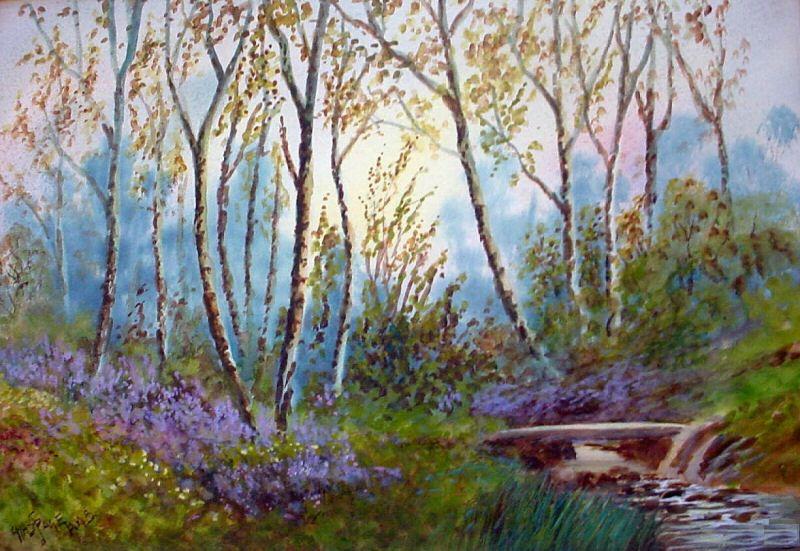
unnamed, Charles Jewett Page, 11" x 16", watercolor
Charles Jewett Page was born
6 August 1837 in Boston, MA, the son of a prosperous
mason, Gilman Page and his wife Louisa Robinson.
Page had many occupations, bank teller in 1861, cap
and hat salesman in 1870, etc., before settling on
real estate around 1880, which occupation he pursued
for many years. He was listed as both a real estate
and insurance agent in Boston City Directories from
1882 through 1893. He was also listed as an
auctioneer and Treasurer of the Real Estate and
Building Co. several times.
When Page developed an interest
in art or where he received his training is not
known, though he was a subscriber to the Boston
Museum of Fine Arts in 1890. He was listed as a
member of the Boston Art Club in 1908 (Clark's
Boston Blue Book) and by 1910 he appeared in the
artist category of the Boston City Directory. I have
been unable to locate him in the 1910 Federal
census, which may show if that was his primary
occupation then.
Charles married Kate Chase
Norcross on 26 December 1859 in Boston and they had
one son, Walter Gilman Page, who later became a
prominent professional artist and writer. The 1880
census lists Walter G. Page as an invalid, which may
be why he pursued a career as an artist. This may
also be why his father developed an interest in
painting. The first mention of Walter Gilman Page as
an artist is in the 1890 Boston City Directory, and
he was a member of the Boston Art Club in 1893, and
was occupied as an artist while living in his
parent's home during the 1900 Boston Federal census.
Both Walter and his father were listed as painters
in the 1908 American Art Annual Volume VI, which was
published by the American Federation of Artists, New
York. Walter Gilman Page attended the Boston Museum
of Fine Arts School, studied in Paris, and served on
the Massachusetts Art Commission in the 1920s. I was
also unable to locate Walter Page in the 1910
census, though he married about 1901. It may be that
father and son were traveling together when the
census was taken.
Charles Jewett Page was a member
of the Boston Watercolor Society, Boston Art Club,
and is mentioned in Who Was Who in American Art by
Falk and Davenport's
Art Reference and Price Guide. One of his
paintings sold at auction for nearly $4000. Page
died on 5 July 1916 in Boston, MA and his death was
reported in the New York Times.

Page's signature

"Maison Montcalm, Quebec", Elizabeth R. Withington, 10" x 8", gouache
Elizabeth Rupp Withington
was a Rockport, Massachusetts illustrator and artist
in watercolors, gouache and oils. She was born on 6
September 1883 in Roxbury, Massachusetts to John
Rupp and Emily Wiswell Wilder Withington. Her father
was a long time Jamaica Plains, Boston resident who
worked for several decades as a Boston customs house
clerk. The Withington family came to Massachusetts
in the 1630s. Elizabeth was attending art school
while residing at her parent's home at 22 Burroughs
Avenue, Jamaica Plain, Boston, MA during the 1900
census. By 1910 she was employed as an artist and
illustrator and was thus occupied in the 1920 and
1930 censuses. She was listed in Rockport city
directories as an artist residing at 105 Main Street
in Rockport from the 1930s until her death in 1962.
It is not known, for
certain, where Elizabeth was a student
in 1900, but by 1903 she was listed in the American
Art Directory as a teacher at Pape's School of Art
in Boston and was listed as an assistant there in
1905. Eric Pape started his school in Boston
in 1898, so it is possible that Elizabeth was
enrolled there in 1900. Such famous artists as N. C.
Wyeth attended Pape's school at the time that
Elizabeth was there. Pape was a well known and
successful educator, artist, and illustrator. Elizabeth
must have continued her training while at Pape's
school as she was also listed as a student there in
1905 and won an award for "Composition Sketches".
Elizabeth became a member of
the Rockport Art Association in 1923 and was a
member until 1960. She was also a member of the
American Watercolor Society. She exhibited her
paintings frequently at the Rockport Art
Association, and also at the American Watercolor
Society and Art Institute of Chicago. She
illustrated
many books. Most of these books were
published by the Boston publishers Lothrop, Lee, and
Shepard (LLS) and L. C. Page & Co. (LCP). I have
included a list of all of these books I have been
able to identify at the end of this biography. The
last credit for her as an illustrator that I can
find was in 1930, when she would have been 47. She
continued working as an artist for many years, so
may have continued as an illustrator, as well, but
without credit for her work.
One book that may or may not have
been her work is different from all of the others.
This book, Lullabies of Many Lands, was
published by the H. M. Caldwell Co., New York and
Boston, in 1908. What makes this book atypical is
that it was completely the work of Elizabeth
Withington, drawn and compiled by her. It is not a
large book, only 30 pages, but contains 13
beautifully done, full page illustrations and many
smaller illustrations. I have a copy of this book
but I have not been able to determine if it was done
by Elizabeth Withington of Boston and Rockport, MA.
I obtained a copy of Mr. Tuckerman's Nieces, which
was illustrated the year before this book was
published and the illustrations are done in the same
style. In my opinion, the book is her
work.
Elizabeth's paintings appear
frequently at the yearly Rockport Art Association
Auction, and at auction houses and galleries in
Essex and Suffolk counties. She is mentioned in Lost Colony:
The Artists of St. Augustine, 1930-1950 by
Torchia, Who
Was Who in American Art by Falk, Davenport's
Art Reference and Price Guide, Index of
Artists by Mallett, Who's Who in
American Art, and other art reference
books.
The painting in my collection was
titled under the mat, but I was unable to decipher
Withington's writing. A visitor to my web site
identified the location depicted in the painting and
it is now easy to understand the title.

One of Withington's illustrations:

Illustration from
Anne of Green Gables by Elizabeth Withington, 1925
Books illustrated by Elizabeth:
Those Thornton Girls (LLS,
1930), The "Icicle" Melts (LLS, 1929), Barbara
Winthrop Abroad (LCP, 1927), Barbara Winthrop at Camp
(LCP 1926), Homer Bright's New Adventure (LCP,
1925), Anne of Green Gables (LCP, 1925), The
Adventure's of Joan (LLS, 1924), Nan's Christmas
Boarder (LCP, 1924), Denise of the Three Pines (LCP,
1922), Blue Bonnet Keeps House (LCP, 1921), Marjorie's
House Party (LCP, 1921), When Gretel was Fifteen (LLS,
1921), Blue Bonnet: Debutante (LCP, 1921), The
Independence of Nan (LLS, 1916), A Real Cinderella
(LLS, 1915), Making Mary Lizzie Happy (LLS, 1914),
Laddie: The Master of the House (Little, Brown &
Co., 1913), The Long Way Home (LLS, 1912), Hester's
Wage Earning (LLS, 1912), Girl from Arizona (LLS,
1911), Lost on the Trail (LLS, 1911), Maisie's Merry
Christmas (LLS, 1911), Victorine's Book (LLS, 1911),
Dorothy Brown: A Story for Girls (1909), Mother
Tucker's Seven (LLS, 1909), The Browns at Mt. Hermon
(LLS, 1908), Mr. Tuckerman's Nieces
(Houghton Mifflin, 1907), Four Girls at Chautauqua
(LLS, 1904), Little Queen Esther (LLS, ?), Ester Reid
(LLS, ?)

Samuel B. Chapman was
born about 1866 in Wayne Township, Wayne County,
Indiana. He and his brother Charles E. Chapman, b.
ca 1857, worked as professional artists for more
than 30 years, painting in Wayne County, Indiana,
New Orleans, and Lexington, MA. The
brothers were sons of George A. and Annie B.
Chapman, born in Scotland and England, respectively.
They moved to New Orleans about 1903. While in New
Orleans, both men first appear in censuses with the
trade of "painter". Charles is also listed as a
"Decorator". According to a descendant, Charles had
an architectural business in New Orleans, and
numerous of his architectural paintings and drawings
survive. The brothers moved to Lexington, MA before
1918 when Samuel was listed as a farmer and Charles
as an architect in the Lexington city directory.
Both brothers were listed as managers of Ryder's
Stock Farms in the 1922 city directory. The 1924
directory lists Charles as an architect and
assistant manager at Ryder's Stock Farms and Samuel
as manager. The 1928 directory shows both men and
their wives living at the same address as they had
for several years, but occupied with "The New
England Fruit & Rural Development Co.".
Both men were thusly occupied in 1932 and were
living at the same address in 1942. Charles had a
studio in Lexington for many years and gave his
occupation as "artist" in the 1920 and 1930
censuses. Where the brothers received their training
as artists in not known.
A large number of
works by both artists was passed down in the family
until they were sold by a grandson in 2006. Neither
artist is listed in any of the major art reference
books, but must have achieved some measure of
success in order to have worked for so long as
professional artists. They may have enjoyed good
reputations locally. Both men seemed to have worked
almost exclusively in watercolors. The painting
above was probably painted in Indiana.
Here are some artists whose work I really like but have not yet added to my collection:
Michael McKee Michael does beautiful work with pastels.
- On line appraisal service
from John Sewell well known Canadian expert on
fine art and antiques. This is a very reasonably
priced on line service from a well respected
expert. Fill out an on line form and send images
of your art objects. No need to send your art
objects through the mails. I am a satisfied
customer! Highly recommended!
- Here is a list of common British art society abbreviations.
- Images
of art works by 29,000 artists. I use this site
to compare works that I am interested in or own
to other works by the same artist. A good place
to spend some time just cruising, too!
Pennsylvania Artists Texas Artists New England Artists Other Artists
UK Artists Canadian Artists South American Artists Asian Artists European Artists
Unknown Artists Unknown Artists 1 Unknown Artists 2 Unknown Artists 3
HOME