copyright 2007-2020
I like a lot of different styles of painting. I have had an active interest in art for the past few years, and my tastes are still evolving as I learn and live with my growing collection. I do not collect as an investment but for the fun of it and to feed my enjoyment for doing research and learning. Here are some of my favorites. By the way, I am NOT the wildlife artist of the same name.
Pennsylvania Artists Texas Artists New England Artists Other Artists
UK Artists Canadian Artists South American Artists Asian Artists European Artists
Unknown Artists Unknown Artists 1 Unknown Artists 2 Unknown Artists 3
HOME

"River Scene", Izetta Perkins, 7.5" x
9.75", watercolor on paper
Izetta
Elaine Perkins was born in Grand Island, Hall County,
Nebraska on 29 September 1926 a daughter of Ernest G.
and Iva Murriel Hiddleston Roseberry. She was married
to Grover B. Perkins about 1947. He died in 2007 in
San Antonio, TX. Izetta was a member of the River Art
Group in San Antonio, TX. This work was shown at the
2001 River Art Group Exhibition, according to the card
taped to the back. She was living as of March 2018
when I found this painting at a thrift shop in Peoria,
IL. I have not been able to find out any further
information about her. I have contacted the River Art
Group to see if more information about her is
available.

Izetta Perkins signature

Exhibition label

unnamed, Minnie W. Johnson, 7" x 9",
oil on artist board
Minnie Lee Wolaver Johnson was born on 29 November 1874
in Diana, Giles County, Tennessee, a daughter of James
Tolbert and Alice E. Wolaver. The Wolaver family moved
to Texas before 1900 and Minnie was married there about
1896 to John Daniel Johnson and living in Italy, Ellis
County, Texas, with their first child, Rose. John Daniel
Johnson was employed as a teacher in 1900. The Johnson
family was living in San Angelo, Tom Green County, Texas
by 1910, where John was employed as a "manager, oil
company". Minnie was employed as a "teacher, art" on her
"own account". Their second, last child, Louis, was born
about 1902. The Johnsons were living in Dallas, Texas in
1920 where John was employed as an "agent, insurance".
No occupation was listed for Minnie. John Daniel Johnson
died about 1928 and Minnie was living with her son and
his family in Dallas in 1930 and on her own in Dallas in
1940. No occupation was listed for her in 1930 or 1940.
Minnie was listed in primary records as either Minnie L.
Wolaver, Minnie L. Johnson or Minnie Johnson. She
apparently used the initial of her maiden name, only for
her artwork.
Minnie is listed in Artists of
the American West by Dawdy, Dictionary of
Women Artists by Petteys, Who Was Who in
American Art by Falk, Dictionary of Texas
Artists 1800-1945 by Grauer, Index of Artists
- Supplement by Mallett, Texas
Painters, Sculptors & Graphic Artists by
Powers and Davenports Art Reference and Price Guide.
According to these sources, she studied under Lawrence
L. Cohen at Trinity University, Waxahachie, Texas,
Lucille Sinclair Douglas in New York, George Brandt
Bridgman at the Art Students League of New York, William
Alexander Griffith in Laguna Beach, California, and
Frank Reaugh and Adele Laure Brunet in Dallas. During
the 1920s Minnie taught art lessons in Lubbock, and had
previously taught in San Angelo and Wichita Falls,
Texas. According to Powers, she graduated from the
Southern School of Interior Decorating and opened a
studio in Dallas in 1928, though the 1940 census
indicates that her education consisted of four years of
high school. Johnson appears to have primarily been a
painter in oils and exhibited her work at the Annual
Exhibition of Texas Artists, Dallas Woman’s Forum
(1927); the Annual Texas Artists Exhibition, Fort Worth
(1928, 1937); the Annual Allied Art Exhibition, Dallas
(1929-33, 1935); and the Dallas Museum of Fine Arts;
Texas Centennial Exposition, Dallas (1936). Some sources
indicate that she painted several murals in Texas high
schools.
Minnie Wolaver Johnson died on 27
November 1954 in Dallas and is buried in the Italy
Cemetery, Italy, Ellis County, Texas,


unnamed, Lila Klute, 20" x 18", mixed
media on parchment
I am
still researching this artist. Not much information
about her is available, even though she appears to
have worked as an artist for most of her life. This
painting in much more muted than this image shows. I
am using the image provided by the seller of this
painting. He appears to have "tweaked" the colors or
perhaps used a flash when taking this image. Any
information about this artist would be appreciated.

Lila Klute signature

unnamed, Dora Ella Nichols, 20" x 16", oil, 1938
Dora Ella Watson Nichols was
born 11 March 1892 in Arkansas, the daughter of
James and Mary George "Mamie" Hollingsworth. Mary
was widowed by 1900 and living with her four
children and her parents in Donald Township,
Franklin County, Arkansas. According to
a brief biography of Dora by the University of Texas
Arlington (UTA), she moved to Texas when she was
eight years old. Mary was living with her
parents and children, including Dora, in Erath
County, Texas in 1910. Dora's occupation was listed
as "Teacher". Mary was later married to Will J.
Hicks who was employed as a "Merchant, Retail Feed
Store" in Arlington, Texas in 1920. He was 73 and
his wife was 50. Dora was living with her mother and
stepfather, employed as a "Teacher, College".
Dora graduated from Arlington
High School in 1907. She graduated from Baylor
University in 1913 with an A.B. in French and
Spanish. According to Browningiana
in Baylor University, Dora Ella Watson
submitted a work to the Baylor faculty titled The
Browning Country. This submission was part of
her work for a Masters of Arts degree, which was
conferred in 1917. The 1940 census
indicated that she had completed 5 years of college.
Her ties with the University of Texas suggest that
she may have attended or been a member of the
faculty of that institution, as well.

From "The Lasso", Howard Payne College
The yearbook of Howard Payne
College, "The Lasso" reported that Dora was a member
of the faculty there in 1916. The 1917 Baylor Alumni
Directory noted that she was teaching Spanish at
Baylor and had been a "Burleson Fellow" 1916-1917.
The Baylor Bulletin, Volume 22 Issue 1 (1919),
Baylor University, reported that "Miss Dora
Ella Nichols is teaching Spanish at the State
College, Arlington, Texas". Dora Ella Watson was a
teacher at Decatur Baptist College in 1920. By 1930,
about 1921 according to the 1930 census, Dora was
married to Henry Milton Nichols and still living in
Arlington. Her mother was living with them, then
widowed. Henry was employed as a "Proprietor, Barber
Shop" and Dora as a "teacher, public school".
The couple, and Dora's mother, were still living in
Arlington during the 1940 census. Dora's occupation
was "teacher, high school".
According to the UTA biography,
Dora started working as a teacher at Arlington High
School in 1933, retiring in 1958. The biography also
mentioned that she was a "noted Arlington artist".
She was a painter in oils and watercolors. Where she
obtained her training as an artist is not known.
Along with well known local artist Josephine
Mahaffey, in 1966 she founded the Starving Artists
of North Texas, later the Arlington Visual Arts
Association. Though few examples of her work are
easily found, those are extremely well done. It
would seem logical that she would be mentioned in
the Dictionary
of Texas Artists or Pettys Dictionary of
Women Artists, but she is not. She is
mentioned in Davenports Art Reference and Price
Guide and on AskArt.com.
This painting was purchased from
a seller in Rockwall, Texas, which is about 40 miles
from Arlington. Dora's estate left funds to the
University of Texas which were used to create "The
Shakespeare Club of Arlington Scholarship". The city
of Arlington named Dora E. Nichols Junior High
School after Dora and awards and scholarships are
given in her name.
Dora died on 19 February 1982 in
Arlington. Henry Milton Nichols died in 1954 and
both are buried in Parkdale Cemetery, Tarrant
County, Texas.


unnamed, Clyde E. Gray, 25.5" x 8.5", painted
ceramic tiles
Clyde
Edward Gray was born on 20 August 1907 in Antioch, Hot
Spring County, Arkansas, a son of Stephen Edward and
Nancy Jane McDaniel Gray. Stephen was employed as a
farmer in Hot Spring County during the 1910 and 1920
censuses. After high school, Clyde moved to Chicago to
study art. His Social Security number was issued in
Illinois before 1951. Social Security numbers were
first issued in November 1935, so this places Gray
there at that time.

Clyde Gray (rear
right) with parents and brother, Curtis
Much
of what follows comes from various local histories.
Clyde relocated to Beaumont, Texas in the late 1930s
or early 1940s where he worked for a marine towing
company, Sabine Towing. He is reported to have come
from "up north" where he had worked as a cartoonist
and to have been a veteran of the US Navy. He married
Lillian Virginia "Bill" Rice while living in Beaumont.
About 1950 the couple moved to Tyler County, Texas,
near Woodville where they operated a goat farm. After
some time in Tyler County, Clyde's interest in art was
apparently revived and he started painting in oils,
eventually opening a gallery on his property. He was
approached by a local businessman who had started a
tile factory and wanted Clyde's assistance in making
colored tiles. As a result, Clyde developed a unique
under-glazing process for copying images and making
paintings on tile. This became a source of income for
the Grays and many homes in East Texas are graced by
these tiles as are several public buildings. Some of
the paintings are very large, composed of dozens of
4.25" square tiles. Clyde also continued to paint in
oils in more traditional mediums. The couple
eventually started a theme park called Heritage
Village, which was composed of curiosities and
examples of early Texas buildings. The Grays sold
Heritage Village to a local group and it is still in
operation in 2012.

Clyde Edward Gray
The
librarian at the Genealogy Library at Heritage Village
was very helpful, providing the photos of Clyde and
his family and more information. Their information
tells that Clyde moved to Chicago to study art after
high school and that he served in the U.S. Navy. This
may explain why there is no WWII Draft Registration
card for him. A search of enrollment records at the
School of the Art Institute of Chicago shows that Gray
did not attend there. A search other Chicago art
schools is underway.

Closeup of tiles
Clyde Edward Gray died in
Woodville, Texas on 7 November 1989. Bill Gray died
there in 1991.


"Paseo de la Reforma at sunset", Martha Axley, 11.5" x 17", watercolor
Martha Frances Axley was born
in Chattanooga, Tennessee on 31 August 1898, a
daughter of William Wesley and Sarah F. Norrie
Axley. William was employed as a "Commercial
traveler" in Hamilton County, Tennessee in 1900 and
as a "Commercial traveler, dry goods shoes" in
Chattanooga in 1910. By 1920, Martha was living in
Manhattan, where she was employed as a
"stenographer, Am. Library Assn". She was employed
as secretary/treasurer for Edwin Outwater Inc., in
New York City in 1922 and 1925, according to New
York city directories.

Passport photo
She applied for a passport on
5 July 1924 citing the intention to travel to
England, France, Spain, Germany, Belgium, Holland,
Switzerland, and Italy. She left Europe to return to
the US on 5 August 1924. She left Southampton,
England to return to the US on 16 November 1932. I
did not find a record of her leaving the US after
her 1924 trip. She gave her New York address as
Three Arts Club, 340 W. 85th St. The Three Arts Club
was founded in New York in 1904, to give young women
who were studying art a place to live and study.
According the San Antonio Light on 7 December 1941,
"Miss Martha Axley of New York, noted artist, who is
teaching at Texas State College for Women in Denton,
was the guest recently of Mrs. Rena Maverick Green.
Miss Axley did a mural for the New York World's
Fair". This article lead me to information about
Martha's work as a muralist.

Martha Axley 1939
World's Fair mural post card
According to the 5 March 1939 edition of the New
York times, Martha created two murals for the
Electrical Products Building called "Transportation
and Industry" and "Distribution". According to the
Times article one mural showed a port scene
typifying distribution and the other showed means of
distribution. One mural was reproduced in various
ways including the post card above. The murals
"decorated" the Electrical Products building at the
fair, according to a New York City guide for 1939.
Axley was one the muralists selected to decorate the
World's Fair buildings by artist Ernest
Peixotto, according to the book Ernest
Clifford Peixotto: American Artist by
Ernest Peixotto. Technically, Martha was engaged by
the Fair Corporation. According to Peixotto, most of
the murals were destroyed when the buildings they
were painted on were demolished. I found the second
image of Axley's mural in the archives of the New
York Public Library.

According to an article in
the San Antonio Light newspaper of 19 September
1943, Axley was then on the faculty of the San
Antonio Art Institute. The newspaper article, which
announced the opening of Fall classes at the
Institute, included the biographies of prominent
faculty members, including Axley. According to this
and other articles in this newspaper, she attended
Shorter College in Georgia and spent five years at
the Art Students League, New York. Her picture
appears in the 1916 Shorter College year book. She
traveled to Europe where she studied for seven years
at institutions including the Munich Bode Schule,
University of Munich, and the Itten Schule in
Berlin. She was reportedly the only woman admitted
to the Berlin Institute. She also traveled to Italy
where she completed three murals during a five year
stay. The article goes on to note that she traveled
to Belgium, Holland, France, and England before
returning to the US to complete murals for the New
York Worlds Fair and other mural commissions. The
1943 article went on to note that she had recently
been in Mexico doing research. Note the car in the
lower right corner of my painting is very similar to
the car in Axley's mural, which may help to date my
painting. The 14 May 1944 edition of the San Antonio
Light reported that, Axley had previously taught at
the Richmond School of Art, Richmond, VA and had
studied extensively in Europe and Mexico. Axley was
a frequent lecturer to the public on specific
artists and artistic styles during her tenure at the
San Antonio Art Institute. Axley' photo appeared in
one of the newspaper articles. She was an instructor
in art composition and construction, and watercolor
painting at the San Antonio Institute.

From the San Antonio
Express
Martha exhibited at the
Marie Sterner Galleries in New York City in 1936.
Her work was sponsored by Malcolm Vaughan of The New
York American. Exhibitions of Axley's paintings and
murals are mentioned several times in the late 1930s
in the New York times. Axley exhibited at the fifth
annual Texas General Exhibition at the Witte Museum
Houston in 1943. She exhibited again at the Witte
Museum in 1944. She was given a one "man" show at
the Laurel Gallery in New York City according to the
27 January 1947 edition of the New York Times. She
exhibited at the Art Student's League in the same
year. Martha Axley is mentioned in Dictionary of
Texas Artists 1840-1945 by Grauer, American Women
1939, Mural Painters in America Volume 1
by Kansas State Teachers College 1949, Women in
Particular: an index to American women by
Herman 1984, Who Was Who in American Art by
Falk, Index
of Artists Supplement by Mallett, and Index to Women
of the World from Ancient to Modern Times
by Ireland 1970. I have not been able to discover
any information about Axley's career after the
1940s.
Martha Axley died in September
1985 in New York City.

"Cats", Josephine Mahaffey, 9" x 11", watercolor
Josephine Vaughn Mahaffey was
born on 16 March 1903 in Hopkins County, Texas, a
daughter of George and Katie Vaughn, a farming
family. She was listed in the censuses of Hopkins
County, Texas as "Margerie J. Vaughn" in 1910 and as
"Josephine Vaughn" in 1920. The birth records of two
of Josephine's children give her maiden name as
"Marjorie Josephine Vaughn" and "Margery Josephine
Vaughn", while other birth records give her name as
"Josephine Vaughn". She appears in the 1930
census of Fort Worth, Tarrant County, Texas in 1930
with her husband and family as "Marjorie J.". She
married Mark Mahaffey about 1922. He was employed as
a salesman for a "packing house" in 1930. She seems
to have fluctuated between going by her first and
middle names for many years, eventually settling on
Josephine.

unnamed, Josephine Mahaffey, 10" x 8", watercolor
Josephine graduated from the College of Industrial Arts and Sciences (now Texas Woman's University at Denton, Texas. When she attended is not certain, though it must have been between about 1921 and 1934, as the school only existed as the College of Industrial Arts and Sciences from 1905 until 1934. Josephine already had three children by 1930, and I have found records of four more children born between 1930 and 1946. After graduation, she continued her studies under Sallie Blythe Mummert, Clinton King, Octavio Medellin, Kathleen Lawrence, and John Erickson. The first record I have found mentioning her work as an artist is as an exhibitor at the 1937 in the Texas Artist's Exhibition at Fort Worth. Josephine operated her own gallery in Azle, Texas and taught watercolor painting in Fort Worth. She exhibited frequently at Fair Park and the State Fair of Texas. She was honored in 1968 with the creation of "Josephine Mahaffey Day" at the State Fair of Texas. She is mentioned in Grace and Gumption: Stories of Fort Worth Women by Sherrod, Dictionary of International Biography by Kay, Index of Artists by Mallett, Davenports Art Reference and Price Guide, and Dictionary of Texas Artists, 1800-1945 by Grauer. There was a retrospective of Mahaffey's work in July 2010 at the Forth Worth Community Arts Center. They have a web site. The following tribute to Mahaffey appeared on the FWCAC web site during the retrospective:
Remembering Josephine Mahaffey:
The Texas Dynamo
Words alone do not adequately describe Josephine Mahaffey's burning need to paint. In 1957 she was nicknamed Mama Mahaffey, the Texas Dynamo by Coronet Magazine in recognition of the thousands of artworks she had produced up to that time. Her career, as it turned out, still had twenty-five years to go. Working in the moment, she combined rapid brushstrokes with earthiness and high energy to produce an astonishingly large and complex legacy of art.
Josephine Mahaffey was born into a rural farming family in Hopkins County, Texas in 1903. She moved to Fort Worth as a newlywed in 1922 and began receiving art instruction from Sallie Blyth Mummert. Mahaffey's gift for rapid composition soon emerged. She called it direct painting. "You've got to get it down fast," Mahaffey once said, "or else you lose it."
Mahaffey's rapid-fire brushwork and bold color selections resulted in dizzying but unfailingly coherent translations of the world around her. For inspiration she typically looked to the faces of family and friends, the barnyard and gardens of her Jacksboro Highway farm, the shores of Lake Worth, and the urban landscapes of Fort Worth itself. In later years, and despite her gregarious nature, she eschewed the familiar and turned inward.
Mahaffey worked primarily in water-based paints but was proficient in the use of oil paints and encaustics when economics allowed. In a pinch she was known to execute paintings on newsprint, brown paper bags, small bits of cardstock, roadmaps, and in one case a Styrofoam egg carton. The choice of media and type of surface on which to work was always secondary to the act of painting.
Over time, Josephine Mahaffey's career branched out into teaching and advocacy. For many years she taught at the Woman's Club of Fort Worth, the Fort Worth Art Center, the northside Boy's Club, and the Arlington YWCA. Mahaffey's policy was to offer art lessons whether or not a student could pay.
Josephine Mahaffey, a mother of eight, never stopped growing as an artist and observer of life. Though she died in 1982, her influence lives on in scores of north Texas collections. Now as then, her art remains an enduring testament to the wonder of human creativity and the infinite beauty of the human mind. -- Scott Grant Barker
Josephine died on 14 March 1982
in Tarrant County, Texas.

Josephine Mahaffey signature

Mrs. Nellie Stoneham was born
on 3 September 1879 in Sherman, Grayson County,
Texas. She was the daughter of Dr. Elijah Evans Winn
and Medora F. Stith. Medora was Dr. Winn's third
wife and Nellie was the youngest of his children.
Nellie attended the North Texas Female College and
Music Conservatory, also known as Kidd-Key College,
in Sherman. At the time she attended there, this was
a very well known and prestigious finishing school
for women. This is likely where she received her
artistic training. After graduating, she worked as a
teacher and cared for her father and mother during
their last illnesses. About 1920 Nellie married
David Jenner Stoneham who was 20 years her senior.
At some time prior to her marriage Nellie moved to
Dallas where she attended business school and later
sold insurance and may have met her future husband
while pursuing this work in Sherman, Texas. Some of
this information comes from Nellie's daughter Dora
Evelyn Colley, an artist, and member of the San
Antonio Watercolor Society.

unnamed, Nellie Stoneham, 7" x 9", oil on paper
Dora Colley knew that her
mother had done some work as an artist, primarily
charcoal portraits, but also remembered that she had
worked at home for a company during the Depression.
This company would send prints to Nellie which she
would then paint using oil paints. Nellie did this
in the hopes of making some money for her family,
but her daughter had the impression that Nellie did
not make much money doing this work. These three
paintings are likely represent this endeavor. Nellie
also worked as Postmaster of Stoneham, Texas which
is in Grimes County.

unnamed, Nellie Stoneham, 7" x 9", oil on paper
All three of these paintings bear
a stamp verso that says "Received <date>
Answered". All are dated 1932 or 1933. All three
paintings also bear Nellie's married name and "Stoneham,
Texas". This may further support the identification of
these paintings as the output of a commercial operation.
It is not clear how this company operated or what
latitude their artists were given in completing the
paintings. I do not know if this was the "paint by
numbers" of the 1930s, etc. Any information on how this
company operated would be appreciated.
Nellie Stoneham died on 7 June 1956
in Grimes County, Texas. David Stoneham died in 1959 at
the age of 100 years.


Judi Coffey is a well known
Texas artist. (Bio in progress)

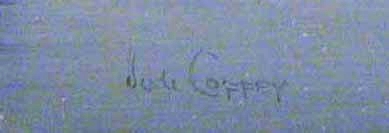
unnamed, Judi Coffey, 8" x 5",gouache

Judi Coffey signature

"Girl on a green pillow", Melissa Grimes, 11" x 14", oil
Melissa Grimes was born in 1950
in Houston, Texas. She is a professional painter,
illustrator, and teacher in Austin, Texas. She studied
art at the University of Texas and earned her BFA there
in 1972 and has taken many additional classes,
particularly in figure drawing, which really shows
in her work. Melissa has been a teacher of
drawing, illustration, and painting at the University of
Texas, Texas State University, and the Academy of Art
College in San Francisco. She works in oils,
watercolors, acrylics, and collage.

"Nude in Orange & Blue", Melissa
Grimes, 11" x 14", oil on board
I like the colors
and lighting in this work, and the shadowy figure of the
artist in the background. I also like the suggestion of
the subject's right leg folded under her. Melissa's
description of this work:
This was painted at Orlando S's wonderful TAD Saturday session. I was late (again) and there weren't any spots left in front of the model. I managed to make lemonade, so to speak, by focusing on the beautiful yellow and orange glow from the light on her skin. Orange and blue are complementary colors, and using complements is always a strong strategy. The placement of the red-orange reflected lights moves the eye really well around the canvas. This one has a mysterious quality, maybe because it has a lot of depth of field & variety of focus.

"The Direct Gaze",
Melissa Grimes, 8" x 10", oil on board
Grimes has a web site
and sells on ebay under the id mjg9999. I really like
her use of light and shadow and her choice of color
palettes. She does landscapes and still lifes, but my
favorite is her figurative work. I particularly love the
expressive way in which she captures her models' facial
expressions, hands, and eyes. This model's name is
Raven.

"Casey in a headscarf", Melissa Grimes, 14" x 11", oil
This painting reminded me
very much of one my favorite paintings from my
collection by an Illinois artist, May Jones Perkins.
Adding this painting to my collection was a win/win,
because in addition to the similarities to that
painting, there are new things I like about this
one.

"Girl in a mirror",
Melissa J. Grimes, 16" x 12", oil
I've always liked paintings where
an artist showed their subject looking into a
mirror, presenting multiple views of the subject, if
done well as this is. I really like the casual intimacy
of this one and the old fashioned bathroom, too.

"Girl in a Red Dress",
Melissa Grimes, 8" x 10", oil
I like a lot of things about this
one. The facial expression, use of light and shadow, the
bright colors, and the proportions of the subject. It is
a stunner, for such a small painting. Her small works
can reach out and grab in a way that is out of
proportion to their size.

"Blonde nude with braids", Melissa J. Grimes, 8.5" x 8.5", oil
They're like potato chips! It
is really amazing how Melissa can make a very small
painting leap out at you. This one is such an odd
size, that I have never been able to find a frame
for it. I whined about this to Melissa and she was
nice enough to send me a very nice bonus still life.
:o)

"Cherries", Melissa Grimes, 10" x 8", oil
This is the whining related
painting that Melissa was sweet enough to send me.
Really well done, eh?

"Brunette model", Melissa Grimes, 14" x 11", oil
There is a nice depth to this
painting. I really like the play of light and shadow,
the reflection of light on her medallion, and little pop
of yellow in her hair scrunchy...

"Pale Blue Kimono", Melissa Grimes, 8" x 10", oil
This is such a classic pose
and color scheme, and again great use of light and
shadow, and great depth, but what really made it for
me was the facial expression of the model. Something
about hands bother me a little bit on this one, but
I knew if I didn't buy it, it would be one of "those
that got away". There are half a dozen paintings
that I have missed an opportunity to acquire over
the past few years, that still give me a twinge of
regret. Melissa told me that the model is named
Michelle and that the blue kimono belonged to her.
This is the first of a new series of paintings
Melissa is making using smaller brushes and
capturing greater detail in the faces.

Maybe not a style and colors
I would normally go for, but the contrast of light
and shadow and the facial expression of the model
was too hard to resist. Not really sure I like the
black background, but that is one of the things that
makes it work. I'll have to live this one awhile to
see what balance my feelings reach. I think finding
the right frame will make a big difference to me.

"Girl in a green robe", Melissa Grimes, 10" x 8", oil
Here are some artists whose work I really like but have not yet added to my collection:
Michael McKee Michael does beautiful work with pastels.
- On line appraisal service
from John Sewell well known Canadian expert on
fine art and antiques. This is a very reasonably
priced on line service from a well respected
expert. Fill out an on line form and send images
of your art objects. No need to send your art
objects through the mails. I am a satisfied
customer! Highly recommended!
- Here is a list of common British art society abbreviations.
- Images
of art works by 29,000 artists. I use this site
to compare works that I am interested in or own
to other works by the same artist. A good place
to spend some time just cruising, too!
Pennsylvania Artists Texas Artists New England Artists Other Artists
UK Artists Canadian Artists South American Artists Asian Artists European Artists
Unknown Artists Unknown Artists 1 Unknown Artists 2 Unknown Artists 3
HOME