copyright 2007-2020
I like a lot of different styles of painting. I have had an active interest in art for the past few years, and my tastes are still evolving as I learn and live with my growing collection. I do not collect as an investment but for the fun of it and to feed my enjoyment for doing research and learning. Here are some of my favorites. By the way, I am NOT the wildlife artist of the same name.
Pennsylvania Artists Texas Artists New England Artists Other Artists
UK Artists Canadian Artists South American Artists Asian Artists European Artists
Unknown Artists Unknown Artists 1 Unknown Artists 2 Unknown Artists 3
HOME

unnamed, Tom Ackman, 11" x 14", watercolor on
paper
Thomas A.
Ackman was born in the 1950s and by the late 1970s was
teaching art at several elementary schools in the vicinity
of Matoon, IL according to the sole mention of him that I
was able to find in an old newspaper. I was only able to see
a bit of the information mentioned in the newspaper, since I
did not have a subscription to the site, though. I am still
researching this artist.

unnamed, A. P. Bennett, 5" x 8", watercolor
on paper
Andrew Peter
"Pete" Bennett was born on 24 May 1924 in Sandwich, DeKalb
County, IL, a son of Andrew Peter and Helen A. Holzworth
Bennett. Much information about him, including a catalog of
his work is available at:
http://www.apbennettwatercolors.com/home

unnamed, A. P. Bennett, 5" x 8", watercolor
on paper

"Snowbound Houses", Hedley Waycott, 10" x16",
oil on pressed cardboard
Hedley William Waycott was born
on 9 February 1865 in Corsham, Wiltshire, England, a son of
Henry Bradridge and Mary Fry Waycott. Henry Waycott was a
tailor who emigrated with his family to the US before 1880.
Hedley Waycott was a well known self taught landscape artist
who lived in Peoria, Peoria County, Illinois. He owned a
framing shop in Peoria for some time before devoting himself
full time to painting.
Waycott exhibited widely, including the
National Academy of Design, Independent Artists Society in
New York and Pallet and Chisel Club in Chicago. He was a
member of the American Federation of Arts. He was listed in
the American and European Blue Books of Artists. Waycott was
a member of the Peoria Sketch Club and very active in the
Peoria Art League, the Peoria Society of Allied Artists and
the Art Institute of Peoria. Waycott enjoyed a long
association with the Peoria community. He was very prolific,
painting almost 900 area landscapes, which made him the most
recognized of the Sketch Club members to the local public.
This painting is unsigned but appears on
page 19 of Hedley Waycott "Peoria's Premier Artist",
2006, Lakeview Museum of Arts and Sciences, which was
published as part of a retrospective showing of Waycott's
work at the museum in 2006-7. Waycott also made the frame
this painting is in. His works are often first recognized
because of his distinctive frames.


"Door County", Angelo Campagnolo, 14" x 20", watercolor on
paper
Angelo J.
Campagnolo was born in Chicago about 1931 a son of Angelo
and Luisa Denda Campagnolo. He resides in Elmhurst,
IL. He is a painter in watercolors. Campagnolo
graduated from the Chicago Academy of Fine Arts. He worked
as a graphic designer and commercial artist for a small
agency. His brother Robert Campagnolo was also a commercial
and fine artist who helped design the Turtle Wax logo.
Campagnolo is a member of the Elmhurst
Artists' Guild, Addison Artists' Guild, the DuPage League of
Artists, and a Signature and Life member of the Illinois
Watercolor Society. He exhibited widely Illinois from the
1960s to the present (2018).

Business card
This
watercolor was apparently purchased in a double mat but
never framed as it still resides in a heavy plastic cover
that has become brittle with age. I did not try to remove
it, so there is some glare in my image in the center and
upper left. His business card was attached verso, but has
been damaged. This painting is a nice complement to some of
the other watercolors by Illinois commercial artists in my
collection. Maybe I should coin the phrase "Illinois style
watercolors" if someone hasn't beaten me to it.

Campagnolo's signature

unnamed, Richard K. Collopy, 14" x 11", acrylic on gessoed
panel on masonite
Richard K.
Collopy was born on 23 June 1942 in Chicago, IL a son of
John and Adeline Henry Collopy. He worked as a high school
teacher before becoming a full time artist, a painter in
acrylics and watercolors. He exhibited widely. There is a
bit of glare at the top of my image.

Standard label from back of painting
Collopy was a
prolific artist, apparently painting thousands of paintings.
He affixed a label (shown above) to many of his
paintings describing the medium and care of the painting and
a containing a lengthy professional biography that makes
creation of a biography by me superfluous. It would be nice
if all artists did this!
Richard K. Collopy died on 29 May 2015 and his obituary appeared in the in the Northwest Herald on June 4, 2015:
Richard Keith Collopy, 72, of Crystal Lake, passed away peacefully at Journey Care in Barrington, IL on May 29, 2015.
Rich was the beloved husband of Elizabeth Holmes Collopy; proud father of Richard (Laura) Collopy, Lisa (Brian) Merz; adoring grandpa of Drew and Ava Collopy and Emery and Declan Merz; loving brother to Dan (Carol) Collopy, Doreen (Bob) Laatz, and Tom (Debbie Hull) Henry.
He was preceded by his brother, Joe Collopy; mother, Adeline Henry; stepfather, Dorr Henry; and father, Joe Collopy. He was also a loved uncle, friend, teacher, and neighbor.
Rich joined the world on June 23, 1942, in Chicago, was a 1960 National Honor Society member and graduate of Lockport Township High School, graduated from the University of Illinois in Urbana Champaign, and received his Masters from Indiana University in Bloomington, IN. After teaching social studies and psychology at Hinsdale South High School, he became a full-time artist. His paintings hang in thousands of homes across the country and will long remain a tribute to the American landscape.
Rich is remembered for his sense of humor, abundant silliness, ample creativity, love of family, passion for learning, and being a true original.
A Memorial Mass to celebrate his life will be held at St. Thomas the Apostle Church 451 W. Terra Cotta Ave. Crystal Lake, IL 60014 at 11:00 a.m. Monday, June 8, with visitation starting at 10:00 a.m. and a luncheon immediately following the mass.
In lieu of flowers, a memorial donation would be appreciated to www.lungevity.org or www.journeycare.org

"On the Rocks" (Pelicans), B. Sanderson, 13.25" x 17.5", watercolor on paper
Beverley Carrick
Sanderson was a watercolor artist, illustrator and art
teacher. She was born on 16 August 1925 in
Toronto, Canada a daughter of Jaques and Gladys Carrick.
She attended the Toronto Art Institute and graduated with
an associate degree. Based on the quality of her work, it
seems likely that she sought additional instruction. She
was married to Glen C. Sanderson, a prominent game
biologist in Illinois. She was the sister of Canadian
wildlife cinematographer Bill Carrick.

Cover art for A Review of the Problem of Lead Poisoning in Waterfowl, Beverley Sanderson, watercolor
Very little information about
Beverley's work as an artist is available. She appears to
have been primarily a watercolor artist though there are
also some mentions of work by her using acrylics. As an
example of her illustration work, she painted a watercolor
of ducks (above) for the cover of A Review of the
Problem of Lead Poisoning in Waterfowl by Glen C.
Sanderson and Frank C. Bellrose which was published by the
Illinois Natural History Survey in 1986. She also
painted other covers for the Illinois Natural History
Survey and for the Journal of Wildlife Management.
Beverley taught art privately and at various Illinois
colleges and universities.
Her art was part of an exhibit by area
artists at the Bicentennial Art Center and Museum in June
1983. Buzz Magazine, 4 March 2004, mentions a showing of
her paintings at the Hays Center in Champaign, IL.
Apparently she was active as an artist and teacher for
several decades.

Not a lot of detective work was needed to figure out who this artist was.
My image of her work is not great, as I
did not take it out of the frame to take the picture and I
had to fight off several cats who wanted to get between me
and the painting while I was trying to shoot it. It is
better work than my image shows.
Beverly died on 6 November 2013 in
Champaign. Glen was born on 21 January 1923 and died on 22
March 2008. The Sandersons were married for 60 years.
CHAMPAIGN – Beverley Carrick Sanderson, 88, of Champaign died at 12:30 p.m. Wednesday (Nov. 6, 2013) at her home.
Cremation rites have been accorded and in keeping with Beverley's wishes, a memorial gathering will be held at a later date.
In lieu of other expressions of sympathy, memorials may be made to www.woundedwarriors.com
Beverley was born Aug. 16, 1925, in Toronto, Canada, the daughter of Jacques and Gladys Carrick. She married Dr. Glen C. Sanderson on Nov. 26, 1947. They celebrated 61 years of marriage before Dr. Sanderson's death in 2008. Also preceding Beverley in death was her daughter Laurie Sanderson of Bloomington, who passed on Aug. 24, 2013.
Her son, Bill Sanderson of Champaign, survives her.
Beverley earned her Associates Degree from the Toronto Art Institute.
She was a teacher who taught preschool before teaching Art at Parkland College and Danville Area Community College. Beverley also taught privately as well as judged numerous art shows. Her art work is enjoyed in private homes and public buildings throughout the country. She has also illustrated numerous books.
Beverley was a member of the J.P. Chapter of P.E.O. and the First United Methodist Church and loved to quilt. She also played and taught piano.
Her love of life and art and travel took her around the world three times, from the jungles of Malaya to the banks of the Thames.
Beverley was a blessing to her lucky family and friends.


art glass bowl, Charlyn Reynolds, 8.5" x 3.25", off hand method, 2010
Charlyn
Reynolds is from Elgin, Illinois but currently resides in
Toledo, OH, when stationary. Charlyn received her BFA at
Illinois State University in Normal, IL in 2011. She studied
under John Miller. After graduating, she was hired by the
Toledo Museum of Art and later by the Corning Museum of
Glass. In 2018 she was working for the Corning Museum of
Glass on Celebrity Cruise Lines cruises where she performs
live glass blowing demonstrations to educate and entertain
the public about the use of glass as an artistic medium. She
resides on the cruise ship for three month periods and has
traveled to places like the Mediterranean, the Alaskan
wilderness and the Caribbean. When not traveling, she
returns to the Toledo Museum of Art where she teaches pâte
de verre. She continues to develop her skills by taking
intensive classes from world renowned artists at numerous craft schools.
She mines her travels for inspiration to create pieces that
she shows throughout the year. She has a web site and a blog. I had the best luck
using FireFox to view her sites.

Side view
I found this bowl at a
local shop in Normal, IL. It was created during Charlyn's
attendance at Illinois State University. I've started
leaving the light on the table where this bowl sits lit
24x7 to get a drive by look at the bowl, with some
occasional lingering action.

Bottom of bowl

Signature

"What lies below", Matthew Holt, 14" x 11",
oil on board
Matthew Holt
is a Central Illinois artist. He received a bachelor degree
in art and biology from Augustana College and a Masters in
Biomedical Visualization from the University of Illinois at
Chicago and works as a medical illustrator. He prefers
figural art, but also paints interiors and landscapes in
plein air. He notes on his web site that most of his work is
plein air landscapes since no model is required and he likes
to paint on cloudy days, since the lighting is constant for
longer periods of time. I often say to judge an Italian
restaurant by its egg plant parmesan, a Mexican restaurant
by its mole and an artist by his figural work. MH is a great
figural artist. His plein air landscapes are very
attractive, too, and he has a distinctive style. Matthew has
a web site.

"Tower #1", Aubrey Pontious, 17.5" x 4" x 4",
walnut and steel
Aubrey Pontious is a Southern
Illinois native. He graduated from Southern Illinois
University at Carbondale (SIUC) in 2011 earning a BFA with
a specialization in metal smithing, and from the
University of Oklahoma with a Masters in Landscape
Architecture. This piece is not signed, but was purchased
at the 404 Gallery in Bloomington, IL where it was on
consignment by the artist. It was also part of a showcase
of the work of several artists at SIUC.


unnamed, G. Foster, 20" x 25", lithograph with multimedia accents, 1965.
George Norton Foster was born on 4
January 1918 at Ridgeway, Gallatin County, Illinois, a son
of Joseph Lane and Mayme Barnett Foster. He married Miriam
Thrall in 1943. Foster received a BFA and MFA from the
University of Illinois at Urbana Champaign (UIUC). He
became a professor of art and design at UIUC where he
taught for 38 years. He was also an artist, working in
oils, lithography, drawing and sculpture. He also studied
at the Pennsylvania Academy of Fine Arts and the
University of Denver. He was the author of at least one
book on art techniques and collaborated in numerous
scholarly publications. Foster is mentioned in Who Was Who
in American Art by Falk. This lithograph was a $19 thrift
shop find.
Foster died on 31 May 1999 in Urbana,
Illinois. His obituary appeared in three newspapers and in
a University of Illinois alumni magazine.
- George N. Foster
- George Norton Foster, a former UI art professor, died May 31 at Provena Covenant Medical Center, Urbana. He was 81.
Foster was at the UI for 38 years. He received a bachelor's degree from the UI in 1940. He attended the Pennsylvania Academy of Fine arts in 1942 and received a master's degree from the UI in 1950. He studied sculpture at the University of Denver in 1958.
He received numerous recognitions and awards for his oil painting, litho painting, drawing and metal collages. His artwork was exhibited in national, regional and local exhibitions.
Survivors include his wife, Miriam; five sons; a brother; two sisters; six grandchildren; and one great-grandchild.
Memorial contributions may be made to the Peace and Justice Ministry of Wesley United Methodist Church and Foundation or to the Nature Conservancy.
OBITUARY
June 2, 1999 "News-Gazette"
Champaign, Illinois
Funeral services for George Norton Foster, 81, of Urbana will be held at 3 p.m. Saturday at Wesley United Methodist Church. Rev. Tom Emswiler and Rev. Sharon Emswiler will officiate. Private burial will be in Clements Cemetery. Heath & Vaughn Funeral Home of Champaign is handling arrangements. Mr. Foster died on May 31, 1999 at Provena Covenant Medical Center. He had been a professor of art and design for 38 years at University of Illinois.

unnamed, Dean C. Howard, 15" x 22", watercolor on Arches
paper
Dean Clinton Howard was
a self taught watercolor artist who lived in Peoria,
Illinois. This painting was $10 thrift shop find. A very
informative obituary appeared in a local newspaper:

PEORIA-Dean C. Howard, 92, of Peoria passed away at 10:35 a.m. on August 1, 2011, at the Apostolic Christian Skylines.
He was born in Cleveland, Ohio on November 17, 1918, to Thomas and Florence Dean Howard. He married Patricia Smith in Sandusky, Ohio on May 26, 1945. She preceded him in death in 2009. He was also preceded in death by his sister, Marion.
He served as a Lieutenant in the US Navy Third Fleet in the Pacific during World War II.
Dean was a professor at Bradley University in the music department for 36 years retiring in 1984. He was a former member of the Peoria Symphony, Peoria Municipal Band, and the Bradley Community Chorus and Orchestra. During this time, Dean also served at the choir director of the 1st United Methodist Church in East Peoria and the Forrest Hill United Methodist Church in Peoria.
While teaching at Bradley, Dean received the Putnam Award for Excellence in Teaching in 1962, the Outstanding Educator's Award in 1973 and the Who's Who in Music in 1974. Many of his compositions have been published and in 1983, he was commissioned to compose "Celebration" for the Peoria Civic Center opening. Dean also enjoyed playing the piano.
He was self-taught in watercolor and received numerous awards from 1965-1990.
Surviving are three sons, Tim (Sandi) Howard of Florida, Tom (Debbie) Howard of Peoria and Ted Howard of East Peoria; his grandsons, Christopher and Patrick Howard.
The family would like to thank all the caring staff at the Apostolic Christian Skylines.
A Memorial Service will be held at 11 a.m. on Wednesday, August 10, 2011, at Westminster Presbyterian Church in Peoria with Rev. John Zingaro officiating. Visitation will be from 9:30-11:00 am. before services. Cremation rites accorded. Private graveside services will be held in Ohio at a later date. Wright & Salmon Mortuary is in charge of local arrangements.
In lieu of flowers, memorial contributions may be made to Westminster Presbyterian Church or WTVP.


unnamed, Erwin Hobby, 13" x 17", watercolor, 1955
Erwin William Hobby was born Irwin
William Miller on 18 December 1892 in Joliet, Illinois, a
son of William and Cynthia Wooley Miller. William and
Cynthia were married on 22 March 1892 in Edgar County, IL
and had two children, Irwin and Lillian. William was
employed as a switchman for the Chicago and Alton
Railroad, according to 1890s Joliet city directories and
the 1900 Federal census. Cynthia was listed as the widow
of William in the 1902 Joliet City Directory. Cynthia
married Jesse Carl Hobby about 1903 and they were living
in Joliet during the 1910 census, where Irwin Miller and
his sister Lillian R. Miller were listed as his
stepchildren. Jesse was employed as a "sign writer, own
shop" and Irwin as a "paint mixer, paint store". Jesse's
occupation was reported as "artist" in city directories in
the 1890s and early 1900s and the 1900 census. His
occupation was reported as sign maker from about 1910
onwards.
Irwin used the last name of Hobby after
about 1912. No record of adoption has been
found, so he may have legally changed his name to Hobby.
He eventually changed the spelling of his first name from
Irwin to Erwin by the 1920s and used that spelling for the
rest of his life. His occupation from 1912 onwards was
given as painter in city directories and the
1920 and 1930 censuses, though in his 1917 WWI
Draft Registration record his occupation was listed as
sheet metal worker for Farrel, Kemp and Guske in Joliet.
His marital status was listed as single. From
1925 to 1953 Erwin's occupation was given as "foreman" in
Joliet city directories. In 1930 he was working as a
painter for an "oil company" and his WWII draft
registration listed his employer as The Texas Company in
Lockport, Will County, IL. Erwin married Mary Slachetka on
14 July 1917 in Cook County, IL and they had two sons.
Hobby and his stepfather are both
listed with the Illinois Historical Art Project. Jesse
Hobby is listed in Davenports Art Reference and Price
Guide. Erwin Hobby taught art in Joliet. One of his
students was Mary Lou Forbes, a Missouri artist who had
this to say about Hobby in a 2007 newspaper interview:
"Forbes grew up on a farm south of Fayette and graduated from Central Methodist University in 1939. While working in the Joliet, Ill., school district and raising her four daughters, she met local painter Erwin Hobby, who turned her interest in art into a lifelong pursuit. She attended Hobby’s class every Saturday for six years until he died. She said those years profoundly influenced how she approaches her art."
One of Hobby's paintings is held by
the Joliet Public Library. It is a good sized oil and
tempera landscape painting that won blue ribbons at four
art exhibitions. Accompanying the painting was an
informative biography for Hobby that is displayed on the
Library's web site:
Erwin W. Hobby, a native of Joliet, born December 18, 1892, is well known to Joliet art lovers. Currently, Mr. Hobby is considered the dean of Joliet artists because of his many years devoted to painting and the fostering of the arts in the Joliet area.
Mr. Hobby became interested in drafting and cartoon painting as a boy in school. In 1922 he began to paint seriously under the tutelage and direction of his father who was also a commercial artist and a gifted scenic painter. Mr. Hobby openly admits to a rather small amount of formal training but it has not hampered his ability to win awards at numerous art shows nor has he lacked for interested people who want copies of his work in their home.
Mr. Hobby is a member of the Joliet Artists' League, for which he has served as president three separate terms. He is also a member of the Aurora Art League, the Palette and Chisel Academy (Club) of Chicago, and the Illinois Valley League. He has exhibited at shows sponsored by these art groups and has had many one man shows in and around the Joliet area.
Mr. Hobby works mainly in tempera and some oil. Many of his works are done in intricate detail with a fine brush. Many paintings are done to scale as is this one. Perhaps he is most noted for his many autumn scenes, vivid in fall colors. He does not entirely confine his work to this one style but also paints in the “looser technique” so well known to the water color artists.
In recent years Mr. Hobby has devoted himself to much volunteer work, especially at the Senior Citizens Center of Will County where he teaches several classes in painting techniques. He has also given generously of his time to many civic and service clubs in putting on a painting demonstration and then donating the finished picture to the club for a door prize or for some other useful purpose. (Compiled April 1, 1970)
Erwin Hobby died on 1 May 1977 in Joliet, IL. Mary Hobby was born on 13 January 1894 and died in July 1974 in Joliet.

"Clock Tower, Kansas City", Marilyn Lantau, 18" x 12",
watercolor on paper
Marilyn
Frances Lantau was born on 25 July 1925 in Ft. Wayne, Allen
County, Indiana, a daughter of William Kenneth Gregg and
Corrine Ayers Pollock. The Gregg family was living in Ft.
Wayne during the 1930 census, where William was employed as
an "Engineer, Electric Factory". Marilyn graduated from the
University of Illinois in 1947. Shortly afterwards she
married Carl F. Lantau, also a graduate of the University of
Illinois. Marilyn worked for a design company in Cleveland,
Ohio until she and her husband started a family. She stopped
her work as an artist to raise their five children. When the
children were raised, Marilyn developed a four year art
program at Savanna High School in Savanna, Carroll County,
IL where she worked for 12 years as a teacher.

Label, verso
There was a retrospective
exhibition of Marilyn's work in 1988, after her death
according to the American Art Directory V. 53, 1991-1992,
by Bowker. The label on the back of one of the paintings
in my collection would also seem to indicate that she did
show and sell her work. The painting of the Kansas City
clock tower is not dated, but may date from the period
before she started her family, as it appears to be
somewhat older than something she would have produced
after her children were raised, which was probably
sometime in the 1970s. Then again, $65 might be too great
a price to ask for this piece in the 1940s and it is in a
metal frame which probably dates to the 1960s or 1970s.

unnamed, Marilyn Lantau, 13" x 10", watercolor on paper
Both of these paintings were found at a
local thrift shop for under $10 for both pieces, though
both were framed under glass, with the Clock Tower
painting being especially well framed, in a metal frame
which, if original, would tend to support a later, 1970s,
creation date.


Examples of Lantau's signature

unnamed, Donald P. Kugler, 12" x 9" (sheet), etching,
1989
Donald Paul Kugler was born in Illinois on 26 November 1925, a son of Paul S. and Elvira T. Kugler. The Kuglers were living in Lenzburg, St. Clair County, Illinois during the 1930 census, when Paul was employed as a garage mechanic. Donald graduated from Ranken Technical College, St. Louis, MO. in 1949. He was employed as an Engineering Aide for the State Division of Waterways in 1955, according to the Springfield, Illinois City Directory for that year. He was married to a woman named Rita H. by 1955. He is listed as a Civil Engineer in The Illinois Engineer, 1968. Mr. Kugler was later a professional engineer, licensed by the state of Illinois, but was inactive after 1997.

No information about Donald's
training as an artist was found using a Google search. He
was a member of the Sangamon Watercolor Society, a painter
in watercolors and pastels, and an engraver. No records of
exhibitions of his work have been found. This piece was
marked NFS, so it was apparently exhibited. His
work was part of a retrospective of deceased members of
the Sangamon Watercolor Society in 2011. I found this
engraving at the local Goodwill store, badly matted, so
that it was not obvious that it was a genuine etching. It
also did not help that Kugler signed and dated it on the
back of the sheet.
Donald P. Kugler died on 13 December
2008 in Springfield, IL. He was survived by his wife and
at least one child, Karen. Attempts to contact his family
for more information about his work as an artist have been
unsuccessful.


Kugler address and signature

unnamed, Therese O'Halloran, 8" x 5", ceramic, 2001
Therese O'Halloran was born in
Ireland and received her BFA in ceramic design from
Limerick College of Art and Design and her MFA in ceramics
and sculpture from Illinois State University. She has also
attended workshops with Paul Soldner and Peter Voulkos. Therese
has worked as an adjunct professor at Illinois Wesleyan
University and as an adjunct assistant professor of art at
Eureka College in Eureka, IL. She has had numerous
exhibitions in the US and Europe. Other examples of her
work may be viewed here.

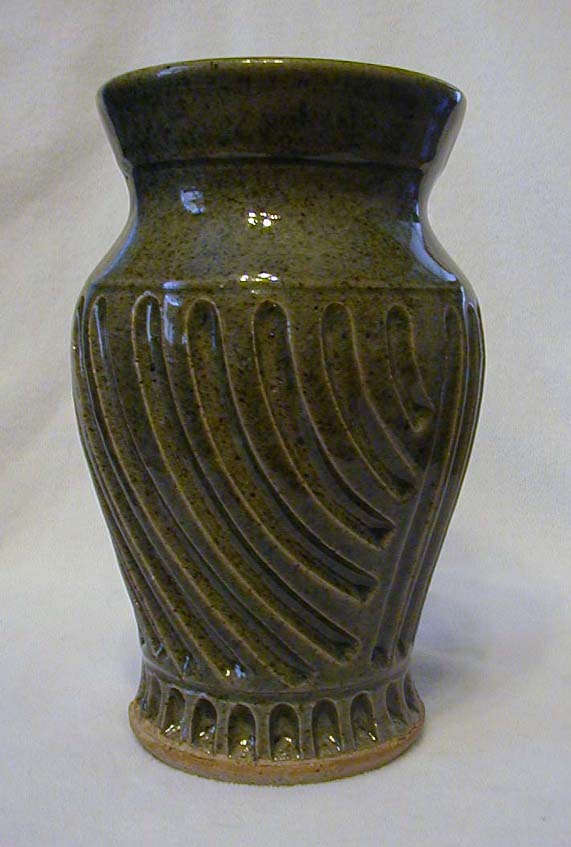
Additional views
Besides the obvious beauty and
complexity of this small piece, I appreciate that she has
a very strong signature, which aided in identifying this
piece.

Therese O'Halloran signature

unnamed, Bernice Ozmun, 16" x 12", oil on board
Bernice
Ozmun was born on 20 April 1892 in Hudson, Steuben County,
Indiana, a daughter of George M. and Cora Reinoehl. Her
middle initial is reported as "C" in records before 1920 and
as "P" in records in 1920 and later. The Reinoehl family was
living in Dekalb County, Indiana in 1900, where George was
employed as a farmer. Bernice has not been located in the
1910 Federal Census, but her parents and brother were living
in Hudson where George was employed as a rural mail carrier.
Bernice was married to Kenneth Leland Ozmun on 12 October
1912 in Cook County, Illinois. Kenneth was employed in the
family business, the Chicago Mat Board Company, and held
several executive positions with that company. Today Chicago
Mat Board is known as Crescent Cardboard and is a major
manufacturer of artists supplies. The Ozmuns were living in
Evanston, Illinois in 1917 when Kenneth completed his WWI
draft registration card, and during the 1920 Federal Census.
The Ozmuns were divorced before 1928 and Kenneth was
remarried to a much younger woman at the time of the 1930
Federal Census of Evanston, Illinois. Bernice arrived in New
York City on the ship Ile de France on 13 November 1928 from
Le Havre, France. The passenger list is the source for her
birthplace and date. She is listed as Bernice "Ozman" in the
1930 census of Evanston at the same address, 905 Michigan
Avenue, that is given in the 1928 passenger list and the
1939 Evanston City Directory. No occupation is given for
Bernice in 1930, but her occupation in 1939 was "instr.
(Chicago)". Once again, her surname is given as Ozman in the
Evanston City Directory. She was possibly teaching art,
though that is a guess. That she was active as an artist by
that time is shown in the 12 February 1927 edition of the
Sarasota Times of Sarasota, Florida:
Mira Mar Hotel Entertains
Guests
During the
early part of the evening Mrs. Bernice Ozmun, of Chicago,
talented singer and artist, here for the season with Mr. and
Mrs. Charles Murphy, delighted the assembly with a group of
songs. Mrs. Ozmun has a rich contralto voice, and her
singing was one of the features of the program.
The first formal reference to
her work as an artist is in Mallett's Index to Artists
Supplement in 1940, where she is referred to as
Bernice Reinoehl Ozman. It is possible that the alternate
spelling of her surname was intentional, as her ex-husband's
parents and brother also lived in Evanston. Coincidentally,
Kenneth Leland Ozmun's brother, Donald Charles Ozmun, was
also married to an artist, Pauline Graff Little Ozmun.

unnamed, Bernice Ozmun, 12" x 9", oil on board
Bernice was an artist in oils and watercolors. According to the Assistant Director of Registration & Records at the School of the Art Institute of Chicago, she took classes at SAIC from 1922-24, 1925-26, and 1936-37. There is no graduation date listed for her. The only record of an exhibition of her work is one exhibition at the Art Institute of Chicago in 1943. She was apparently a successful artist, though, as President Harry S. Truman sat for her portrait of him in 1945. This portrait is currently in the Truman Presidential Museum and Library. In addition to the listing in Mallett, Bernice is listed in Falk's Who Was Who in American Art and Jacobsen's Biographical Index of American Artists, and may be the "Beatrice" Ozmun listed in Davenports Art Reference and Price Guide.


Examples of Ozmun's
signature
The
paintings in my collection were part of a lot of paintings
by Bernice, some of which were fully signed "Bernice Ozmun".
Several also included an early 1940s date. Ozmun sometimes
signed her work verso and sometime both on front and verso.
The lot included oil portraits, florals and still lifes, and
watercolor florals and still lifes.

unnamed, Bernice Ozmun, 24"
x 20", oil on board, 1943
No record
of Bernice's death has been located. It is possible that she
remarried or died before she could collect Social Security.
There were three women in the Social Security Death Index
named Bernice who were born on 20 April 1892. Their surnames
were Cartier, Heisler and Cotten. None of these women's SSAN
was issued in Illinois, nor were any of them living in
Illinois at the time of their deaths.

"Comlara Hedgerow", Dale C. Evans, 9" x 12", oil on masonite, 2010
Dale C. Evans was born in
Bloomington, Illinois. He attended area schools and
studied under local teachers Herb Curtis and Elizabeth
Stein. Evans received a BFA in painting from Herron School
of Art of Indiana University. Evans is also a maker of
folk music instruments and his work has been exhibited at
the Illinois State Museum. He has also taught painting and
drawing locally, especially plein air painting. Evans
painting work is very loose has to be viewed from the
proper distance, maybe six feet to get the correct
perspective, so it is difficult to display on my web site.
You can enjoy his use of color and light (when you realize
where those components are) from any distance. He
specializes in painting Illinois landscapes.

"Dale Park Winter", Dale C. Evans, 9.5" x 9.75", oil on masonite, 2011

Dale C. Evans signature

unnamed, Frank Izard, 15" x 20", oil
Frank W. Izard was born in
California on 4 January 1904, a son of Percival Griffith
and Frances Belle Murray Izard. Percival was born in
Brighton, England and Frances in Hawick, Scotland. The
1910 Federal census of Chicago shows by the birth places
of their children that the Izards lived in Illinois in the
1890s, British Columbia, Canada around 1900, California
about 1903-1905, and back to Chicago, Illinois after 1905.
The Izards did not appear in the 1900 U.S. census,
probably because they were living in British Columbia,
Canada at the time. Percival was employed as a minister in
the 1910-1930 U.S. censuses. Frank's brother, Graham
Izard, was a listed artist. Graham and brother Paul Izard
were listed as "artist, engraving" and "apprentice,
engraving" in the 1930 census. Frank was married in
Chicago on 20 April 1927 to Virginia Greenleaf, but the
1930 census reports his wife's name as Frances, though the
age at marriage in the census indicates they were married
about 1927. Frank's occupation in 1930 was "commercial
artist, newspaper". Frank worked as a commercial artist in
the creative services unit of The Chicago Tribune's
advertising department for almost 41 years, starting in
the late 1920s.
Frank Izard
Services for Frank Izard,
85, a retired commercial artist for The Tribune, will be
held at 1 p.m. Saturday in the chapel at 6150 N. Cicero
Ave. Mr. Izard, a Northwest Side resident, died Wednesday
in Swedish Covenant Hospital. Mr. Izard retired in
February, 1969, after nearly 41 years as an artist in the
creative services unit of The Tribune`s advertising
department. He is survived by his wife, Virginia; two
sons, Robert and James; a sister; a brother; and four
grandchildren.
Frank Izard apparently also worked
as a fine artist, though mentions his work are scarce. I
did find a few mentions of Izard's work as a watercolor
artist. He is not mentioned in any art reference work that
I have examined. It is not known where he received his
training as an artist, but it was likely in Chicago.
Frank W. Izard died on 8 February 1989
in Glenview, Illinois. Virginia Izard died on 19 April
1997 in Glenview, IL.

Frank Izard signature

unnamed, Kenneth Kilstrom, 16" x 20", oil
Harold
Kenneth Russel Kilstrom was born on 25 December 1922 in
Chicago, Illinois, only child of Harold Robert and Hulda
Elfreda Elizabeth Nelson Kilstrom, both children of
Swedish immigrants. Harold Robert Kilstrom was employed as
an optician in Chicago in the 1910-1930 censuses.
Kenneth Kilstrom married Joy Soeda, a
Japanese American born in 1915 in Kauai
County, Hawaii, of Japanese immigrant parents.
Joy's Social Security Number was issued in Illinois, so
Kenneth and Joy may have married there. Joy has not been
identified in the 1920 or 1930 Hawaii censuses. Yokichi
and Kame Shoeda and son Takeo appear in the 1910 Paalaa
Uka, Honolulu census. No Soedas appear in the 1920 Hawaii
census, though there are several Soundex spelling variants
that do appear in the census. There is one
family of Soedas in the 1930 census of Hawaii, headed by
Yokichi and Kame Soeda, but no female that fits Joy's age
is reported. The census lists Takiyo, Kenzo,
Yoshio and Tashio as sons of Yokichi and Kame Soeda. This
couple has not been located in the 1920 census, but the
birth dates of their children and other information
indicates they were in Hawaii by 1907. It is possible that
her birth name was not Joy, or that she may have been in
Japan during the 1920 and 1930 censuses. Joy is listed in
the 1937 and 1938 Honolulu City directories as a teacher
at the Castle Free Memorial Kindergarten. Takeo
Soeda, manager at the Soeda Garage and Kenzo a mechanic at
the garage are listed, as well. Also listed are Raymond T.
and Yokichi. All of these Soedas, excepting Joy, are
listed as residents of Heeia, a Honolulu
neighborhood. Yokichi Soeda and wife
Kame left Hawaii for Japan in 1939. Whether
this was a relocation or vacation is not noted, but it was
noted their last arrival in Hawaii was on 26 March 1907,
so it seem likely this was vacation. A Yoshika Soeda the
right age to be Joy arrived in Los Angeles from Honolulu
on 14 June 1940. Joy Soeda was interred as part of the
Manzanar Relocation Project in 1942, during WWII, either
while living in Los Angeles, or was transported there. The
brief record of her internment contains some interesting
information about her. She had attended one year of
college, had received a teaching certificate and taught in
kindergarten and primary schools. She is mentioned in a
history of the Manzanar camp as a teacher and also
instructor of new teachers. She had lived in Japan for a
period of one to five years before the age of 19, and
spoke, but did not read or write Japanese. Kenneth
and Joy are listed as Kenneth Kilstrom and Joy Soeda at
the same address in the 1957 Manhattan city directory. Joy
Soeda was still at the same address in 1959 but Kenneth
was not listed. This may indicate that they did not marry
until later, or that Joy continued to use her maiden name
after their marriage. Joy Kilstrom received
credit as the costume designer for the 1961 short film
"The Sin of Christ", according to the Internet Movie
Database. She is recorded as Joy Kilstrom in
the Social Security Death Index.


Kenneth Kilstrom, 1940 and
ca 1960s
The photo on the left above is of a
Kenneth Kilstrom who was a senior in the 1940 class at
Sterling Morton High School in Cicero, IL. It is not
proved that this is the same man, but the timing is right,
the name is uncommon and there is a strong resemblance to
a later photo of Kenneth Kilstrom. This Kenneth Kilstrom
was a member of the National Honor Society, according to
the yearbook. The second photo was obtained
from Sally Midgette Anderson, who knew the Kilstroms.
Kenneth Kilstrom reportedly attended
the University of Illinois (1942-1943) and the Schools of
the Art Institute of Chicago (1943-1944). That
Kilstrom attended the University of Illinois has not been
proved, though if he did, it was likely the University of
Illinois Chicago. The registrar of that school would not
confirm his attendance due to privacy concerns. His
attendance at the SAIC has been confirmed.
Much of what follows in this paragraph
is unconfirmed and comes from a source that has not been
able to provide any documentation, but has published this
information on the Internet where it has been widely cited
from. Kilstrom
attended the Canterbury School of Drama in Fort Wayne,
Indiana and the Goodman school of Drama in Chicago. Kilstrom
was awarded a scholarship for art to Cooper Union in New
York City and moved there in 1945. He attended the
school briefly and was offered a job as an apprentice
with sculptor, Isamu Noguchi from 1945-1947. During the
time Kilstrom worked with Noguchi he did set design for
Martha Graham. He also studied musical composition with
renowned composer Meyer Kupferman and percussion with
the Francesca Boaz dance group.
When contacted, the Archivist at the
Noguchi Museum reported that there is no mention of
Kilstrom in their Archives. This does not mean that
Kilstrom did not work with Noguchi, but that records do
not exist that can confirm this connection. If Kilstrom
did work with Noguchi during this period, he would likely
have worked on Graham's production of either "Cave of
Heart" or "Errand into the Maze". It seems unlikely that
Kilstrom could have attended the Canterbury School of
Drama and Goodman School of Drama in the time between his
attendance at the SAIC in 1944 and his reported move to
New York City in 1945. No records for a
Canterbury School of Drama in Fort Wayne have been found,
but there is mention of such a school in Chicago. There is
a Canterbury School in Fort Wayne, but is was not created
until 1977 and serves grades K-12. The Goodman School is
now known as the Theater School at DePaul University. It
seems most likely that Kilstrom attendance at these
schools may have been in the nature of individual classes,
not enrollment in any specific degree program, and perhaps
between the time he graduated from high school in 1940
until he moved to New York in 1945.
No records of a Francesca Boaz Dance
Group have been found. Only two mentions of Francesca, or
Francisca, Boaz were found using a Google and Ancestry.com
search. First, in the Rome News Tribune on 20 January 1958
it is reported that Francesca Boaz was the director for
the dance segment of a children's play. Second, a single
mention of "Francisca Boaz's Dance Studio in Manhattan" is
made in A Fire
in the Mind: the life of Joseph Campbell by
Larsen (1991).
An attempt to confirm Kilstrom's
scholarship to the Cooper Union is under way. All of this
being said, there may be some grain of truth in these
claims but they may have been inflated, perhaps by a
gallery for the purpose of enhancing Kilstrom's
credentials at some point. This is only speculation,
though.
In 1947 Kilstrom joined Stanley
Hayter's Atelier 17 in New York City, which was reportedly
in close proximity to his apartment. One
researcher has speculated that the painting above depicts
this apartment. While working at Hayter's Atelier in 1948,
Kilstrom is mentioned in The Grove Encyclopedia of Materials and
Techniques in Art by Gerald W. R.Ward (2008) as
possibly the first artist to add real world photographic
imagery onto an intaglio printing plate as an element in a
composition, in his work "Attack on Marshall Gilbert".
This print is currently in the collection of the Harvard
Art Museums/Fogg Museum. Kilstrom had early success as a
print-maker and won awards and prizes for his prints,
including a purchase award from the Museum of Modern Art.
Sally Midgette Anderson noted that he was known as a
"star" in the world of print artists at the time. He won a
first prize from the Philadelphia Print Club. Kilstrom was
almost certainly exposed to a new movement in painting
called the New York School, or Abstract Expressionism,
when he moved to New York. He is said to have attended Robert Motherwell's
"Subjects of the Artist" discussions and been very
interested in this style, which is reflected in his
printmaking.

Kilstrom's Tanager show
flier
In the early 1950's, Kilstrom was
committed to a psychiatric hospital where he was confined
for around a decade. The reason for his commitment has not
been preserved. According to a memoir by a friend of the
Kilstroms, Pat Passlof, Kenneth's wife, Joy, brought him
home cooked meals and painting materials on the weekends
and he would pass the day of her visit in painting and
picnicking, weather permitting. Pat Passlof was the spouse
of noted artist, Milton Resnick. Kilstrom could not keep
painting materials at the hospital as the other patients
would take them. It wasn't until around 1960 when
prominent people from the art world, including Robert
Motherwell, Richard Bellamy and others, attempted
unsuccessfully to get Kilstrom released from the hospital.
At the urging of Pat Passlof, the Tanager Gallery in New
York agreed to sponsor a one man show of Kilstrom's works
and the success of this show aided in achieving his
release. The gallery was not told that Kilstrom was
residing in a psychiatric hospital. Purchasers of
Kilstrom's work at this show included Tom Hess, editor of
ArtNews Magazine. The Tanager show of his work was a near
sellout, and favorably reviewed, so Joy Soeda Kilstrom
showed Xerox copies of the receipts and reviews from this
show to the director of the hospital where Kilstrom
was detained. This convinced him to immediately release
Kilstrom. Subsequently, Kilstrom had many successful one
man and group shows.
Kilstrom exhibited at the Pennsylvania
Academy of Fine Arts in 1948, the Renaissance Society at
the University of Chicago in 1949, the Tanager Gallery in
New York City in 1961, the Zabriskie Gallery in New York
in 1963, 1964 and 1966, at the Fishbach Gallery 1964-1967
and at the Roswell Museum in 1971. According to a history
of the program, he was accepted into the Roswell Artist in
Residence program in 1970-1971. This history also noted
that he was friends with abstract expressionists Milton
Resnick and Pat Passlof, who were also members of the
program, and also from New York. Pat Passlof and Milton
Resnick recommended Kilstrom for the program. At various
times the Kilstroms and Passlof and Resnick were neighbors
in various apartment buildings that were favored by New
York School artists in Manhattan. According to the 22
September 1975 issue of the Village Voice, Kilstrom's work
was among that exhibited at the MOMA as part of the "76
Jefferson Streeters Show". This show was comprised of the
work of 17 well known artists who had resided at 76
Jefferson St., NYC over a period of about 20 years. The
building was a widely known as a residence of poor artists
and musicians. Kilstrom was living there at the time of
the MOMA exhibition. The article notes that the building
was "a microcosm of the New York art scene".
Kilstrom's work is included in the
collections of the Smithsonian Institution’s Hirshhorn
Museum and Sculpture Garden, the Indianapolis Museum of
Art, the Amon Carter Museum of American Art, the
University of Missouri Museum of Art and Archaeology, the
Anderson Museum of Contemporary Art, the Roswell Museum
and Art Center, Harvard Art Museums/Fogg Museum and the
Brooklyn Museum of Art. Kilstrom is mentioned in various
art magazines in the 1960s including the New Yorker, Arts
Magazine, The Art Gallery, Art International and Studio
International. The following excerpt is from The Roswell
Artist-in-Residence Program: an anecdotal history
by Ann McGarrell and Sally Anderson:
Ken Kilstrom was the last of the group of artists who had applied either because they were personally acquainted with the Andersons or with one of the artists already on the grant. He and his wife, Joy, were friends of Milton Resnick and Pat Passlof in New York City. His paintings were filled with angels and wonderfully strange, naive figures. He also enjoyed the open landscape of the compound and the possible kinds of recreation available. He had a habit of coming into Bill Midgette's studio asking him if he'd like to play a game of badminton. (At this time, Midgette was scrambling to get ready for his first New York show and was not receptive.)
The last mention of Kilstrom's work
as an artist found to date was in Arts Magazine: Volume
51, Issues 6-10, 1977. Kilstrom is also mentioned in Ten Years of
American Prints 1947-1956 by Una E. Johnson, Out of the Picture:
Milton Resnick and the New York School by Dorfman
and Davenports
Art Reference and Price Guide.

unnamed, Kenneth Kilstrom,
12" x 16", oil on board
There has been some doubt cast on
the claim that a lot of paintings offered on ebay starting
about 2009, bearing the "HKK" monogram, were the work of
Kilstrom, since he also, perhaps more commonly, signed
"Kilstrom" or "Kenneth Kilstrom". When this question was
raised with the seller of these works, the seller supplied
the following response:
Subsequent conversations with the
seller revealed that the art professor was a noted African
American abstract artist, as well, Marvin Prentiss Brown
(1943 - ). Note that one of the paintings in my
collection, the seascape, came from this lot and bears the
"HKK" monogram on front and is signed "Kenneth Kilstrom"
verso. It is possible that these are early works by
Kilstrom, created before he dropped his first name,
possibly from the late 1940s or early 1950s.

unnamed, Kenneth Kilstrom,
16" x 20", oil on board
Kenneth Kilstrom's full name, and the
names of his parents, are proved by the 1930 Federal
census of Chicago, IL, by the Cook County, Illinois Birth
Certificate Index, 1871-1922 FHL Film #1379146, and
by the Cook County, Illinois Birth Index 1916-1935, File
#6055470. When contacted for information about Kenneth
Kilstrom's attendance there, the registrar of the School
of the Art Institute of Chicago (SAIC) replied:
"Kenneth Harold Kilstrom
attended SAIC from 1943 to 1944 but did not graduate."
The Registrar also noted that he
was the only person with this surname to have attended the
SAIC. Kenneth Harold Kilstrom gave his address as 6957
Riverside Drive, Berwyn, Illinois in his SAIC registration
forms. This is the same address that Harold Robert
Kilstrom, Kenneth's father, reported on his WWII Draft
Registration Card. This seems to support the claim that
these works, monogrammed "HKK", were done by Kenneth
Kilstrom. One other thing that could be done to further
validate this identification would be to obtain a copy of
Kilstrom's New York death certificate, determine if his
parent's names are included on the certificate and if they
match the names in the Chicago birth records. This may be
complicated by the fact the Joy Soeda Kilstrom died
several years before Kenneth, so there may have been no
one who knew enough about Kilstrom's background to provide
the names of his parents. Kenneth Kilstrom was an only
child and did not have children. Kilstrom's birth date is
given as 29 December in the Social Security Death index,
but multiple records, including Chicago birth records and
his SAIC registration, give the correct date of 25
December.
Kilstrom died 11
May 1995 in New York City. Joy Kilstrom was born on 2 July
1915 in Hawaii and died on 16 November 1988 in New York
City.


Kilstrom signature

unnamed, White, 14" x 28", oil
Though this is an unidentified
artist, I am including this painting on my Illinois page
because I am confident that this is an Illinois artist.
This painting was likely commemorates some local history
associated with the introduction of hybrid corn in central
Illinois. I have been told that the corn pictured is
Yellow Dent #2, common to the region. The man on the left
may be Perry Greeley Holden, once a professor at the
University of Illinois, and who did pioneering work in
increasing corn yields for farmers.

Yellow Dent #2 corn
The
identities of the other two men is not yet known. I am
still researching this painting. It was likely
commissioned to hang in a sales office or some other
facility associated with the production of hybrid corn.
The artist was likely not a professional artist, but more
likely a folk artist.


unnamed, Luther Kush Bey Woodley, 14" x 11", watercolor, 1995
Luther Kush Bey Woodley was born in
1940. He receive a BFA from St. Paul University and MFA
from the University of Minnesota. He also studied at the
Art Institute of Chicago. He resides in Chicago, Illinois
and has been very active in the African American art
community there since the late 1960s. He started the
Chicago Society of Black Arts and Crafts at the Afro Arts
Theater. He has frequently exhibited his work in one man
and group shows. He is a painter, teacher, illustrator and
print maker. He is also an art historian. This work was
given as token of gratitude to a benefactor and contains a
lengthy, personal inscription verso.


unnamed, Norbert Czarnowski, 8" x 10", watercolor
Norbert A. (or R.) Czarnowski was
born on 9 August 1897 in Lebno, Poland, a son of Leon and
Emerentia Czarnowski, Polish immigrants. The Czarnowskis
were living together as a family in Chicago in 1930, where
Leon was employed as a "Janitor, Building" and Norbert was
working as an "Artist, Engraving House". According to his
naturalization record, he arrived in the US on 16 February
1921 and was naturalized on 22 April 1927 in Chicago. His
arrival date in the US is contradicted by the 1930 census
and a 28 December 1912 passenger list, which shows his
arrival in the US. It gives his last European residence as
Hohensalza. He was alone and his mother's name is given as
Em. Czarnowski, which is consistent with other records for
him. Norbert does again appear on a US passenger list on
28 January 1921, again alone, occupation "artist", last
residence Warsaw, Poland. It would appear that he returned
to Poland between 1912 and 1921. Czarnowski enlisted in
the US Army on 1 October 1942, at the age of 45. He was a
commercial artist, by occupation, with one year of college
education.
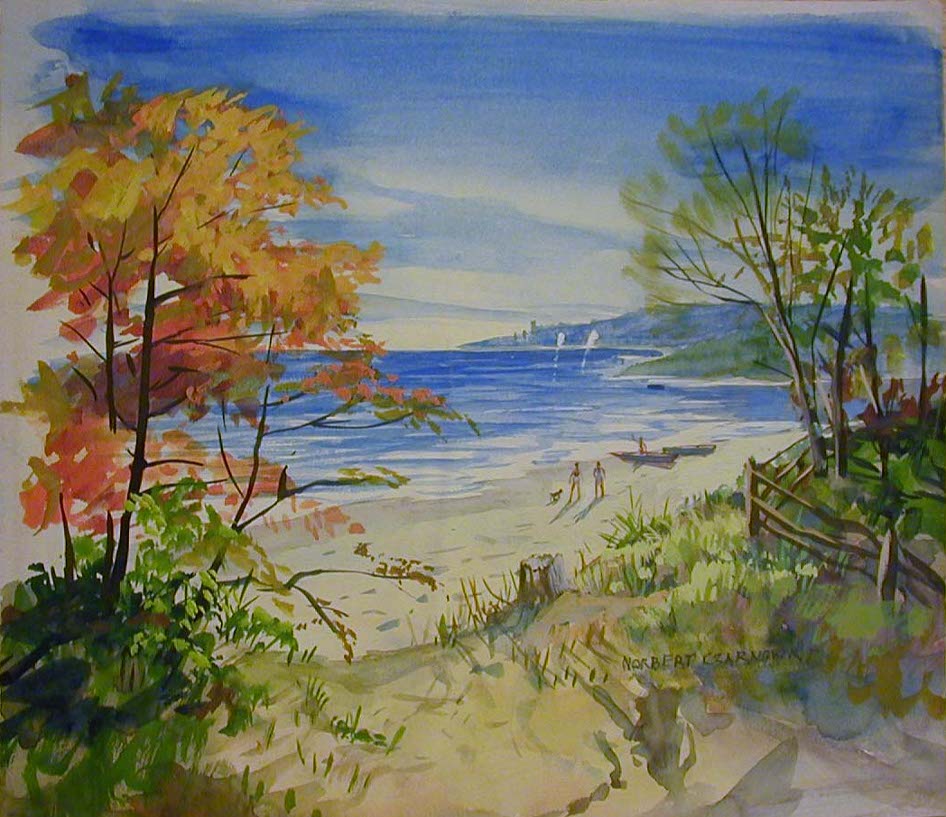
unnamed, Norbert Czarnowski, 8" x 10", watercolor
Czarnowski attended the Warsaw
Academy, Art Institute of Chicago, and Chicago Fine Arts
Academy. He also studied with Charles Schroeder and Oscar
Gross. He worked as a painter, decorator, and teacher. He
was a member of the Polish Art Club. Czarnowski exhibited
at the Art Institute of Chicago. He decorated the interior
of the Stanislaus B & M Church in Chicago in 1928. He
is mentioned in Mallett's
Index of Artists, Who Was Who in American Art by Falk,
Poles of Chicago
1837-1937 by Zglenicki, Who's Who in Polish
America by Bolek, Mural Painters in America: A Biographical
Index 1949, and Davenports Art Reference and Price Guide.
Norbert Czarnowski died on 10 July
1994 in Kerrville, Kerr County, Texas.

unnamed, Jeanne Haberlaw, 10" x 8", oil
Mrs. Jeanne "Cherie" Haberlaw was
born on 27 September 1895 in Paris, France. Her maiden
name is not known. Her father was born in London, England
and her mother in Gien, France, according to the 1920
census of Bureau, Bureau County, IL. She was married in
Paris, France to Captain William Edward Haberlaw, of
Company B, 13th Engineers on 13 February 1919. Their
marriage date and place is given in the 1931 passenger
list of the S.S. Lafayette. An interesting mention of
their marriage appears in a railway company history:
The Santa Fe magazine, Volume 13
By Atchison, Topeka, and Santa Fe Railway Company
13th Engineers Return, pages 36-37
I almost forgot to say that it was not before March 1 that all the members of Company F had quit work and assembled at Fleury, from which place they left for Marseilles on March 19. On April 12 they set out for America, stopping two days en route to coal at Gibraltar. The personnel of the regiment had been increased by one member – Captain Haberlaw of Company B, the jolly Rock Island crowd, having taken unto himself a wife, a charming little lady who had been a Red Cross nurse on the French hospital trains and who had been decorated with the palm for bravery.
The "palm" refers to the French medal,
the Croix de Guerre. It might be possible to discover
Jeanne's maiden name by researching this award. William
was the Road Master of the Railroad in Bureau in 1920. The
couple traveled to France in 1921 and their US address was
given as 5489 Princeton Ave, Chicago on the passenger
list. William applied for a passport for this trip, which
provides us with a poor passport photo of the couple:

1921 passport photo
The Haberlaws appeared together in this
photograph because Jeanne had become a naturalized citizen
by virtue of their marriage. They traveled to France again
in 1926 and their US address was given as Bureau,
Illinois. I suspect that the Haberlaws may have had an
apartment or home in Chicago and lived in Railroad Company
housing when William worked. The Haberlaws traveled to
France many times, probably to visit Jeanne's family. This
makes it possible to get a good record of where they lived
in the U.S. They were living in Peoria, IL in 1939, and
still in Peoria in 1942 when William was working for the
Chicago, Rock Island and Pacific Railway, according to his
WWII draft registration. Their 1948 trip showed them in
Peoria, but at a different address than before. They were
still living in Peoria in 1951, 1953, and 1956, according
to passenger lists. William was likely retired by this
time as he was born on 6 November 1887, so would have been
69 in 1956. The Haberlaws were living in Pompano Beach,
Florida in 1978, at the time of William's death at the age
of 90.

unnamed, Jeanne Haberlaw, 10" x 8", oil
I have found no record of Jeanne's
work as an artist. She and William had no children. It is
possible that she received her artistic training in
France. Peoria, Illinois has a long history of artistic
endeavor and the Peoria Art Guild (PAG) is over 125 years
old, so she may have been affiliated with that group.
Unfortunately, the PAG does not have a historian, so there
are few records available about their past members and
exhibitions.
I was contacted in late 2009 by a
lady who had known the Haberlaws as a child. Her parents
were close friends of the Haberlaws, and her father was
also a Civil Engineer who worked with William. She told me
that Jeanne was commonly known as "Cherie" and, in fact,
she did not even know her first name was Jeanne. Jeanne
conducted French language lessons for children in her home
and this lady was one of her students. She and her family
also accompanied the Haberlaws to their Bureau County farm
on visits. She spent time in Jeanne's home art studio,
while her parents and the Haberlaws played bridge, and
knows that Jeanne was a prolific artist in oils,
watercolors and pastels. Her parent had numerous pastels
by Jeanne and she has a watercolor she received from the
Haberlaws as a wedding present. This watercolor is a scene
of Menton, France viewed from the "Italian Frontier". She
also passed on the tradition that Jeanne was the first
French war bride of WWI.
These are both attractive little oils,
and they display much better than they photograph. They
were found in identical, high quality gilt frames, so were
apparently prized by someone. They probably date from the
1930s-1950s, judging by the age of the boards they
are painted on, so likely done while the Haberlaws lived
in Peoria. Both are painted on what appears to be
non-commercial linen wrapped boards, so it is possible
that Jeanne made them herself.
Jeanne Haberlaw died on 4 April 1992 in
Pompano Beach, Florida. William died in Pompano Beach on
25 January 1978 in Pompano Beach. The Haberlaws are buried
in the Pompano Beach Cemetery.


Examples of Jeanne
Haberlaw's signature

unnamed, C. O'Toole, 20" x 16", oil
Mrs. Catherine M. O'Toole was born
about 1899 in Massachusetts. She married John J. O'Toole
about 1921, probably in Chicago. John O'Toole was born in
Philadelphia, PA on 7 September 1892 and living in Chicago
by 1917, according to his WWI draft registration card.
John was employed as an "accountant, Real Estate" in 1930.
I have not been able to locate either Catherine or John in
1920. They were likely married in Chicago, since John
filled out his draft card there.

unnamed, unsigned (Catherine M. O'Toole), 24" x 20", oil
Catherine is not mentioned in any
art reference book, and I found no mention of her work as
an artist. Luckily, she wrote her name, and street and
house number on the back of one of the paintings, and I
was able to use that information to locate her in the 1930
census. She and John were living at the address on the
painting, 8246 Throop Street, Chicago, Illinois. Both were
children of immigrants from the Irish Free State.

unnamed, C. O'Toole, 24" x 20", oil
John and Catherine owned their home
in 1930, so may have lived there many years, which makes
these paintings more difficult to date. The O'Tooles were
still living at 8246 Throop Street in 1942, when John
completed his WWII draft registration card. He was
employed at the U. S. Audit Co. at the time.
Two of the paintings are signed and one
is unsigned, but in a frame similar to one of the other
paintings. I have no doubt that the unsigned
painting is also Catherine's work. They had two children,
John J. and Robert D. in 1930. There was a Catherine
Otoole b. 11 January 1899 who died in November 1995 in
Chicago, but I have not been able to determine if this is
the same woman.


unnamed, Joy Layson, 16" x 13", crayon and colored pencil
Joy C. Layson was born 21 August
1927 in Waukegan, Illinois. She received a degree from the
Chicago Academy of Fine Arts. She lived and worked in
Illinois until about 1960 when she moved to Colorado for
10 years, before finally settling in Payson, Arizona. She
has worked in oils for many years, but in the 1950s she
worked in other mediums including colored pencils and
pastels. One way she made money was by sketching portraits
of passersby in bus terminals. She believes that this
drawing may be such a work. I found it in a local thrift
shop and, at first, was only interested in the frame. It
did not take me very long before I realized that this is a
very fine drawing, and I was even more impressed once I
discovered that Layton must have completed in it a very
short time, in less than ideal conditions. Layson has
worked as an artist, art teacher, and gallery owner since
leaving Illinois. She received a letter from President
Dwight D. Eisenhower complimenting her on a battlefield
scene she had painted. The painting now hangs in the
Eisenhower College in Seneca, NY. At the age of 80 she
suffered a severely broken right wrist which caused
complications and a stroke. She overcame all of these
obstacles and resumed painting and at age 83 is back at
work as an artist.

Joy Layson signature

unnamed, Salvatore Salla, oil, 11" x 23", 1975
Salvatore Salla was born in Kosrowa, Persia on 3 August 1903, a son of Abraham and Angele Yohanan Sallaheddin. The California Death Index gives his mother's maiden name as Sacerdotis. He was of Syrian ancestry and born in India, according to the 1930 census. He became a naturalized US citizen in 1927, and his birth name is given as "Isho Sava" and birthplace as Persia in the record of his naturalization. There is no doubt that this record is for him as his address is the same as that given for him in the 1930 census. The Salla family came to the US in 1920, but do not appear in the 1920 census. Salla was employed as an "artist, studio" in 1930 and living at his mother's home in Chicago. He married Anna Ursini in Chicago in 1926.

A close up
Salla is listed in Who's Who in
American Art (1974-1982), Davenports Art
Reference and Price Guide, Mallett's Index of Artists
Supplement, and Who Was Who in
American Art by Falk. This painting is not
typical for Salla's work. He normally painted in a much
more sophisticated, realist style. I was able to contact a
family member who confirmed that this is Salla's work and
that he infrequently painted in this style. Salla taught
life drawing and oil painting at the American Academy of
Art in Chicago. I have not been able to discover where he
received his training as an artist, but he may have
continued on as an instructor after completing training at
the American Academy of Art. Just a guess. He exhibited at
the Art Institute of Chicago in 1929 and 1933. He was a
pupil of L. DeMango in Constantinople, according to Falk.
Salla died on 20 August 1991 in
Carlsbad, CA.

Salla's signature
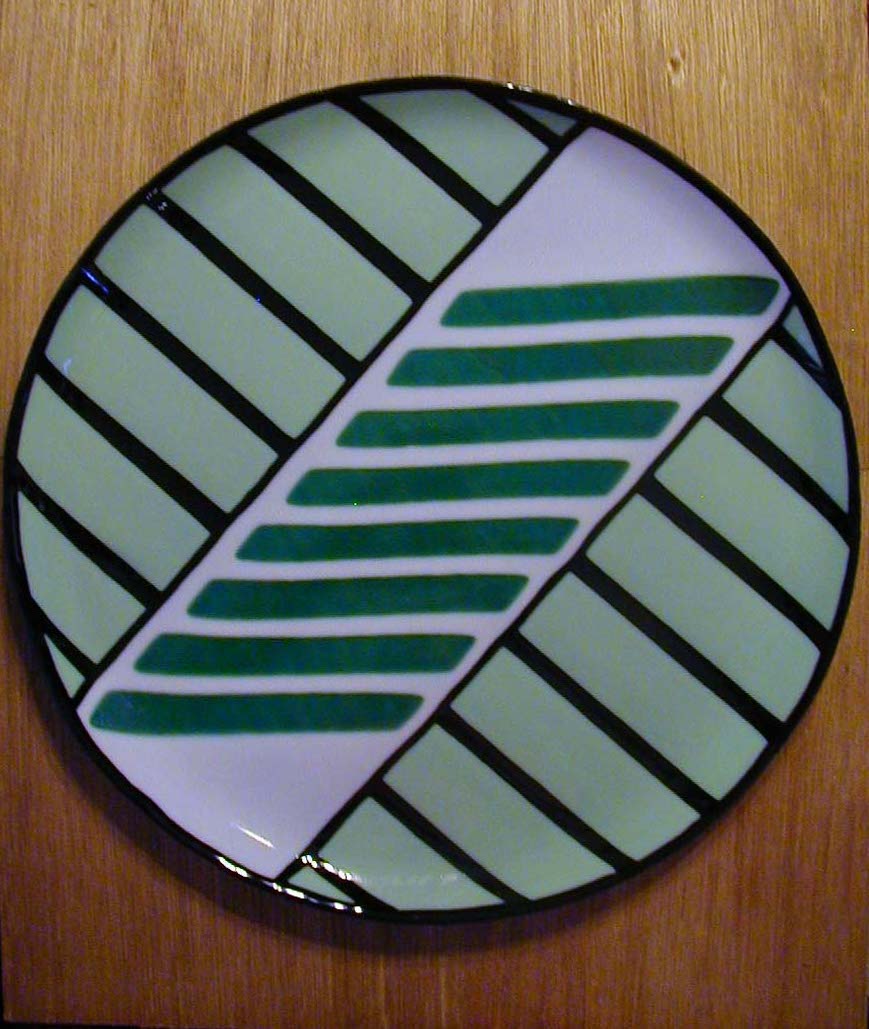
unnamed, Edward Martin, 16", fused glass plate
Edward Martin is a self taught
artist who works with glass and wood. When I first added
this plate to my collection, I found that the URL listed
on the card below, was no good, but was able to locate Mr.
Martin's new web site. He
is a Springfield, IL artist who has been working at his
craft for 30 years. There are a couple of YouTube videos
about him, one accessible from his web site. This photo
does not show that the diagonal green bars in the middle
of the plate are iridescent. This is a very striking
effect.

unnamed, Edward Martin,
18.5" x 15", fused glass
Both of these works came from local
estate sales. I was able to contact Mr. Martin and he told
me that this plate was part of a large order from the
United Way. The order consisted of several hundred small
plates and six of these larger plates that were given to
donors by the United Way. Mr. Martin has a new studio in
downtown Springfield, IL. The large plaque is not signed,
but I contacted the artist, since I thought he might
recognize the artist and he replied:


Signature from plate, etched verso, and attached card

unnamed, Richard P. Strand, 13.5" x 21.5", watercolor
Richard Paul Strand was born 17
August 1917 in Chicago, Illinois, a son of Henry and
Evelyn Matthews Strand. Henry was employed as a "wholesale
dry goods salesman" in 1920 and as "commercial salesman,
wholesale paint" in 1930. Richard married Susan Plowden.
He enlisted in the U.S. Army on 7 April 1941. He gave his
education as "high school", and his occupation as
"commercial artist".

unnamed, unsigned, 13.5" x
21.5"
Richard
graduated from the Art Institute of Chicago. He owned his
own commercial art business, Dick Strand Studios, on the
Chicago Loop. He painted mostly in watercolors, as a
hobby. I do not know if he exhibited his work, but I
suspect that he did.

unnamed, unsigned, 13.5" x 21.5"
Strand
moved to Des Plaines, Illinois in the early 1980s with the
intention of setting up a business there, but died
suddenly of a heart attack on 2 August 1983. All of these
works came from a North Side Chicago estate sale. Also
included in the sale were works by Walter Mazeski and
Linda Dahl. I have several watercolors by Mazeski in my
collection. Susan Strand passed away in 2007.

unnamed, unsigned, 13.5" x 21.5", watercolor
Only the first of the paintings
shown above is signed, but I am confident the other
three are his work, as well. They are all painted on
the same paper stock, have staple holes around all
four edges where they were mounted to a backing while
being painted, and each has a number in pencil written
in the upper right corner. All four also exhibit very
sharp edges around the perimeter of the painted
surface, as if Strand used tape to mask the edges.
I'll get a closeup from one of the paintings to
illustrate my observations. All are done in the same
style and use basically the same color palette.
I was fortunate enough to be able
to locate Mr. Strand's son, Paul, who supplied or
confirmed much of the information above.

Richard P. Strand signature

"Coral Ridge Moravian Church - View from west parking lot", Henry A. Reents, 10.25" x 13", oil, 1970
Henry Arthur Reents was born 25
March 1892, in Chicago, Illinois, a son of Henry and
Johanna Reents, German immigrants. His father was working
as a candy peddler and his mother as a fish saleswoman in
1900. I have not been able to locate the Reents family in
the 1910 census. Henry completed a WWI draft registration
card in 1916. He was working as a supply clerk at the
Chicago Telephone Company in June 1916 and as an
accountant for a telephone company in 1920. Henry A.
Reents was awarded a commendation in the Junior
Photography competition of American Photography magazine
in 1921. His photograph was titled "Dad". He was still
living in Chicago and employed as a "photographer,
telephoto" in 1930. Reents married Grace Violet Stineman
on 30 March 1937 in Chicago. He completed his WWII draft
registration card in 1942 giving his sister as his
contact, though his wife died using her married name in
1979 in the same city where Henry later died. I suspect
that Henry was moving back and forth between Indiana and
Chicago at this time, as Falk notes that he exhibited at
the Hoosier Salon from 1935-1938. He did give his
employment as American Telephone and Telegraph in Chicago
on his draft registration card, though. It is possible
that his job required travel. According to the Kokomo
Tribune, 19 January 1939, Henry A. Reents was elected to
membership in the Indiana Artists Club. The article seems
to indicate that he was a resident of South Bend, Indiana.
Henry A. Reents was enumerated on a list for delinquent
taxes in Beverly Shores, Indiana in May 1955.
Reents is listed in Who Was Who in
American Art by Falk. According to Falk he
studied at the Art Institute of Chicago (AIC) with Albert
Francois Fleury, Edward J. Finley Timmons, and C. Buhr. He
was a member of the Hoosier Salon. The 1948 supplement to
Mallett's Index
of Artists gives his residence as Michigan City,
Indiana. Reents is also listed in Davenport's Art
Reference and Price Guide. I do not know if he
exhibited in Illinois, but suspect he did at the AIC,
being a student there. Since he was born and lived in
Illinois for several decades, and received his art
education in that state, I am including him on my Illinois
Artists page.

Inscription, verso
Reents apparently painted this as
a gift for Rev. Henry A. Lewis. Lewis was probably the
minister at the Coral Ridge Moravian Church in Ft.
Lauderdale, Florida. I assume Reents must have been one
of his parishioners.
Henry Reents died on 13 August 1983
in Ft. Lauderdale, Florida.


"Rough seas", S. R. LaCroix, 10" x 14", watercolor
Steven R.
LaCroix is an artist in several mediums including
watercolor, chalk, digital, and ceramics. I received
biographical information about Mr. LaCroix and will update
this site, as soon as I have repaired the computer I have it
stored on. He may be the S. R. LaCroix who attended the
University of North Carolina and Chicago American Academy of
Art. I like the action and colors in this painting and the
blend of realism and impressionism. My first impression of
it was that it reminded me of the style of a California
watercolor from the 1950s or 1960s.


"A Pink and White Bouquet", Olivia T. Sumrall, 6.5" x 4.5", acrylic
Olivia T. Sumrall resided in
Danville, Illinois from 1936 until at least 1949,
according to city directories. Her husband, William M.
Sumrall, worked as a physical therapist at the Veterans
Hospital in Danville. I believe they did not marry until
after 1930 as I found a man who appears to be William
living alone as a boarder aged 27 in Aspinwall, PA
where he was employed as a physical therapy aide in a
hospital. He and both parents were born in Mississippi.
William M. Sumrall, Head Aide in Physiotherapy at the
Veteran's Hospital at Aspinwall, PA, published an article
in a Veterans Administration medical bulletin in 1929. It
seems reasonable to assume if this is the correct William
Sumrall, that Olivia was born sometime after 1903. Neither
William or Olivia appear in the Illinois death index,
which ends in 1950, or in the Social Security Death Index
for Vermilion County,Illinois, though a William Sumrall
the right age did die in Madison County, IL in 1972.
Olivia was apparently a member of the
Danville Art League which was founded in 1938 and still
exists. The fact that this is an acrylic painting would
seem to indicate that it was painted after 1950, when
acrylic paints first became available to artists, and more
likely after 1960 when the use of acrylics became more
widespread. No idea where she received her training
as an artist or any details of her work as an artist.

I found this painting in a thrift
shop for fifty cents and thought it would be a good
research opportunity. The label on the back provided
valuable information about the artist. I hope that the
Danville Art League will be able to provide more
information about Mrs. Sumrall.


unnamed, Arne Bodholdt, 18.5" x 14", watercolor
Arnost "Arne" Bodholdt was born 8
August 1892 in Waterloo, Iowa, the son of Danish
immigrants John and May Bodholdt. John Bodholdt was
working as teamster for an oil company in 1900 and as a
shipping clerk for Standard Oil in 1910. Arne Bodholdt
received a Bachelor of Science degree in Architecture from
the Armour College of Engineering in 1914. His thesis was
titled "A Modern Hotel for a City of 100,000 Inhabitants".
He was residing in Chicago on 20 June 1916 and employed as
a draftsman when he applied for a passport to travel to
Brazil on "Commercial Business". He sailed from New York
on the ship Verdi on 1 July 1916. Bodholdt's 1917 WWI
draft registration card gives his occupation as
"Architectural Draftsman" for the company of Dean &
Dean, his residence as East Chicago, IL, and marital
status as single. Bodholdt was a member of the Field
Artillery Central Officers Training School Association in
1919 and may have served in WWI. He was employed as an
architect in 1920, living in a boarding house in Chicago,
IL. Bodholdt married Grace Lavina Dryden between 1920 and
1930. She was born 2 February 1894. I found no trace of
Arne or Grace in the 1930 census. It is possible that they
married in that year and were honeymooning or traveling. I
found reference to the birth of their first child, Bette,
in 1932.
Bodholdt exhibited at the
Art Institute of Chicago in 11 of the years between 1922
and 1949. For instance, Bodholdt exhibited an
oil titled "Dreary without, drearier within" in 1935 and a
watercolor titled "Winter dress" in 1948. The latter
painting had an asking price of $200. The Iowa
Library Quarterly of 1937 mentioned an exhibition of his
paintings at the Cedar Falls Public Library. It was noted
that he was originally from Waterloo but then occupied as
an architect in Chicago.
My painting seems to be typical of
Bodholdt's style, based on other works by him that I have
seen, brightly colored and surreal. I found several
mentions of auctions of his work, so he may have been
prolific. Bodholdt was a member of the Cliff Dwellers,
a Chicago art club. He taught at the Art Institute of
Chicago and owned his own architecture firm. He is
mentioned in Davenport's Art Reference and Price Guide and
Falk's Who Was
Who in American Art. His obituary appeared in the
Chicago Tribune and in the Evanston Review on 14 April
1966:
Arne Bodholdt, 73, of 419 Lee St., an architect, died
Monday in Wesley Memorial Hospital after a short illness.
Mr. Bodholdt, who retired from his own firm two years ago,
came from his native Waterloo, Ia., to attend the Armour
Institute of Technology, from which he was graduated.
He formerly was a teacher at the Art Institute and was a
member of the Cliff Dwellers, a Chicago club. He lived in
Chicago before coming to Evanston 25 years ago.
He is survived by his wife, Grace D.; a daughter, Mrs.
Bette LaPorte, 419 Lee St.; a sister, Mrs. Agnes Conover,
1132 Grant St.; two bothers, Richard S., 1132 Church St.,
and Edward N., Washington, D.C.; and one grandchild.
Funeral services were held yesterday in the Hebblethwaite
chapel. Burial was private.
Arne Bodholdt died on 11 April 1966 in
Evanston, IL. Grace Bodholdt died on 15 December 1981 in
Chicago, IL.

Bodholdt's signature from my painting.

"Wash Day", L. Sampiere, 13.5" x 10.5", oil, 1962
Luigi Biagio Sampiere was born 17
July 1908 in Comiso, Sicily a son of Giuseppe and Concetta
Sampiere. Information about Sampiere in published sources
is scarce but he is described as "an established artist"
and watercolorist in Chicago's Italians: immigrants, ethnics,
Americans by Dominic Lawrence Candeloro, 2003.
This book mentions the Casa Italia, an Italian cultural
association in Chicago. Contained within Casa Italia is
the Italian Cultural Center, which includes an art gallery
that features the works of Italian and Italian-American
artists. I contacted the gallery and, though the curator
could not tell me much about Mr.Sampiere, he did say that
the gallery has several of his paintings in their
collection. Aside from this, the Social Security Death
Index, and references in Chicago city directories, I was
able to discover little more about him, until I had the
good fortune of locating his daughter.
Sampiere married a woman named
Francesca in April 1937 in Comiso, Italy. She was born 25
August 1914 and died 29 November 2007 in Chicago,
Illinois. Sampiere worked as an artist his entire life,
receiving his training from his father and grandfather,
who were also artists, painting signs and decorative art
in homes. His life and work as an artist were
featured in a local newspaper article in 1993, just prior
to a rare exhibition of his work at the Lincolnwood Public
Library in Chicago. Sampiere noted that his first memory
of creating a painting was at the age of 6. By profession
he was a commercial artist, mainly painting mural sized
advertisements. At the age of 20 he moved to Tunisia for
four years where he worked with a brother-in-law painting
wall sized movie advertisements. During WWII he returned
to Sicily and worked as an interior artist, painting
murals and decorative art in homes as his father had done.
He attempted to move his family to the US in 1951 but was
turned away due to immigration quotas. Instead, he moved
to Caracas, Venezuela working as an advertising painter
for two years until he was allowed to enter the US in
1953. He then started work painting billboards for Foster
and Kleiser, a billboard advertising agency, and did so
for the next 27 years, painting advertisements for Sara
Lee, Seagram, and Budweiser, among others. His daughter
was kind enough to give me a picture of Sampiere working
on a billboard depicting the Budweiser Clydesdale horses.
During his career as a commercial artist, for relaxation
Sampiere painted fine art in his home, for his own
enjoyment, only exhibiting and selling his work after his
retirement in 1980.
No matter how huge; his art
is still art
Retired
billboard craftsman finds even bigger thrills on smaller
canvasses
by Ed
Bannon, Staff Writer
Luigi
Sampiere, a Harwood Heights artist painted a career's
worth of advertising billboards in his 85 years. But as
far as he's concerned, his smaller paintings are not for
sale
"I'm free when I work for myself."
Sampiere said. "When I don't like (a painting), I throw it
away."
But he will sell a painting, and he
hopes to at an exhibition that began this week and runs to
Jan. 8 at the Lincolnwood Public Library, 4000 W. Pratt
Ave. His days of painting for other people are over.
Sampiere worked for 27 years painting
billboards designed by someone else. A client delivered a
sketch that was projected large enough to fill the
billboard, Sampiere said. Then Sampiere would outline the
sketch and begin painting.
Sampiere painted between four and five
ads a month while working for Foster and Kleiser, a
billboard advertising agency. He's painted pies for Sara
Lee, bottles of whiskey for Seagram, and Clydesdale horses
for Budweiser.
Although painting advertisements on
billboards has always been work, painting with oil on
canvas is a relaxing hobby for Sampiere.
"Some people go to the bar and have a
beer," he said. "I just go downstairs and paint."
Sampiere's paintings do not define
their subjects. Instead, they suggest them.The Chicago
skyline or the accordion player in his paintings do not
appear immediately. But on examination take shape. So what
looked like nothing, suddenly becomes two faces kissing.
He paints some subjects literally, such
as several flower-filled vases. But he said he prefers his
more vague paintings.
Sampiere uses his palette, he said,
stressing the word "uses".
"I use the palette. I like to play with
colors."
Some painters squirt colors from their
tubes and never blend them. But Sampiere's rectangular
palette is smeared with hundreds of pigments inspired by
his imagination.
"I was born and raised among the
colors," Sampiere said.
His great-grandfather and (missing text
in article) ings in Sicily, where Sampiere was born. His
father painted walls inside people's homes, before there
was wallpaper.
Born in 1908, Sampiere began sketching
and playing with colors as early as the age of 6, he said.
He crossed the Mediterranean Ocean when
he was about 20, and worked with his brother-in-law in
Tunisia for four years, painting wall-sized movie
advertisements, he said. Sampiere returned to Sicily for
World War II, working as an interior artist like his
father.
He tried to come to America in 1951,
but was turned away for two years because of immigration
quotas, he said. He lived in Venezuela for that time,
painting ads for a company in Caracas.
Sampiere finally entered America in
1953, quickly getting the job painting billboards. But
don't ask him to to paint them anymore. He retired in 1980
and said he hasn't been back to the billboard since.
"When I paint, I'm free," he said. (The
article includes image of Sampiere at work, painting a
floral still-life)

Framed painting
I was
attracted to this painting by the bright colors and use of
light and shadow, but also by the very ornate, high
quality frame. The cost of the painting with frame that I
paid was less than the value of the frame, which is
considerable. From the back, it can be seen that the frame
is constructed of quality hardwoods and assembled with
multiple pieces of wood using very fine workmanship. The
frame is solid wood, deeply carved, and gives this
painting a deserved importance.

Sampiere at work on a
billboard.
Luigi B. Sampiere's obituary appears in the 1 April 1999 edition of the Norridge News, a local newspaper:
Luigi Sampiere: Luigi B. Sampiere, 90, of Harwood Heights, died March 19 in at the Alden Nursing Home. He worked as a commercial artist. His funeral Mass was held March 19 at St. Rosalie Catholic Church. Burial was at All Saints Mausoleum, Des Plaines. Funeral arrangement were handled by Cumberland Chapels, 8300 W. Lawrence Ave., Norridge. He was the husband of Francesca; father of Josephine and the late Guiseppe Albert.
Luigi Sampiere is not listed in
any art reference book. He worked for many years as a fine
artist, in addition to his work as a commercial artist,
but did not show his work extensively, painting more for
personal pleasure than for recognition. I suspect that he
is well known, regionally, and that more of his work will
surface.
Sampiere died on 19 March
1999 in Harwood Heights, Chicago, Illinois.


unnamed, Stevens, 13.5" x 17.5", oil, 1958
Just guessing that this is an
Illinois artist as it was purchased at an estate sale in
the Chicago area in mid February 2009 and passed to a
dealer in Des Plaines, IL for resale. A label verso reads;
A & J Picture Framing, Greeting Cards, Gifts - 3346
1/2 W. Lawrence Avenue, Chicago 25, Illinois, which
strengthens my suspicion that this is an Illinois artist,
probably a Chicago artist. This address was in the Albany
Park district of Chicago.
This looks very much like the bluffs
along the Des Plaines River or the Illinois River. Very
much a Midwest scene. Pretty well done, not the work of an
amateur. The artist has nicely proportioned the curve of
the road. It came in a period frame. Doubt that I will be
able to find out anything about this artist, but liked the
painting, especially the two spots of red and the way the
lamp post and telephone pole lean away from each other.
That makes this painting more dynamic for me. Kind of
expect a car to zip around the corner at any moment. Not
sure if traffic warning signs in Illinois were ever red.
At any rate a pleasant little painting.

This painting also has a very
cryptic inscription on back, signed by the artist four
years after the painting was dated. It shows a drawing of
a toe and the inscription "Hadassam's Big Toe - Stevens
1962". How is that for mysterious? The painting is on
commercial artist's board and even has a place for title
of the painting, name of the artist, etc., but Mr. (?)
Stevens preferred to write his own inscription.


The painting below was offered on
ebay at about the same time as my painting, but by a
seller in Montgomery, New York. The seller of this
painting suggested it might be by either Lee or Peter
Stevens, New York artists, but I am fairly confident that
it is not by either of those artists, based on works of
theirs that I have seen. The signatures of the two
paintings are very similar.

unnamed, Stevens, 12" x 12", oil, 1948

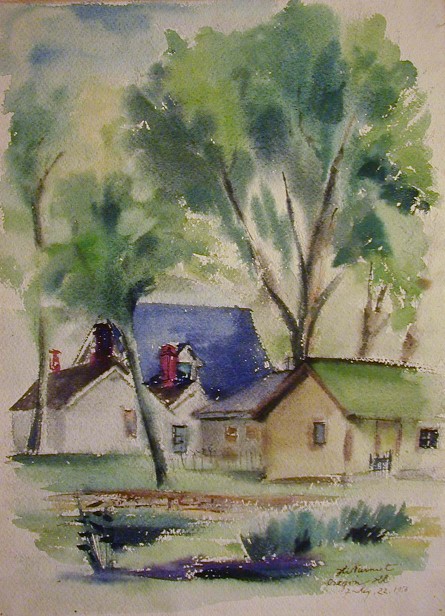
"Houses in Oregon, Illinois", Harry Nurmet, 14" x 10", watercolor, 1950
Harry Nurmet was born in Tallinn,
Estonia on 25 April 1909. He and his wife immigrated
to the US and settled in Oregon, Illinois in 1950, the
same year that this painting was created. Nurmet founded
the Eagle's Nest Artist Group in 1957, commemorating the
Eagle's Nest Artist Colony that had prominent members
including Lorado Taft. Nurmet is a very interesting man
and there is a great deal of information available about
him. I am in the process of compiling a biography for this
web site.

There was a one man show of Mr. Nurmet's work as late as 2007. Mr. Nurmet inscribed his signature, address, year, and the title of this painting across the back of this painting. The glass over this painting was thickly covered in dirt on both sides of the glass and it appears that there is a bit of water damage on the right middle along with a couple of spots of foxing, but it is still a very attractive watercolor and interesting because it must be one of his earliest works done in America. Harry Nurmet, wife Linda, and son Maert, aged 10, arrived in New York City on 15 May 1950 on the ship General R. L. Howze. Their destination was Washington St., Oregon, IL, the address on the back of this painting.

unnamed, Harry Nurmet,
10" x 14", watercolor
Harry Nurmet died 28
December 2009, in Plano, Texas.

Harry Nurmet

unnamed, Walter A. Mazeski, 14" x 11", watercolor, 1981
Walter Adolph Mazeski was born 28
July 1909 in Globe, Arizona the son of Russian/Polish
immigrants, John and Josephine "Josie" Mazeski. John
Mazeski was born in Poland about 1876 and immigrated to
the US in 1903. Josie was born in Poland about 1883 and
also immigrated in 1903. Both became naturalized citizens
in 1917. John Mazeski moved his family from Globe,
Arizona, where he worked as a copper miner, to Chicago,
Illinois about 1911 where he worked as a tinsmith in 1920
and 1930. Walter married Casimira J. Sajewski on 17
November 1943 in Chicago, Illinois.
Walter Mazeski attended the Art
Institute of Chicago (AIC), probably in the late 1920s and
early 1930s. He studied under Charles Schroeder, Francis
Chapin, Charles A. Wilimovsky, and Louis Cheskin. He
exhibited at the Chicago World's Fair in 1933. He took
high honors at the Federated Polish Artist Societies
Exhibition in Milwaukee in 1936. Sometime in 1936 or 1937
he and another painter, Norbert Czernowski, went to Poland
and traveled with the Polish army, painting many pictures.
Passenger lists record their return from Poland on the
ship Battory which left Goynia, Poland on 24 August 1937
and arrived in New York City on 3 September 1937. Mazeski
exhibited at the AIC 1937-1946, Polish Art Club 1929-45
where he won numerous prizes, and Milwaukee Art Institute
1940-1942 where he won a prize. He was a member of the Oak
Park Art League and the Chicago No-Jury Society of
Artists.
Walter Mazeski is mentioned in Poles of Chicago
by Zglenicki (1937), Who's Who in Polish America by Bolek
(1943), Who's
Who in American Art (several years), Who Was Who in
American Art by Falk, Mallett's Index of Artists,
Who's Who in
Commercial Art and Photography (1964), and Davenport's Art
Reference and Price Guide. Mazeski is described
as a painter, illustrator, American craftsman, designer,
teacher, and more. He apparently enjoyed a long and
diverse career as an artist.

unnamed, Walter A. Mazeski, 28" x 20", watercolor
The paintings in my collection were
apparently done rather late in his career and I have not
been able to find an example of his signature to compare
to the ones on my paintings. The styles of these paintings
are not very similar to the few other examples of this
artist's work that I have been able to examine, but he was
obviously a versatile artist. Earlier works of Mazeski's
that I have seen were abstract. Though the first painting
above was dated 1981, it reminds me more of an earlier
time, possibly the 1940s or 1950s.

"My son the musician", Walter A. Mazeski, 14" x 20", watercolor, 9/1964
At first glance the painting above
seemed childish and amateurish to me, but after a second
glance I realized it is very well done, just a bit
surreal. I was able to contact Mr. Mazeski's son, but
neglected to ask him if he was the subject of this
painting.

"West Bay Ont. Canada
7-77", Walt Mazeski, 14" x 18.75", watercolor, 1977
I was able to contact a former
student of Mr. Mazeski's, Juliet Cristensen, who told me
that she took night classes from him in the 1980s. She
remembers Mazeski as a fun person, very likable, with a
good sense of humor. He was fond of martinis, but had
diabetes so could not have them whenever he liked. He was
inspired by an artist who painted South West scenes,
though she could not remember the name of the artist.
Mazeski learned a style of watercolors from this artist
that used orange undercoating. Mazeski exhibited work at
some of the same shows as Ms. Christensen. Mazeski was an
inspiration to Ms. Christensen and she later became an art
instructor, too.

unnamed, Walter Mazeski,
14" x 19", watercolor
Mazeski died on 24 March 1989 at Mt.
Prospect, Cook County, Illinois. His wife, Casimira, died
there in March 1996.


Examples of Mazeski's signature

"Farm on Algonquin Road", Malcolm Mlodoch, 20" x 24", oil
Malcolm Mlodoch is a Des Plaines,
Illinois artist who was born about 1964. He creates art in
numerous mediums and styles from oil paintings to
sculptures to molded art. He is president of Artists Inc.,
a Chicago based custom art studio, and also works for a
museum exhibit company. He has 25 years of experience
working with museum exhibits; creating murals, dioramas,
and models of all kinds. He learned to create art "on the
job". The painting above he says is in the plein aire
style of the French Impressionists of the 1870s, a style
he is particularly fond of. The farm in this painting no
longer exists and this land has been converted into a
miniature golf course. I believe the Malcolm also created
the frame that this painting came in. The frame is heavy
wood, probably oak, and painted black, so heavy that I
used two hangers to hang it even though it is not a large
painting. I like this one very much. I had been keeping my
eye peeled for a typical Illinois farm scene in this style
and was taken by this one as soon as I saw it.


unnamed, Irene Selonke, 14.5" x 10.5", watercolor
Irene Augusta Riese Selonke was
born 4 September 1910 in Chicago, Illinois. She was a
painter, illustrator and teacher. She may have been the
daughter of Theodore Frederick Henry and Anna Riese who
appeared in the 1910 and 1920 Cook County, Illinois
censuses. Theodore's occupation was "artist, commercial"
in 1920 and "artist, mechanical" in 1910. His 1918 WWI
draft registrations gives his occupation as "artist, self
employed" and birth date 24 December 1875. Theodore was
the son of Theodore and Augusta Riese who were in the 1900
Cook County, IL census. Theodore Jr. was living with his
parents in that census, occupation "artist". Irene moved
to Johnson County, Kansas where she spent much of her
life. She lived in Leawood and Kansas City.
Irene attended the Art Institute of
Chicago, Kansas City Art Institute, and studied with
Joseph Fleck in Taos, New Mexico and Olga Dormandi in
Paris, France. She exhibited widely including National
League of American Pen Women exhibitions (four awards,
1962-69), of which she was a member and state art chairman
1971-1972. She also exhibited at the Council of American
Artists and Greater Kansas City Art Association (five
awards, 1962-68). She won the Pikes Peak National Award in
1972. She is mentioned in Who Was Who in American Art by Falk,
Who's Who in
American Art (multiple years), Biographical
Dictionary of Kansas Artists active before 1945
by Susan V.Craig, An Encyclopedia of Women Artists of the
American West: A Biographical Dictionary by
Kovinick, Missouri
Historical Review 1956, and Women Artists in
America: 18th Century to Present (1780-1980) by
Collins. Her work as an illustrator included Modern Handcraft Magazine,
Workbasket Magazine,
and Workbench Magazine.
Selonke died in Kansas City on 17 July
1978. She was married to Elmer Frank Selonke who died in
1977. This painting has a metal gallery or exhibition tag
attached to the frame. I have not removed the backing so
it is possible that it is titled verso. It was purchased
from a dealer in Kansas City, MO. I love winter scenes.


"Killdeer", Henrietta H. Tweedie, 6" x 8", drypoint engraving with watercolor, 2/15
Henrietta Herndon Tweedie was born
28 May 1923 in Springfield, Illinois, the daughter of
Richard Fleetwood and Henrietta Robinson Herndon. Her
father was a physician. Tweedie worked in watercolor and
ink drawings, watercolor enhanced drypoint engravings, and
etchings. She received a BA from Smith College in 1945 and
also studied at the Springfield Art Association, Morton
Arboretum, and DuPage Art League. Henrietta first married
a man named Kestner, and second married Edwin Clarence
Tweedie. She worked extensively as a botanical illustrator
which work included several books about native Midwest
plants. She exhibited her work at the International
Exhibitions of Botanical Art and Illustrations, and was
listed in Guide
to Exhibited Artists, 1985, where she is
described as an "American Printmaker, Draughtsman", media
"Etching, Drypoint; Pen and ink". I have also seen
references to her as a watercolor artist. She is mentioned
in Art in
America, 1987. Her work is included in the
permanent collection of the College of DuPage. She is a
member of the DuPage Art League, Wheaton, IL. I have seen
references to her work as an art teacher and suspect that
she taught at the DuPage Art League, among other places.
She also seems to have worked extensively as a public
speaker and presenter at numerous environmental
educational events. She exhibited in Illinois at the
DuPage Art League, Fermilab Morton Arboretum, Wheaton
Public Library, Chicago Botanical Garden, and in Michigan
at Fernwood Arboretum, Gillette Nature Center, Kalamazoo
Nature Center, and The Dunes Gallery in Pentwater.
This etching is labeled in the artist's
hand under the image, from left to right, title, number,
and signature. The killdeer is one of my favorite Illinois
birds, so it was a pleasant surprise to find this etching,
especially as it had such a limited printing. I really
love this one, so I took it to work, as I am there so much
:o( and placed it so that it is not in my immediate line
of sight. I constantly "rediscover" this one, and give a
little mental squeal of joy each time I do.


unnamed, Teddye Jo Davis, 16" x 20", oil
Teddye Jo "T.J." Davis was born 10
December 1939 in Littlefield, Texas, the daughter of Joe
W. and Fern Elms Bitner. She was a designer, interior
decorator, and artist. T.J. attended Texas Technical
College, now Texas Technical University, where she studied
art or decorating. She worked as a secretary and was a
self employed interior decorator in Ft. Worth, Texas
before relocating to Peoria, Illinois where she also
worked as a secretary and decorator. She was a member of
the Illinois Art League and continued to train as an
artist for many years.
I originally bought this painting
at a thrift shop about 50 miles from my home
for $6, with the intention of reusing the frame. I often
stop at this shop on my way to or from one of my favorite
hiking spots. The frame is dark green and nicely detailed.
The framing was obviously professionally done and on the
back was taped a business card for "T. J. Davis, Custom
Decorating, Consulting, Accessories" and a telephone
number. The painting itself bore the monogram
"TJD". I happened to have a blank spot on the
wall opposite the head of my bed where the morning sun
shines, bare basically because I did not want to subject
one of my watercolors or nicer oils to solar bombardment
every day. Since this was ready to hang and not precious
to me at the time "bang!" up it went, until I found a
candidate for the frame. After a few weeks of waking up to
this colorful painting I really started to like it, and
also enjoying a good mystery, I decided to try to find out
who the artist was.
I have decided to keep this painting
and close the blinds to the morning sun. I managed to clip
a bit off of the right side of this painting when I
photographed it. The painting actually shows all of the
window framing and a bit of the wall on the right side. I
will get a full image when I can.
Teddye Jo Davis died on 15 November
2004 at Dunlap, IL which is very near to Peoria. Her
obituary appears in a Fort Worth, Texas newspaper.


"Deep Summer Woods", Charles MacMillan, 21" x 14", watercolor
Charles Wight MacMillan was born 2
August 1902 in Denver, Colorado a son of Charles Asa
MacMillan, a Denver attorney, and his wife Ann Wight. Ann
was the daughter of prominent Colorado pioneer Frederick
Dearborn Wight. MacMillan's first real experience east of
the Mississippi was when he matriculated to Dartmouth
College in Hanover, NH in 1921 where he received a BS in
Sociology in 1925. After graduating he moved to Pampa,
Texas where he ran an auto repair and tire business with a
friend. MacMillan then enrolled in the Colorado School of
Mines for one year before enrolling at MIT. To finance his
education at MIT he sold a patent he held for automatic
chokes for automobiles. He may have worked for the
Civilian Conservation Corps during the Depression, but by
the mid to late 1930s he started to work as an automotive
engineer for Kent Moore in Detroit. He met his wife, Helga
Elizabeth "Sally" Sahlmark through friends in Grand
Rapids, Michigan. Sally later became a very prominent and
pioneering woman artist in the Quad Cities in Illinois.
The Rock Island Art Guild, which she founded with others
in 1955, established the "Sally MacMillan Watercolor
Award" in 2003 in her honor. A website
honoring Sally's work and life, SallyMacMillanArt.com, is
maintained by her son.
Charles W. MacMillan was drafted into
service during WWII and worked at the Army Ordinance
Department in Washington, D.C. where he attained the rank
of Colonel. He was responsible for vehicle safety for all
Army military vehicles. After the war, in the summer of
1945, the MacMillans moved to Florida where Charles worked
as an engineer and also started his own company. Having
received an offer from Bear Manufacturing, an automobile
safety company, in 1950 the family moved to Rock Island,
Illinois. MacMillan retired as Chief Engineer there in
1971. Mr. MacMillan held many patents related to
automobile safety. Already possessing some artistic
ability due to his skills as a draftsman, and spurred by
his wife's interest in art, MacMillan started to paint in
watercolors. Their children well remember many painting
expeditions on which they accompanied their parents.
The painting in my collection is one of
the most well documented paintings that I have seen. It
was awarded an "Honorable Mention" at the 1957 Quad Cities
Art Exhibition, which was hosted by the Davenport Art
Gallery, now known as the Figge Museum in Davenport, Iowa.
Taped to the back of the painting was the gallery label,
the award certificate, the letter to Mr. MacMillan
announcing the award, and a local newspaper article that
shows the painting hanging in the home of the owner, Mrs.
O'Malley. The MacMillan family often visited Colorado and
Mr. MacMillan's son told me that he suspects that this
painting was probably inspired by a Colorado memory.
Charles Wight MacMillan died on 13
September 1992 in Rock Island, Illinois. Sally died in
2006.


"Salt Creek Impressions", Alla Jablowko, 5.5" x 11.5"

unnamed, Alla Jablowko, 6.5" x 10", watercolors
Alla Jablowko was born in 1929 in
Leningrad, Russia. Her family moved Germany as a result of
WWII and came to the US in 1951. She received
a Masters degree in biology from the University of
Chicago in 1955. She developed an interest in watercolors
and took classes with Zoltan Szabo, Frank Webb, Nita
Engle, Barbara Nechis, Jeanne Dobie, and others. Ms.
Jablowko cites Ms. Dobie as having the greatest influence
on her. She is a signature member of the Transparent
Watercolor Society of America, member of the LaGrange Art
League, and a signature and life member of the Illinois
Watercolor Society. Her works are part of numerous private
and corporate collections as well as that of The Elmhurst
Art Museum, Hinsdale Center for the Arts, and Union League
Club of Chicago. Ms. Jablowko began teaching watercolor
painting at the LaGrange Art League in 1987 and is still
active there.

"Salt Creek Bluffs", Alla Jablowko, 7.5" x 9.5"

"A Place to Picnic in a World of Pain", Herb Eaton, 18" x 24", oil
Herb Eaton was born in 1949 in
Peoria, Illinois. He received an MFA in sculpture and
drawing from Illinois State University in 1974. Herb was a
student of Harold Gregor and he and his wife operate a
gallery around the corner from the Gregor Gallery in
Bloomington, IL. See Herb's web site for
more of his work. He is listed in Davenport's Art
Reference and Price Guide for his work as a
sculptor. To date he has preferred to not exhibit his work
in other galleries outside of Bloomington.
The place in this painting is real and
Herb and his wife do picnic there. I don't want to give
away their spot, so I will just say that it is somewhere
in McLean County, Illinois.....

"Stormy Morning", Herb Eaton, 18" x 36", oil on board

unnamed, Walter M. Johnson, 24" x 18", oil
Walter Miller Johnson was born 5
April 1913 in Brooklyn, New York the son of Walter M. and
Emma L. Miller. His father was a clerk in an insurance
office and the family resided in Woodhaven, Queens, NY in
1920 and 1930. Miller attended the Pratt Institute (BFA),
New York University (MA), University of Colorado (MFA Art
Education), and New York School of Design (MFD). Miller
became a professor of Art and Architecture at the
University of Illinois in 1947, and was head of Extension
of Visual Arts starting in 1964. He was married to Mildred
Spitler on 19 June 1949. She was a U of I graduate and
associate professor of Social Work at the U of I. Miller
was active in state and national educational art
organizations. He was an artist in oils, watercolors, pen
and ink, and pencil. He was active in promoting art
education on television.
Miller is mentioned in American Artists of
Renown 1981. He died on 4 January 1998 in Urbana,
Champaign County, IL where his wife died on 23 February
2008. Both of the paintings in my collection came from the
estate sale of his widow.

unnamed, Walter M.Johnson, 9.5" x 6", watercolor

"Winter Stacks", Mike McNeil, 16" x 20", acrylic on canvas
Michael McNeil is a Bloomington.
IL artist who works in oils, acrylics, chalk, pencil, and
markers, sometimes in mixed medias in a single piece. Mike
was an art major with an emphasis in painting at Southeast
Missouri State University and obtained an MA in art at
Washington University in St. Louis. Mike's artist
statement says in part:
"It took me three moves to
Bloomington from other parts of the country before I
saw the beauty here. Now my goal is to process what
others might find ordinary into my version of
extraordinary. To see and show beauty where it
is not readily apparent. I paint form life and
memory augmented by photos taken as I drive around the
countryside. I try to do several paintings
concurrently, all with the same theme and palate."
This painting
was done in a field outside of Towanda, IL.

"Self Portrait", May Jones Perkins, 19.5" x 16", oil on canvas, dated December 1954
May Jones Perkins was born 1 January 1920
in Hanover, New Hampshire. She is an artist in clay,
steel, stone, wood, yarns, watercolor, oil, and acrylics.
She worked as a teacher, illustrator, painter, and costume
designer. For many years she taught in schools in Normal,
Illinois. She holds Diplome of L'Ecole A.B.C of Paris,
France, a BFA from Illinois Weslyan University, M.A. from
Illinois State University, and a State of Illinois Special
Certificate - Art. She also studied at the New York School
of Applied Design for Women, MacDowell School of Fashion,
and The Art Student's League. She was the author of A survey of public
school art education in six Swiss cities, 1965,
Illinois State University.
Her artist's statement says in part "My
style varies according to the demands of the media..
watercolors run into landscapes and flowers; oils and
acrylics from realistic (including portraits) to
non-objective or experimental. Art, for me, is a way of
communicating and sharing my love of nature with others,
whether it be teaching or creating. Oriental simplicity,
light, and color are very important elements of my work.
These paintings from my collection are
a good example of her portrait and landscape work. Ms.
Perkins is still living at this time, though retired. She
is one of a surprising number of talented artists that
live and lived, working in the Bloomington/Normal,
Illinois area.

"Woman in White", May Jones Perkins, 23" x 19.5", oil on canvas
I call this one "Woman in White".
Mrs. Perkins did not remember if she had titled this
painting when I asked about it, nor did she remember who
the model was. I have this in my living room where it
replaced another portrait in my collection by Kay
Darville. The Darville painting is dark and seemed to suck
all of the light out of the room. This painting is in the
original white painted wood frame and once hung, the whole
room seemed immediately brighter. This is one of my very
favorite paintings.

"Cynthia sitting", May Jones Perkins, 23" x 19.5", oil on board, 1956-7
This is a painting of May Jones
Perkin's daughter, Cynthia. She was a graduate of Indiana
University and was the wife of an evangelist. She died of
malaria in Lagos, Nigeria in 2002. She would not quite
have been a teenager when this painting was done. I am
especially fond of this one, too. I actually worry about
what will happen to these two when I am gone. Will they be
appreciated as much by their next owner? Will they be
separated? Sigh.

"Cat", May Jones Perkins, 12" x 9" x 12", sandstone
This is a small example of Mrs.
Perkin's sculpture work. This is the only example that I
have seen. When I visited her in 2008, this was in her
living room on the floor, next to a chair. She incised one
of the three "signatures" that she used during her career
on the back. When she downsized her apartment, after the
death of her husband, and in preparation for moving to
Chicago in April of 2009, she consigned this piece to a
local antique shop where I purchased it. I met with her a
few days later to get the particulars about this
sculpture. I am a cat person, and fell in love with this
one the first time I saw it.


"MJP" Monogram used by Perkins on multiple media
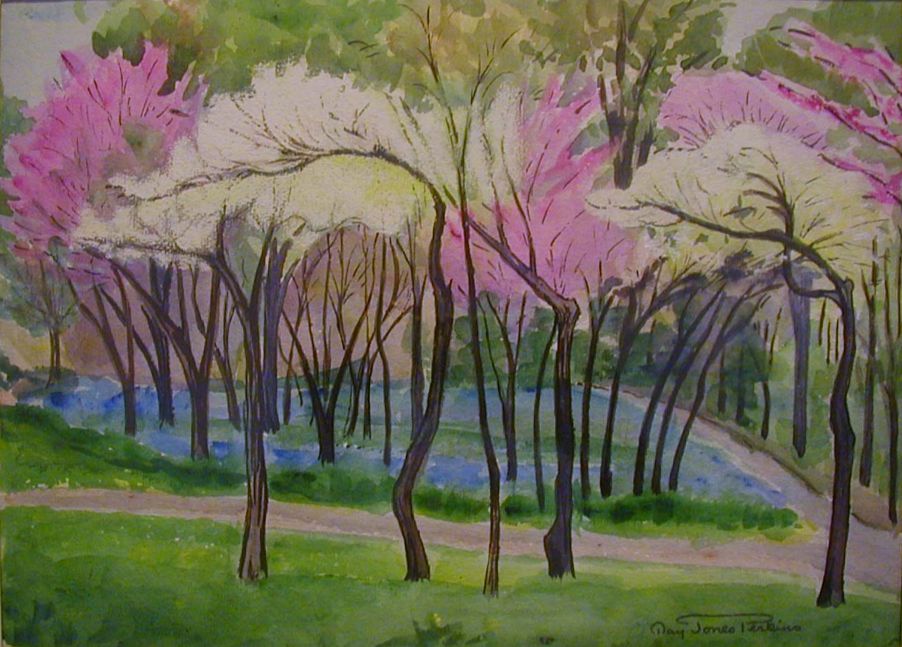
"Spring at Ewing Manor", May Jones Perkins, 9" x 12", watercolor and acrylic
Ewing Manor is a local landmark and
consists of a theater, Medieval style conference center,
park, and various style gardens. A nationally known
Shakespeare festival is held there annually. This painting
bears Perkins' full signature.
May Jones Perkins, full
signature
Mrs.
Perkin's signature changed so many times that she actually
devoted a whole paragraph to these signatures in one of
her artist statements. In addition to the two signatures I
described above, she also just used her initials, M.J.P.,
on some pieces. She noted that she tended to use just her
initials on block prints. Though her artist's statement
said she used specific signatures for specific types of
art, I have found all three used on paintings.

Bowl, May Jones Perkins, 8" x 3", ceramic
Above is an example of her pottery.
This piece is among the art pieces she retained for
herself, before downsizing to move to a retirement
home in Napierville, IL in April 2009. I would guess
it must have been a particular favorite.


This is actually part of a
set of two pieces. The second piece looks nearly
identical, but is uniform beige in color,
unsigned, and designed to be used as a lid for
this piece.

"Picture Window",
May Jones Perkins, 20" x 27", oil on canvas, 1957
This is another piece that came from Mrs. Perkins
downsizing efforts before moving to an assisted
care retirement home. This painting is of her
mother, Yvonne Jequier Jones. When I first visited
her at her retirement apartment, this painting was
hung in her living room above her sofa. Being a
real color junkie I like this one very much. When
I first saw it, I had no idea that it would one
day hang on my wall. This was painted while she
was living with Richard and May Jones Perkins in
her later years. This was displayed at the
consignor's next to another painting by Perkins
that received a lot of attention while this one
was somewhat denigrated by the shop owner ("Oh,
that thing!"). The other painting, obviously
another favorite of Perkins as it was also a
victim of her downsizing, was pleasant, colorful
and impressionistic of a chair table and lamp, but
I found it very conventional and lifeless compared
to this painting. It did sell quickly and several
offers were made for it, so it could just be my
taste. I would call this painting a good
example of a Mid-Century Modern style painting.
While it might seem rather garish to today's
tastes, it embodies the spirit of art created at
that time. This is not my favorite era of
painting, but the colors remind me of the
colors prominent in art glass of that period.

"Mother", Yvonne Jequier Jones, 11" x 14", pencil and watercolor, March 1908
Yvonne Marguerite
Jequier Jones was born 13 December 1884 in
Neuchatel, Switzerland a daughter of August
Jean Jequier and Berthe de Pierre. Her father
was a banker. She attended the Academie de la
Grande Chaumiere. She was a correspondent of
American author Katherine Butler Hathaway and
art school friend of Irish artist Cesca
Chenevix Trench (AKA Sadhbh Trinseach). Yvonne
was a professional artist and illustrator in
France and Switzerland. I found several
mentions on the Internet of her work in
Switzerland as an illustrator. She met Leonard
Chester Jones while he was working for the Red
Cross in Switzerland during WWI and they were
married on 20 July 1918. They were the parents
of May Jones Perkins. This drawing was also
part of Mrs. Perkin's downsizing. This is a
drawing of the mother of Yvonne Jequier Jones.
The watercolor is very subtle and only on the
face. I disassembled this drawing from the
frame in order to replace the backing with
acid free backing and discovered that the
drawing had been taped around the edges to the
thinnest piece of wavy old glass that I have
ever seen. It is only as thick as perhaps 4 or
five sheets of paper and is also somewhat
bowed. The light border around this drawing is
from where the tape protected the drawing from
the backing. The darkening was caused by the
backing. Still a very striking drawing. How
long Yvonne Jequier worked as an artist is not
known. Yvonne Jequier Jones died in
Bloomington, IL on 4 June 1978.

Among the items that
also went to an antique shop for consignment
were two very fine pencil drawings of the
grandparents of Yvonne Jequier Jones, done
by her mother, Berthe de Pierre Jequier.
Apparently artistic talent ran in this
family. The drawings are the same size, it
is my photos that differ in size.


Grandparents of Yvonne Jequier, drawn by her mother,
Berthe de Pierre Jequier

"Fall Pasture", Tracey Frugoli, 24" x 36", oil on canvas.
Tracey Frugoli is a Central Illinois artist, but she is starting to be noticed more nationally. Tracey is a trained artist, and received her Bachelors of Fine Art from Illinois State University, and, a Masters in Art Therapy from Southern Illinois University.
I
really like the Fall and "Fall Pasture" conveys what an
Illinois Fall feels like to me. It is the first of
Tracey's paintings that I purchased and I schmoozed for
quite a while before deciding on this one. She paints in
several styles, plein air, impressionist, etc., but
considers her work to be in the American Impressionist
tradition. Fall Pasture is a bit different than her
normal style, IMHO. "Fall Pasture" was painted while
Tracey was staying near the Eagles Nest Art Colony in
Ogle County, Illinois. Tracey and her husband were
lodged with a local farmer during their stay, and this
field is on his property. She has been dating her work
for the last several years, but this one is not dated. I
suspect it was probably painted in 2001-2. I'll have to
ask her.

"A Little Spring Reading", Tracey Frugoli, 14" x 11", oil on linen on board, 2006
"A Little Spring Reading" was
painted in 2006. It is interesting to see how her work is
changing. I love it all, though. This image is a bit dark.
Much more detail is visible in the dark spots, like the
hand holding the book. All of the tulips in that hand are
visible when you are standing in front of the painting.
The sense of luminescence seen in her wrap is not
diminished, though. Very nice.

"Santa Fe Stairway With
Stealth Cat", Tracey Frugoli, 8" x 6", oil, 2009
I love
the light and color in this piece. I like the way she
sneaked a cat into the painting. She and her husband,
Ed, are real cat people, like me. Tracey has a great
eye for what a friend of mine calls "micro-views".

"Sleepy Kitty", Tracey
Frugoli, 8" x 10", oil, 2007
I looked at this painting for
several years on Tracey's web site, before seeing it at
an exhibition in 2010. It looks so much better in
person, that I arranged to buy it on the spot. The
colors are richer, and the effect of the light is much
more striking than this image shows.

"Little Colette", Tracey Frugoli, 6" x 8", oil on
linen on wood panel, 2007
This is another painting that I
dithered over for several years, but was slow to let
Tracey know I was interested. Luckily, I was attending
a local show where she was exhibiting and this
painting was being offered, unframed, at a bargain
price in a pile of sketches. Fortune was smiling on me
that day. I really like the colors and composition in
this painting and the bit of effort it takes to absorb
it. This one grew on me over time. I put it in a very
minimalist wooden frame that subtly complements
the browns in the painting.

Henry Hulsmann is often
misidentified as "Howard" Hulsmann a "California
artist". He was a German-American artist who was active
from about 1890 until around 1930 in Chicago, Illinois
and the vicinity, though, according to his great
granddaughter, he did travel to California to paint at
some point. He is mentioned in Davenports Art
Reference and Price Guide and in
www.askart.com's "The Artists Bluebook". His clouds and
the way he painted ruts in dirt roads are very
distinctive, and I have seen this repeated in several of
his works. This artist consistently dated his oil
paintings with the year that they were painted, which
makes it possible to have a good idea of the period in
which he was active. Works dated from the late 1890s
through the late 1920s are extant. The artist's style is
distinctive which further aids in this identification.

Henry Hulsmann and daughter Lillian Miller
This artist is often identified
as h. Hulsmann, L. Hulsmann, H. Hulsmann, Howard
Hulsmann, etc. It is likely that in most instances this
was actually one of two artists, either Henry Hulsmann,
or his daughter Lillian B. Hulsmann who was born in
Illinois in 1885. It is important to note that
Hulsmann's signature changed little over time. The way
that these works are signed is very distinctive,
“Hulsmann” in block letters, with a thick line coming
from the last “n” and extending back under the surname,
usually ending under the letter “m”. They are
occasionally also signed “HuLsmann” while still
including the thick line. The signature is usually
followed by the year, followed by a period (“.”). The
artist used their first initial, a capital "H", and
perhaps also a lower case "h", that may be mistaken for
a capital "L". It is also possible that this actually
was a capital "L" and the signature of Lillian Hulsmann.
To support this identification, no other man or woman
named Hulsmann was listed as an artist in any Federal
census during the time that this artist, or artists,
were active. Though “Howard” Hulsmann is sometimes
identified as a California artist most of these works
have surfaced in Chicago and the vicinity.
Most of the information about
Henry and Lillian Hulsmann to date comes from Federal
census and Illinois state records and Henry's great
granddaughter, granddaughter of Lillian Miller. Henry
Hulsmann was born 1 February 1849 in Germany, a son of
Cord Hulsmann, and died 26 March 1930 in Belvidere,
Boone County, IL. His death is recorded in the Illinois
statewide death index. He appears in the 1900-1920
censuses of Chicago, Cook County, IL. His occupation in
all censuses is given as "Artist" and in the 1910 census
it was given as a self employed “Artist, Landscape”.
Hulsmann was apparently successful as an artist as he
owned his own home by 1900. What complicates the
identification of his work is that, in the 1910 census,
Lillian B. Hulsmann is living in her father's household
and is also listed as an "Artist, Landscape". This is
the only census in which she is thus occupied and by
about 1914 she was married to Otto Miller, a
refrigerator salesman, who later became a doctor.
Lillian continued to work as an artist after 1910, into
her 70s, according to her granddaughter. She did not
sign her work "Hulsmann" after her marriage, though she
likely may have before then. The question is then, were
some of the paintings now extant done by her, in her
father's style, and similarly signed? If so, she copied
his style very closely. She may be traced in Federal
census records in Cook County, Illinois from 1900-1930.

Henry Hulsmann, artist
Census records indicate that
Henry Hulsmann emigrated to the United States in 1868
and became a naturalized US citizen in 1895. I have been
unable to locate him with certainty in the 1870 or 1880
censuses. All censuses show that he could read, write,
and speak English. He was married to Albertina Glende,
daughter of Louisa Glende, 24 March 1878, and their
first child, Cord F., was born in January 1883 in
Illinois. Albertina was born in Germany in May of 1851
and died 12 January 1932 in Berwyn, Illinois. Both
photos shown here are courtesy of Muriel Johnson,
granddaughter of Lillian B. Miller.
He was born in Germany, Feb. 1, 1849 and came to this country when 19 years old and located at Baltimore where he lived for a short time. He was married in Clinton, Ia., March 24, 1878 and after about a year the family removed to Chicago. Later they made their home in Oak Park and Elmhurst prior to coming here about a year ago.
There survive the widow and two daughters, Mrs. R. C. Lamm of Maywood, and Mrs. O. H. Miller, of this city and five grandchildren. A son died 13 years ago and two daughters died in childhood.
He was a member of the Immanuel Lutheran church.
Funeral services will be held at the home, 101 South State street, on Friday forenoon at 10 o'clock, the Rev. F. E. Gohlke officiating and burial will be in Concordia cemetery at Forest Park.

unnamed, "Lample", 13" x 16", oil on canvas
Lillian Bertha Hulsmann was born on 25 October 1885,
probably in Chicago, IL, a daughter of Henry and
Albertina Glende Hulsmann. She married Otto Miller
about 1910 in Chicago. Her occupation in the 1910
Chicago census was a self employed "artist,
landscape". There is a great similarity between her
work and the work of her father, Henry Hulsmann, a
prolific Chicago artist, so it seems likely that she
was his student. Differentiating Lillian's work from
that of her father is difficult, when she signed
using her maiden name. Much of the information about
Lillian comes from her granddaughter:
Grandma
was born on Oct. 25, 1885 and died on August 8,
1966. I am not sure where she was born, but
think it probably was in Chicago. Her middle name
was Bertha. She didn't choose the name
Lample. She painted for a wholesale house in
downtown Chicago. I used to go there, when I
was little with my mother, to deliver her paintings,
but can't remember the name of the company.
They were the ones that chose the name Lample.
She sold pictures to them for many years, and also
sold to private parties under her own name. I
just checked with my brother, (name removed), and he
remembered that the company wanted her to have a
fictitious name so customers wouldn't buy direct
from her.
Lillian worked as an artist in Illinois from the early 1900s into the early 1960s. She painted under the names Hulsmann, Miller and Lample. Much of the work retained by her family is signed "L. Miller". Her work appears to have been mainly landscapes, using oils on canvas. She worked both independently and for a Chicago based wholesale business. There is no record of exhibitions of her work. She is likely the artist "Lample" who is listed in Davenport's Art Reference and Price Guide and could also be the "L. B. Miller" listed in that reference.
Lillian B. Miller died on 8 August 1966 of a heart attack at Elmhurst Hospital in Elmhurst, IL.


"Memories of a Pond", Jeff Little, 4"x 6", gessoed oil on paper.
The depth of detail and color are
amazing for such a tiny painting. Jeffrey
A. Little is a Bloomington, Illinois artist.
He does works of all sizes and his subject is
usually Illinois landscapes. This pond is near his
grandparent's farm in Charleston, Illinois. Jeff was
a student of local artist Harold Gregor.

"Fall Pasture", Jeffrey A. Little, 7" x 10", oil on paper
I like Jeff's work a lot, and
really liked this one when I saw it. I had recently
purchased another painting called Fall Pasture and
when I saw that this one had the same name, I took
it as sign to buy it, even though I was still paying
for the first one. This site is off of I-74 between
Bloomington and Peoria, Illinois, just south of
Goodfield. Jeff told me that this was the bluest sky
that he has ever painted.

"Salty's Creek",
Jeff Little, 12" x 16", oil
This painting is after a
painting by Omer "Salty" Seamon, an Indiana artist
who was a friend of Jeff's. Jeff visited him one day
at his home in Terre Haute, Indiana and Salty
proceeded to pull art out of every nook and cranny,
60 years worth, and let Jeff pick one to take home.
Jeff picked the one that this painting is after.

"Ode to Samuel Palmer", Jeff Little, 9.5" x
13", oil on clay tile

"Mackinaw River",
Jeff Little, 9.5" x 13", oil on clay tile
I
like that Jeff sometimes uses non-traditional media,
like these clay tiles.

unnamed, Susan Palmer, 4" x 6", pen and water color.
Susan
Palmer is another Bloomington, Illinois
artist. She does impromptu pencil and ink
sketches of every day scenes as they happen.
When I saw this painting, it reminded me of my
late best friend, Gabriel.

"Hydes Ranch", Harold Gregor, 5" x 7", watercolor, 2004
Harold Gregor
is a well known Midwestern artist who currently
resides in Bloomington, Illinois. Check out his web site for more examples of his
work. Gregor received a BS from Wayne State University
in 1951, MS Michigan State University 1953, and Ph. D.
Ohio State University 1960. He worked as an art
professor from 1960-1995 at San Diego State
University, Purdue University, Chapman College, and
finally at Illinois State University where he remains
a Distinguished Professor Emeritus and Adjunct. Gregor
has received numerous grants and awards and is
mentioned in Who's Who International, Who's Who in
American Art, Who's Who in Midwest America, and
Outstanding
Artists and Designers of the 20th Century
(2000).

"Thornberry Patch", Harold Gregor, 7.5" x 10", oil, 2003
The image above comes from
the slide that was included with the painting. It
does not capture the deep, rich colors and light and
shadow in the painting. I think it was taken before
the painting was varnished. I'll get a better image
when time permits. I am able to afford paintings
like this because artists like Mr. Gregor are
willing to let me "lay them away" and make payments.
Always good to ask an artist if you can make
payments if the initial price is too great for one
payment. I often have a couple of paintings on
lay-away at a time.

unnamed, Marion Miller Mullins, 15.5" x 22.5", watercolor and gouache
Marion Miller was born 2 December
1919 in Chicago, Illinois and apparently lived in Oak Park
for most of her life. She attended the Art Institute of
Chicago (AIC) from 1938 until she graduated in 1942. While
at the AIC she studied under Francis Chapin, Hubert Ropp,
and Edmund Giesbert. She submitted a painting for the 1949
Blackstone Hall exhibit at the AIC which was hosted by the
Art Institute Alumni Association (AIAA). Her painting was
not accepted for this show, however. In 2006 a large
number of her paintings and other works were purchased at
an auction in Chicago. These paintings, numerous sketch
books, and some sculptures apparently came from an estate
sale in Oak Park, IL. These watercolors had a folksy charm
and mostly depicted city landscapes, neighborhoods,
houses, etc., and some images of nuns, portraits, etc. All
of these paintings and sketch books were sold on ebay.
There were some 40-50 paintings. I purchased only the one
shown, which is somewhat different than her other works.
I was able to locate Marion in the
1920 and 1930 Illinois Federal census records. She was the
daughter of Herbert L. and Lillian M. Miller. Herbert
Miller worked as a chief bank clerk and the family lived
at 524 South Euclid Avenue where Marion also resided while
attending the Art Institute of Chicago. Marion married
Arthur S. Mullins and some of her sculptures were signed
"Marion Mullins". Marion did not pursue a career as a
professional artist after her marriage, but worked as an
art teacher in several Catholic high schools. She is
not mentioned in of the authoritative art reference books
that I have examined. I am still researching this artist.
She and her husband continued to live in the family home
at 524 South Euclid Avenue until her death on 15 March
1998. I was able to contact Mr. Mullins in early 2007 and
am currently corresponding with him in order to discover
more information about Marion Miller Mullins.

"Beyoglu Street Scene" Mineke Reinders, 16" x 20", watercolor
Mineke Reinders was born in 1956 in Westerbork, the Netherlands. She graduated from Texas A&M Corpus Christi with a BA in Art. An example of her work was published in How did you paint that? 100 Ways to Paint Your Favorite Subjects. She lives in Bloomington, IL, where her husband is a professor at Illinois State University. This painting was done in Istanbul on a recent trip by Mineke and her family. Check out her web site for more of her work.

"Two Pumps", John Mosiman, 8" x 16", serigraph
John Mosiman was
born in 1931 in Elgin, Illinois. He worked
mostly as serigraph and performance artist. Mr.
Mosiman graduated from Wheaton College, Wheaton,
IL with a BA in art in 1953 and started at
Northern Illinois University (NIU) in the Spring
of 1966 where he earned an MA in printmaking. He
also earned a teaching certificate for K-14.
While at Wheaton College he worked with
charcoals, pastels, and oils, doing mostly
landscapes. At NIU he was a student of David F.
Driesbach focusing on photo screens and hand
screens.
After completing his Masters degree Mr. Mosiman
moved to Ecuador where he worked as a missionary
for 12 years. Returning to Elgin, Illinois he
worked primarily as a musical artist targeting
mostly grade and middle schools, but also
completed numerous serigraphs, prints and pencil
drawings. He traveled with his musical art shows
to New York, Florida, California, and other
states. Mr. Mosiman's performance consisted of
using various colored chalks to create large
drawings to the accompaniment of music. He
created a series of serigraphs that were sold as
souvenirs of his performances. These are some of
his most often seen works and were not numbered
but were signed and titled. "Grand Canyon",
below, is an example of such a work along with
an example of his stamp from the back of the
work. Mr. Mosiman's work is often mistaken for
woodblock art, but he assured me that he never
worked in that medium. He did not produce these
serigraphs, himself, but contracted this work to
a local printer in Elgin.

"Grand Canyon",
John Mosiman, 6" x 8", serigraph

Mr. Mosiman was
commissioned by several northern Illinois cities
to do drawings and prints to commemorate their
sesquicentennial celebrations. These cities
included Dundee, Palatine, Deerfield, and
Wheaton. He created several numbered sets of
landscape serigraphs and also did a series of
scenes of Chicago. "Two Pumps" is an example of
a work from his numbered landscape prints. The
reproduction work was also contracted to a
printer and not done by Mr. Mosiman, personally.
Mr. Mosiman worked as an artist for 42 years
before moving on to other activities. He now
lives in Texas.
- On line appraisal service
from John Sewell well known Canadian expert on
fine art and antiques. This is a very reasonably
priced on line service from a well respected
expert. Fill out an on line form and send images
of your art objects. No need to send your art
objects through the mails. I am a satisfied
customer! Highly recommended!
- Here is a list of common British art society abbreviations.
- Images
of art works by 29,000 artists. I use this site
to compare works that I am interested in or own
to other works by the same artist. A good place
to spend some time just cruising, too!
Pennsylvania Artists Texas Artists New England Artists Other Artists
UK Artists Canadian Artists South American Artists Asian Artists European Artists
Unknown Artists Unknown Artists 1 Unknown Artists 2 Unknown Artists 3
HOME