copyright 2007-2020
I like a lot of different styles of painting. I have had an active interest in art for the past few years, and my tastes are still evolving as I learn and live with my growing collection. I do not collect as an investment but for the fun of it and to feed my enjoyment for doing research and learning. Here are some of my favorites. By the way, I am NOT the wildlife artist of the same name.
Pennsylvania Artists Texas Artists New England Artists Other Artists
UK Artists Canadian Artists South American Artists Asian Artists European Artists
Unknown Artists 1 Unknown Artists 2 Unknown Artists 3
HOME

unnamed, unknown, 9" x 12", oil on wood panel
This is
an ebay find. I am using the seller's images which show
some dirt and stains that were easily cleaned off. It is
unsigned but has a fairly uncommon color palette, so I
thought I would take a chance and see if I could
identify the artist, because it is a fairly high quality
painting. I am surprised that the artist did not sign
it, so it could be a study, though a pretty detailed
one. It is painted on a wood panel with grain similar to
that I have seen on furniture imported from SE Asia, so
it may not be a commercial art board. A sheet of brown
paper was glued on as backing.
The seller was located in Woodland
Hills, CA which is near the Santa Monica Mountains in
the San Fernando Valley, so this may be the work of a
local artist. It was placed in a nice, but somewhat
generic, re-purposed oak frame. There are signs of a
previous backing and cryptic numbers and letters on the
frame that likely have nothing to do with this painting.
I paid $98 shipped for this painting, which is much more
than I would typically pay for a painting by an unknown
artist, but the color and brush work is so bold and
confident that I couldn't resist it. Pretty sure that it
is not the work of an amateur artist. It thought it
might be the work of Karen Winter, since there are
similarities to her work, but she says it is definitely
not her work. The search goes on....


This was an ebay find from
some years ago. I am calling it a plein aire sketch.
It is actually quite striking from the proper
distance, and well done, IMHO. There is another
painting, another sketch, verso, along with an
inscription, all of which is fairly clear, except for
the name of the town where it was painted in New York.
The artist recorded that she painted this work while
spending the summer with her "Aunt Lilian". I believe
the artist's last name is Ken, but it might be Kent. I
have not been able to find an artist by either name.
The name of the town appears to be Braincliff, and I
wondered if it might actually be "Briarcliff" but
can't quite make that fit with the artist's scribble.
It is possible that it is "Briarcliff" and was
misspelled by the artist. I found several Helen
Kens in searching records on Ancestry.com who are
candidates to be this woman, but just don't have
enough information to make the identification. Help!

Inscription, verso
"Made by Helen Ken-
at Braincliff (?) , N.Y.
Spent summer with
Aunt Lilian"

Practice work, verso

unnamed, N.R (AKA Nina Hill), 10" x 14", oil on board, 1943
This was one of several
paintings offered by a North Carolina seller on ebay
in October 2013. Some were signed "Nina Hill" and some
had no visible signature, but all were undoubtedly by
the same artist. I purchased this painting, which had
no visible signature. Upon taking the painting out of
the frame, I discovered a monogram, "NR 43". My guess
would be, based on the fact that one painting was
signed by Nina Hill and dated 1958, that she married a
man named Hill after 1943 and before 1958, though the
name change could also have been the result of a
divorce. The sellers of this painting could not
remember where and when they purchased it:
"I wish I could have more to tell you, we are in our mid 70s and have been to many sales over the years. We purchased the painting approx. 15 to 20 years ago. Possibly from a sale in the Pinehurst, N.C. area. I have no idea as to time of year."
Several of the paintings were
in Art Deco frames, similar to the one on my painting.
There are a half dozen women named Nina Hill in North
Carolina in the Social Security Death Index, though
none were in the vicinity of Pinehurst. Note that the
style of the trees in the 1943 and 1958 paintings are
very similar, which may indicate that this artist's
work was mature by 1943 and that she had been working
for some time. The 1958 painting was later resold at
auction attributed as the Nina Hill 1877-1970 who is
weakly listed on AskArt.com. This attribution seems
very iffy, based on the lack of any other information
about this artist on that site or in the auction
listing. There is also no Nina Hill with these dates
listed in the Social Security Death Index. There are
several paintings at various auction houses attributed
to a British artist named Nina Hill 1877-1970 and her
work does bear some similarity to this artist's work
but not similar enough, in my opinion, to conclude
that all of these works are by this artist. Any help
in sorting this out would be appreciated!

Nina Hill monogram and date
Other works and signature examples
for Nina Hill:

unnamed, Nina Hill, 16" x 19", oil on
canvas, 1958


unnamed, Nina Hill, 10" x 14", oil on board

unnamed, Nina Hill, 10" x14", oil on board

Nina Hill signature

Nina Hill signature

"Key West Watercolors - Back Street", unknown, 12" x 16", watercolor on rag paper
This was a $10 thrift shop
find. I had forgotten to take my jeweler's loupe with
me that day and was convinced that I would find this
was a print, or maybe a very good quality lithograph,
when I got it home. I was amazed to discover that it a
was an exceptionally well executed watercolor on high
quality rag paper, and probably about 50-60 years old.
There was a framing shop stamp, verso, that dates the
painting to the 1950s. The framer, Helen Ritter
appears in several Peoria, Il city directories during
the 1950s and the 5 digit telephone number in the
stamp supports this date. Also, the two girls in the
image appear to be holding a hula hoop, which was
"invented" in 1958 and became a huge fad in 1958 and
1959. There are few other clues, though, as this
painting is not signed. There is a penciled notation
in the lower right corner of the painting that appears
to be 144, or possibly the initials of the artist. The
back of the mat bears the notation "Key West
Watercolors Back Street". My guess would be that the
title of the painting is "Back Street", but I am not
sure what the significance of "Key West Watercolors"
is, besides perhaps indicating that this is the
location of the scene. This is obviously the work of a
talented artist, but as it is solidly glued to the
mounting, if there is any more information verso, we
will never know. It may be that the framer copied
information from the back of the painting to the mat,
prior to laying the painting down. The mat was also
glued to the backing and a bit of the mat stuck to the
painting when I separated them. Any help is
appreciated.

Note lower right on painting

Notation on back of mat
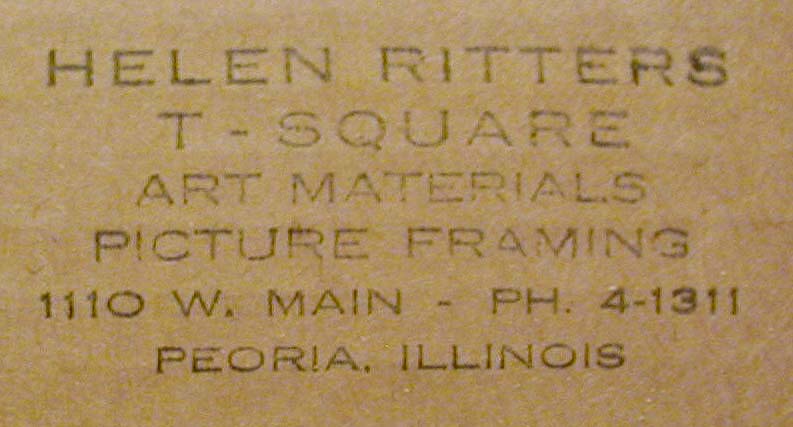
Framer's stamp

unnamed, unknown, 10" x 12", oil
I found this is a local thrift
shop and paid only about $5 for it. It was well framed
by a local frame shop that was in business in the
1950s to 1980s. There is what appears to be signature
in the lower right corner, but I cannot make it out.
It is painted on a commercial canvas board that has
been cut down to this size. The canvas board does not
have a manufacturer's mark on it. The framer, Chester
Wonderlin, advertised himself as the largest framer
east of the Mississippi River, a tongue in cheek claim
based on his 300 pounds plus weight. Probably won't
be able to find out more about this piece. I
like these kind of Fauvist, soft landscapes, which
seem to have been in fashion in the 1940s and 1950s. I
have several that can be traced to various parts of
the country, so assume that there was some movement
associated with this style.


unnamed, Williams, 14" x 11.5", oil
Don't really expect to find out
anything about this painting, but it is a bit unusual.
It is and odd size, painted on a home made canvas
glued on a thick plywood board, which may be a clue
for those who know this artist. The signature is a bit
unique, too, composed of upper and lower case letters.
I like the simplicity of this piece and the colors. It
was purchased on ebay in March 2011 from the Goodwill
Industries of Middle Tennessee.

verso

Signature
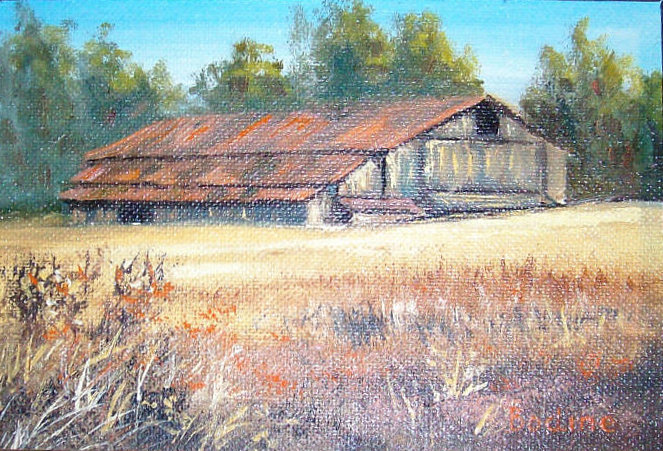
"Methow Valley Barn", Helen Bodine, 5" x 7", oil
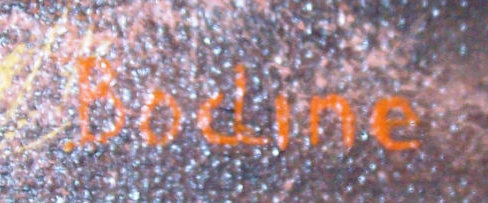
Kind of a mystery artist. I
have found a couple of other paintings by this artist,
both with Washington state roots. Methow Valley is in
Okanogan County, Washington, so my guess would be that
Bodine was a Washington State artist. The other two
paintings I have seen were mountain scenes and Methow
Valley is in a mountainous region. One auction for
another painting described Bodine as an artist who
died in 1958, but I have not been able to confirm
this.
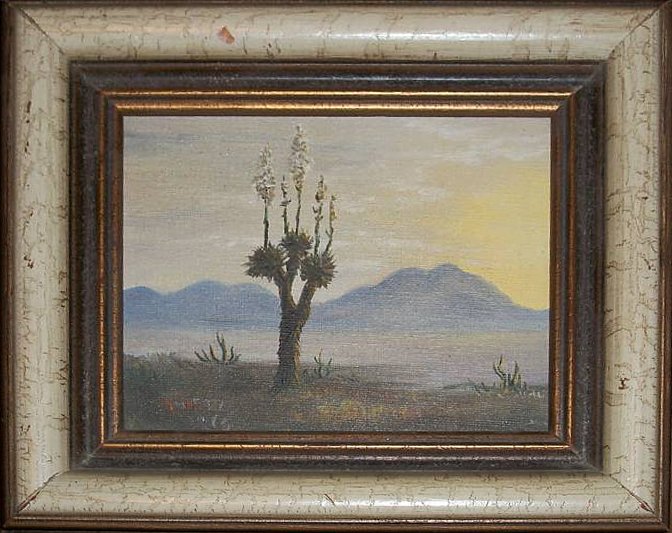
Just a nice little painting
of a yucca tree. The artist's management of light
and shadow is better than this image shows. It is
not signed and is painted on a small stretched
canvas that is stapled into the very attractive
frame with brads. I bought it knowing that it would
be a mystery painting, but really like it.

unnamed,Fizesil, 10" x 8", oil
I found this on ebay and paid
very little for it. I think it is a fairly well done
portrait, at least the face. The signature is
awkwardly signed, with the last letter of the name
wrapped around the side of the canvas. The name is so
odd the I doubted that I was reading it correctly
until I found three other mentions of the artist's
work, two figurative works of females, one identified
as a "gypsy". The subject of the third painting, from
a Swedish auction, was unidentified. The style of the
painting makes me think this was painted in the 1970s,
perhaps. The frame is a fairly interesting 1970s or
1980s vintage frame, made in Mexico. The seller was
located in Woodland Hills, California. I'll get a
better image of the painting and signature when time
permits.

"A Fall Spectacular", J. Hutson, 2.5" x 3.5", acrylic, 2010
I am generally not a fan of
miniature or ACEO-type paintings, but this one was
very nicely framed and matted, and as a package, quite
striking. It is signed, titled and dated, verso. It
was very inexpensive, as well, so hard to pass up. I
like Fall scenes and this one is very well done, with
lots of detail and nice use of light and shadow.
Unfortunately, I cannot find out anything about the
artist. Any help would be appreciated. I purchased
this from a dealer in Ipswich, Massachusetts, so this
may be a New England artist.

Framed painting

Inscription, verso

unnamed, Melodie Song, 11" x 14", oil, 1973
This was an
ebay find, purchased from a seller in Monrovia,
California. I believe it is by a California artist, as
the frame is a standard style that I have seen on
several California paintings from this period. Other
than that, there are no clues as to the history of
this artist. The name almost seems to be made up. I
have not been able to find any mention of this artist,
though I did find mentions of an alternate spelling,
Melody Song, though nothing for an artist. The Song
surname appears to be either Chinese or Korean. The
work seems to be more complex than that of an amateur,
so I would suspect that there are other works out
there by this artist. This is possibly Monument
Valley, if an actual place.

Signature from painting

unnamed, Montford, 4" x 5", oil
I purchased these two small
paintings on ebay from a seller in London, Ontario,
Canada. The bridge scene is not signed, but there is a
notation verso that says "R. D. Montford". This
may or may not have been added by the artist. The
paintings are in identical frames and well presented.

These are obviously fairly
contemporary paintings, probably painted in the past
20-30 years. The artist may be Canadian or British.
There were, and are, several active artists named
Montford, but I could find no examples of works or
signatures that were similar to these works. I would
appreciate hearing from anyone who can identify this
artist.

Montford signature

unnamed, unknown, 7" x 10", watercolor
I purchased this from a seller
who believed it to be done by a French artist. He also
believed that he had seen or owned other work by this
artist in the past, but could not remember the
artist's name. Unfortunately, it is so lightly signed
in pencil in the lower right corner that neither he
nor I could make out the signature. Just a nice little
watercolor.

unnamed, H. Harvey,4" x 6", oil
Paintings by H. Harvey are
fairly common and were produced in apparently large
quantities by this artist for the Woodstock Workshop,
as shown by the label on the back of this painting,
and several other examples of the artist's work that I
have seen. Several artists created small paintings for
this art colony, some later well known artists, and
others, like Harvey, obscure. Much of this artist's
work appears to be very crude, especially the small
works. Some of the artist's larger works, and a few of
his small works, are more well done, though I have
seen only three or four examples of these larger works
and all were in the 8" x 10" to 12" x 16" size range.
It is difficult to date this artist's work as the
Woodstock Workshop seems to have been active from the
1930s through the 1950s, but my guess is that these
works were produced in the later years of this range.

Label, verso
Paintings by this artist have been
attributed to Harold LeRoy Harvey 1899-1971. I am not
comfortable with this attribution at this time, I
actually do not believe that this attribution to be
correct, but list information for this artist as I
found no comprehensive biography for him. Harold
LeRoy Harvey was born 7 July 1899 in Baltimore,
Maryland, a son of Harry D. and Mary C. Harvey. Harry
D. Harvey was employed as "Secty. R. W. Supply Co.
Maryland, USA." in Baltimore in 1900 and as a
"manufacturer, chemical" in the 1910 Baltimore census.
Harold LeRoy Harvey completed his WWI draft
registration, giving his occupation as "commercial
surveyor" and employer as "United States government".
Harold was still living at home in 1920, and gave his
occupation as "Art Student, Oil Painting". Harry D.
Harvey was employed as a "manufacturer, Iron and
Steel" in 1920. Harold applied for a passport in 1921
indicating his desire to travel to France, Greece,
England, Spain, Italy, and Switzerland for the purpose
of "Study of Art". This application contains a
document signed by his parents attesting to his date
of birth and place of birth as 606 North Carrollton
Avenue, Baltimore, Maryland. Harold traveled to Europe
in 1922 and left Cherbourg, France when he came home.
Harold applied for a passport again in 1923, noting
that he had last applied for a passport in 1921. He
indicated his intent to travel to Portugal, Gibraltar,
Spain, Monaco, France, Italy, Finland, Germany,
Holland, Belgium, Greece, Constantinople, Palestine,
Egypt, British Isles, Switzerland, Assyria, Damascus,
Aleppo, and other places which were obscured by
binding of the pages. His objective as noted as "Study
and Travel". He appears on several passenger lists in
the 1920s. He had adopted a very stylized signature
which he used on his passport applications. I do not
know if he continued to use this signature. His
applications also included a photo, though the 1921
application photo was very poor.


Passport photo and
signature
Harvey is listed in Davenport’s,
Who’s Who in
American Art, Who Was Who in American Art,
Fieldings, etc. He was an illustrator, painter,
photographer and designer, though perhaps best known
as a photographer. According to Falk, Harvey studied
at the Pennsylvania Academy of Fine Art where he was a
pupil of McCarter, Despujols, Baudouin, Turner, and M.
Denis. I have read that he was an assistant to Man Ray
from 1920-1923, but have not been able to confirm
this. If true, this likely took place in Paris,
as Ray relocated there in 1921. This claim does not
really fit well with the extensive travel plans noted
in Harvey's passport applications, so I expect the
truth is somewhere in between. I have also read that
he was interested in experimental printing, and
developed "777" liquid film developer and several
toners. He later founded the Harvey Chemical Company
in New Jersey, but his Social Security number was
issued in Maryland in the early 1950s.

unnamed, unknown, 16" x 20", oil
This was an ebay find. I can't
decide if it is amateurish or if it is sophisticated
in its simplicity. Maybe I was simple for buying it. I
really like the colors and all of the action in the
piece, though. I think it is just a fun piece and it
was very inexpensive. I guess I'll call it a good buy,
because I think the entertainment value will repay the
small price I paid for it. Unfortunately, it is not
signed, so I bought it knowing that I will probably
never know anything about it. I purchased it in
October 2010 from a seller in Vermillion, Ohio, but I
have also found that this seller has a Wilton,
Connecticut address. Maybe an importer, though this is
not a new piece. The seller is also connected to an
art and picture frame restoration and interior
decorating business, I discovered.

unnamed, H. Larimore, 12" x 16", oil
I purchased three paintings by
this artist out of about a dozen that the Tuscon
seller listed on ebay. Some of the paintings that were
sold before I discovered these auctions were quite
striking. All three of mine are painted on Grumbacher
Plyex Canvas Board. The seller found them at a church
based thrift shop. I am undecided about the skill
level of this artist. The paintings seem deceptively
simple in style at first glance, but are well composed
and complex when examined more closely.

unnamed, H. Larimore, 16" x 12", oil
Both the seller and I
suspect that the paintings came from the estate of
a Tuscon citizen. The only Larimore with the first
initial "H." who died in Arizona was, according to
the Social Security Death Index, Harry J.
Larimore. Harry J. Larimore was born in
Plainville, Illinois on 13 January 1919, a son of
Harry W. and Nellie M. Larimore. Harry W. Larimore
was working as a farmer in Pike County, Illinois
in 1920 and in Hand County, South Dakota in 1930.
Harry Larimore was living in Seligman, Arizona at
the time of his death. He died on 31 March 2004 at
the Veterans Affairs Medical Center in Prescott,
Arizona. There is a very brief obituary for Harry
in a Prescott newspaper.

unnamed, H. Larimore, 12" x 16", oil
I have been able to find out
very little about Harry J. Larimore, so far. The
search continues.....

"Connecticut March" (?), J. Nichols, 8" x 10", oil, 1950
This painting was purchased
from a seller in New York City who said "this is a
antique oil painting i just acquired at a high end
thrift in new york city just came out of a penthouse
on central park west". I'll get a better picture of if
by and by. What is apparently the title and date are
lightly penciled on the dust cover where it is glued
to the frame. I am not certain the second word in the
title is "March", but the first two letters do appear
to be "Ma". There are several Nichols artists listed
in Davenport's Art Reference and Price Guide who had
the first initial "J", and there were probably many
more who were never listed. I guess I would say this
is done in the Fauvist style, and the seller estimated
it to be a 1940s vintage painting. I doubt that this
seller has the knowledge to
make this judgment and also they have not been
particularly truthful with me and other customers in
the past, so the seller's statement is not that
credible. I do really like the painting, though,
especially the colors, depth and style of it. I also
like that it is thinly painted, except for some
heavier work in the clouds. It did come in a vintage
frame and it is obvious it had not been out of the
frame for many years. It seems unlikely that I will be
able to discover the identity of this artist.


unnamed, Clute, 16" x 20", oil
This painting was purchased at
an auction in Allentown, PA. There were at least three
listed artists named Clute who were active in New York
City, which is not far away. One died in 1914, long
before this painting was created. This painting
probably dates from the 1940s. There may have been
other artists with the same surname, so it is by no
means certain that one of the two remaining artists
created this painting. The bridge in the painting, if
it is based on an existing bridge, may be a clue as to
the identity of the artist. I suspect that the bridge
is in either New York or Pennsylvania. I would
appreciate hearing from anyone who recognizes it.

Signature
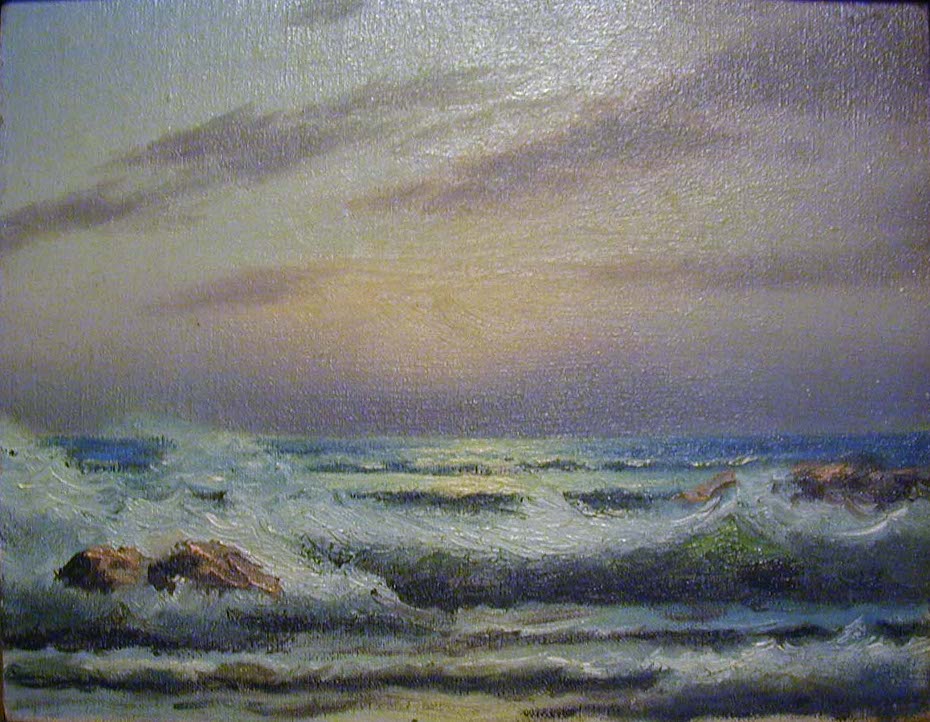
unnamed, Yaffe, 7" x 9", oil
This was an ebay find, which I
purchased because I liked the painting and the frame
it is in. The seller represented it as the work of
either Edith or Herman Yaffee. I was pretty sure it
was by neither of these artists since it was signed
twice as "Yaffe", once on the back of the canvas and
once on the back of the frame. When pressed the seller
said it was definitely the work of Herman because it
was in his style and in the type of frame that he
used. When I asked where the seller had seen Yaffee's
work before he replied that he had seen them on
www.AskArt.com. No works for Yaffee are shown on
AskArt's web site, and when I sent an email to AskArt,
they said that they had no images of works by this
artist. Enough said. The seller was located in
Morrisville, PA.
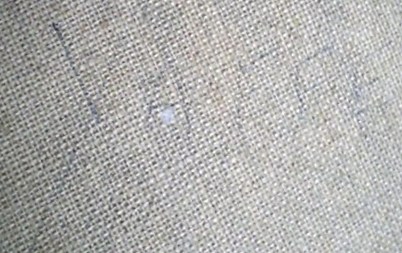
Yaffe signature on
back of canvas
There quite a few artists named
Yaffee or Yaffe, so I am not optimistic about finding
out more about this artist. Especially since this
piece is pushing 100 years old. It is a neat painting,
in a neat frame, and it gives me the opportunity to
tell the sordid story of Herman and Edith Widing
Yaffee, who were man and wife. Sort of.
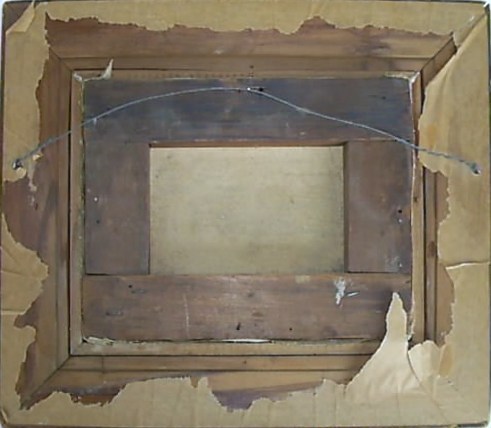
Edith Louise Widing was born on
Helsingfors, Finland on 16 January 1895, probably the
daughter of Rudolph and Elvira K. Widing. They arrived
in Boston on 19 May 1910 on the ship Saxonia from
Sweden. Rudolph's occupation was listed as
lithographer. Ivar Widing, probably Edith's brother,
arrived from Sweden on the Saxonia on 21 April 1905.
The Widing family was living in Boston, MA in 1914. At
the same address were Ivar Widing, illustrator, of
Munro and Widing, and Rudolph Widing, lithographer.
All three were still at the same address in 1915 and
1916. Edith was not listed in the Widing home after
1916, probably because she married Herman Albert
Yaffee. (in progress)

Signature on back of frame

"Cloud Chase", ? Johnson, 15" x 17", serigraph from photograph(s), Artist's Proof
Please excuse the reflection of
my arms and camera in this one. This print is
expensively framed, and I do not want to take it apart
to get a better image. It is a pretty striking piece,
on very expensive paper, with what appears to be gold
foil edging. I am not normally a print person, but
this one is so well presented that I could not abandon
it to it's fate at the Habitat for Humanity store in
Champaign, Illinois where I found it hanging. I can't
make out the artist's first initial. It could be an
"A" or a "C", or maybe even a "G". I am guessing that
it is a serigraph created from a photograph or
superimposed photographs. Prints are really not my
thing, so this is a WAG. I guess you could say that
the whole paper is the image, since it is mounted on a
background with the watermark prominent in the lower
right corner. This would make the dimensions of the
piece 4-6" bigger than given above. It is an artist's
proof for what that is worth. No idea who the artist
is. This could be the work of a student at the
University of Illinois, as the store where I purchased
it is only a couple of blocks from the campus. Not too
many students could afford this presentation, IMHO.
Any help in identifying this artist would be
appreciated.
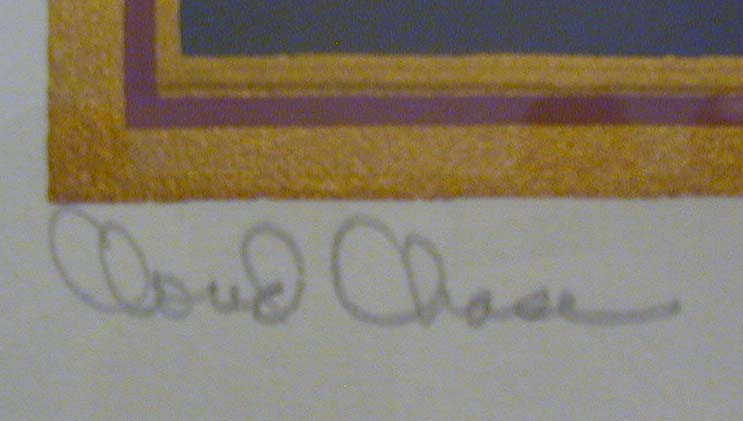


Title, proof mark, signature
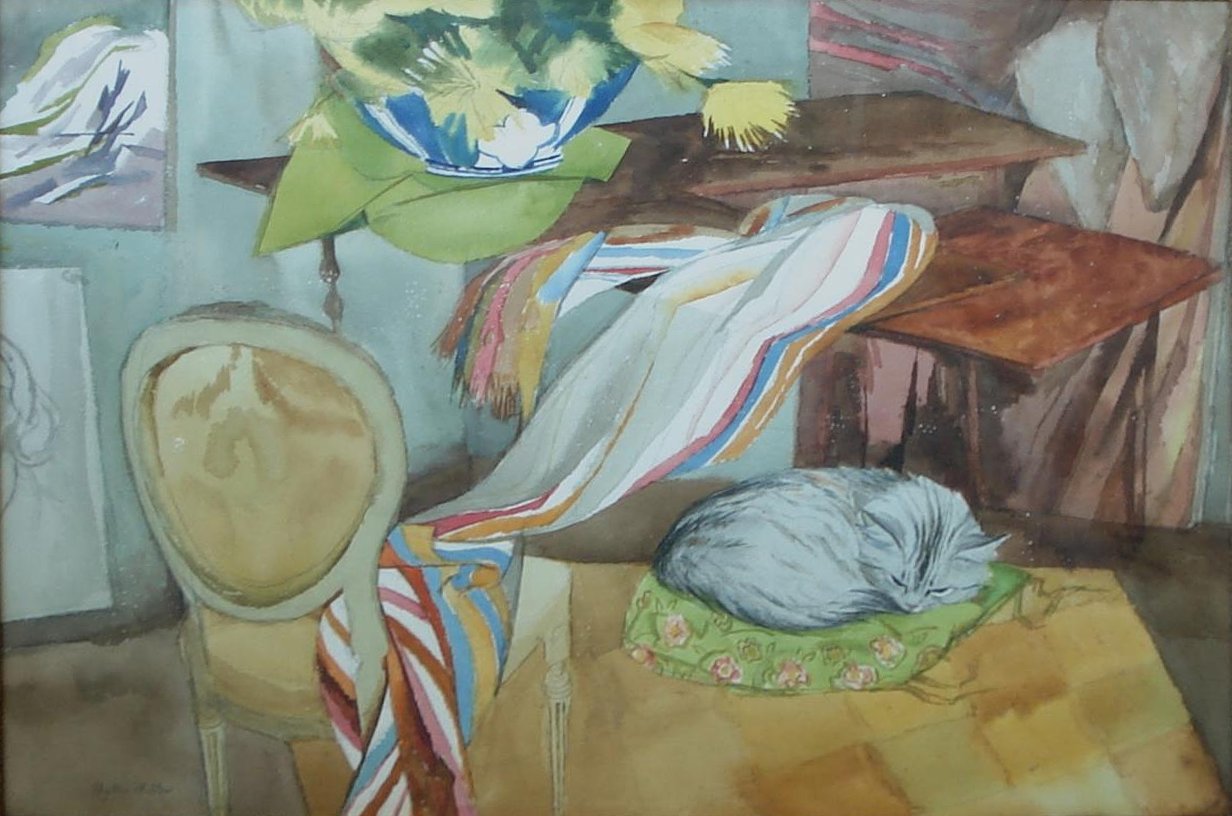
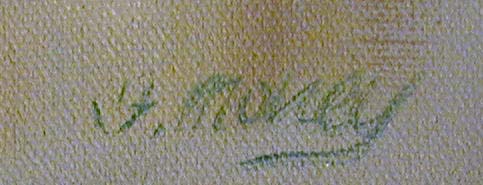
unnamed, Phyllis Miller, 22" x 30", gouache
I originally had this on my "Other Artists" page, as I was confident that I would be able to fairly quickly identify this artist. Oops! My preliminary research turned up three artists by this name who were active in the period, 1970-2000, when I thought the painting was done, even though the frame appears to be much older, perhaps dating to the 1950s. I quickly eliminated two of the Phyllis Millers, one deceased of Hendersonville, NC (she signed her works Rueggeberg Miller according to her family) and one very much living of Los Angeles, CA. The third artist I eliminated after viewing her work and signature. A little more digging disclosed several other artists by this name, one a Professor Emeritus at the University of Houston. So the search continues.

Framed painting
Here are the clues that I
currently have about this painting. The seller of the
painting was located in Monrovia, CA. The seller had
had two other watercolors by this artist, one of a cat
and one of a fox. This leads me to believe that this
was a local (Los Angeles County) artist. The artist
seems to have been a serious amateur or trained
artist. There are pencil marks visible beneath the
paint, so the work was apparently carefully planned
and executed.


unnamed, F. Money, 12" x 9", oil
This is an oil on canvas. The
seller dated it to the 1950s. There was a French
artist named Raoul Billon (1882-1956), who painted
under the name Fred Money. Don't ask. I don' know why.
There are some similarities to the signature on this
painting to Fred Money's signature, but some
dissimilarities, too. I do not think this is the work
of Fred Money, AKA Raoul Billon, but thought I'd
mention it.... I found several of his works on the
Internet, and his style is not similar. Nothing in the
painting to give clue as to the locale, just two kids
flying kites. I like it because I only paid $5 for it,
and also because it is interesting. I find myself
straining to make out the faces of the children, but
know I never will be able to.
UPDATE: I was contacted by a lady who has two
paintings similar in style, color palette, subject,
and signature to my painting. They were purchased
about 1970 by lady's grandmother in Texas. She was
told by the seller that the performer Carol Burnett
was a collector of this artist's work. One is signed
"Fred Money" and the other "F. Money". Unfortunately,
I also found several images of paintings that are
proved to be by the French artist. The style and
signature of these works are very different from my
work and the two similar works. I suppose that it is
possible that the French artist's style and signature
changed over time, but think that this is a stretch. I
did find a fourth work very similar in style and
signature to my painting, and the other two paintings,
that was offered in an online American auction as the
work of the French artist, but I am not convinced that
this attribution is correct. This remains a mystery,
in my opinion.
Signature

unnamed, unknown, 10" x 8", oil
This small painting hung in a
local thrift shop for several weeks, maybe months. I
paid only a couple of dollars for it, and since it
came in a decent, common sized frame, I don't regret
it. It is rather oddly colored and though signed, the
signature is largely illegible. I can only make out
the first three letters of the artist's name, "B - r -
u". It is painted on an "Anco Bilt" canvas,
manufactured in Glendale, NY. I think that later these
canvases were manufactured in Taiwan. I have no other
information on this painting. It may be one of the
thousands of paintings commercially produced for
hotels, etc., in the last half of the twentieth
century.

Canvas maker's stamp
The "ANCO BILT"
stamp appears several times on the back of this
painting.

Numbers on back of canvas
There are a couple of
numbers on the back of the canvas, one stamped and one
in black marker, which may be inventory numbers. This
strengthens my suspicion that this painting was
commercially generated and once hung in a hotel,
motel, etc. It may be by an American artist, judging
by the age and origin of the canvas, I have several of
these small commercial oils, and some are quite
attractive. I am guessing that generations of
frustrated, well trained artists, made extra cash
cranking out these types of paintings, until much of
this work went to other countries like Mexico and
Taiwan, where they could be purchased in bulk for
pennies, as opposed to a few dollars in the U.S. I am
not sure that this happened, but is seems logical from
the information I have seen.

Signature from this
painting
I am now seeing machine
generated oils that can be cranked out like ten
dollar watches, many identical paintings. I was
quite amazed when I found a whole stack of such
paintings at a local used furniture store. I have to
wonder if the better done of these small American
painted commercial paintings might not become
collectibles, as it seems that Paint by Numbers
paintings are becoming? Time will tell...

unnamed, unknown, 1 7/8" x 5 7/8", monotype, 1/1, 1991
I found these two small
monotypes in a local pawn shop. They are beautifully
framed and matted. They have the framing label of a
local framing shop, that is no longer in business. I
took them to a framer who sometimes does some work for
me, and coincidentally it turns out that he worked for
the same framer at this time, but could not tell me
anything about them. They are quite striking.

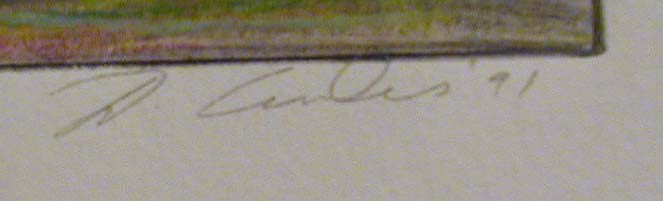
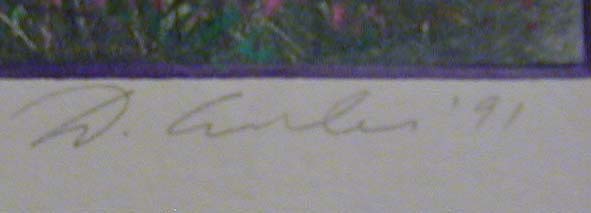
unnamed, unknown, 1 7/8" x 5 7/8", monotype, 1/1, 1991
Both are signed and numbered
1/1 below the print, but I cannot read the signatures.
The first initial appears to be a "D".

unnamed, Jewel, 9" x 12", oil, 1952
This is an ebay find, purchased
from a dealer in Los Angeles, CA. The seller
speculated that it might be the work of California
artist Jewel Cooper. Her work pops up on ebay fairly
regularly, but little information about her is
available. All of the other works by her that I have
seen are fully signed "Jewel Cooper" and dated
similarly to the work in my collection. The signature
is very similar to my painting, though, and I am more
and more leaning toward accepting the seller's
attribution. All of the other works I have seen are
from the 1960s and 1970s, so it is very possible that
she changed her signature, at some point, adding her
last name. The other paintings that I have seen are in
a similar, though more sophisticated style, and of
similar subject matter. It is likely that this is one
of her earlier works.
There is very little information
available about Jewel Cooper, so I compiled a
biography for her, though I have not been able to
absolutely confirm that there were not two Jewel
Coopers working as artists in California.
Jewel Ida Kelton Cooper was born on
25 November 1902 in Ridge, Fayette County, AL, a
daughter of Lytle Alexander and Ellen Janette Bynum
Kelton. Lytle Kelton was working as a coal miner in
1910. Jewel married Ottis Lee Cooper on 6 October
1951. Ottis was also born in Alabama and was first
married to Abbie Lee. Cooper is mentioned several
times as State Commander of the American Legion,
living in Red Level, Alabama in the mid and late
1940s. I do not know where Jewel and Ottis were
married. They may have married in Alabama.
I have not been able to locate Ottis and
Jewel as a couple in records prior to 1952 when they
appeared in the voter registration records of Los
Angeles, CA. They were registered
as Democrats, living at 11608 Archwood St. in 1952 and
1954. Jewel is mentioned several times in the
Van Nuys News in the early 1960s in connection with
her work as an artist. She was an art teacher and Art
Chairman of the North Hollywood Women's Club. She held
a one woman show at the Security First National Bank
on Ventura Blvd. in Studio City, CA in 1961. The
newspaper reported that she had won many awards for
her work as a landscape artist. Jewel was the
Recording Secretary of the Valley Art Guild in 1961
and "Otis" Cooper was mentioned as an honorary member
of that organization. I have found no record of where
Jewel received her training as an artist. She is not
mentioned in any art reference work.
Jewel Cooper died on 18 October
1992 in Sun City, CA. Ottis died in Sun City on 1 July
1985. Ottis Cooper was a 2nd Lieutenant in WWI and he
and Jewel are buried in the Riverside National
Cemetery in Riverside, CA.


unnamed, Joseph Sacks, 16" x 12", oil
This was an ebay purchase.
There was a well known artist of the same name, whose
signature is very similar, but I have not been able to
confirm that this painting is by that well known
artist. It could be another artist of the same name. I
just liked the colors and style of this painting. The
seller said that the painting came from the San
Francisco area and the well known Joseph Sacks lived
in California at some point in Pasadena, Los Angeles,
and Altadena. I have seen one reference that places
him in San Francisco. I am including a biography of
the well known Joseph Sacks below.
Joseph Sacks was born on 1
September 1887 in Shavli, Russia, a son of Isaac and
Ida Sacks, Russian Jewish immigrants. Isaac came to
the US in 1888 and was joined by his wife and son in
1891. Isaac worked as a peddler in 1900 and 1910, in
Philadelphia. Joseph's birth month and year are given
as July 1886 in the 1900 census but in 1910, his age
was given as 22 which fits, as the date of the census
was 21 April 1910. Joseph's occupation in 1910 was
"artist, studio". Sacks declared his intent to become
a U.S. Citizen on 4 June 1909, while residing at 401
Dallas Street, San Antonio, Texas. His occupation was
given as "artist" and his description as 5' 4" tall,
120 lbs., brown hair, and blue eyes. It was noted the
he arrived in New York City on the ship Arizona on 3
August 1892 from Liverpool, England. On page two of
his petition for naturalization dated 22 May 1914, he
was residing at the same address as that in his WWI
draft registration. His father, Isaac, and a neighbor,
Louis Miller, witnessed his petition. He was
granted citizenship on 15 September 1914. Sack's WWI
draft registration gives his birth date and place,
marital status as single, and his occupation as
"artist painter", employed by "Kimsey 1026 Chesnut
Street", Philadelphia. The registration also contains
a very nice example of his signature, as do his
declaration of intent and petition for naturalization.
I was not able to locate the Sacks family in the
1920 census, but I did find them in Philadelphia in
the 1930 census. Isaac was deceased and Ida was the
head of the household. Ida owned the home, which was
valued at $17,000, a lot of money for the time. Of her
four children living at home, three were employed in
the tailoring business, which may indicate that Isaac
was a tailor. Joseph was employed as an "artist,
portrait shop". I next find Joseph in records in his
WWII draft registration. He was living in
Philadelphia, and gave his contact as Ida Sachs. I
don't know if this was his mother or wife of the same
name. They were living at the same address, though. He
was employed as "artist, portrait painter".
Sacks attended the Pennsylvania
Academy of Fine Arts and was supposed to be a student
of Thomas Pollock Anshutz, William Sergeant Kendall,
and William Merritt Chase. Sacks was a member of the
Philadelphia Sketch Club and the Philadelphia Art
Alliance. He also studied in Europe for several years.
He lived in California in the 1930s. He is mentioned
in Who Was
Who in American Art by Falk, Artists of the
American West by Dawdy, Mallett's Index of Artists,
Dictionary
of American Painters, Sculptors, and Engravers
by Fielding, and Davenport's Art Reference and Price
Guide.
Sachs died in May 1973 in
Philadelphia.


Signature from estate painting
The image of the first
signature above is from my painting. The next image is
of Sacks signature from a painting the was signed
lower left, like mine, and was stamped verso with the
estate stamp from Sacks' estate. They are very
similar. I have seen several other examples of his
signature that are also very similar and a few
paintings on the same size canvas. I'll get a better
image of the signature from my painting, when time
permits.

unnamed, unknown, 12" x 18", gouache
I have had this painting for
quite some time, but only recently put it back
together after taking it apart for cleaning. There is
a framer's label on the back of the painting for
Robert Richard Toth's gallery and framing services. It
is not signed, but I felt certain it was his work as
it is very similar to a couple of paintings from his
archive of works from private collections on his web site.
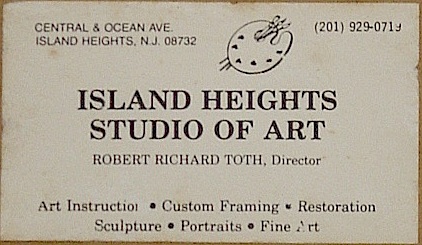
Business card, verso
I was eventually able to
contact Mr.Toth, and he told me that this is not his
work, but probably something that he framed for
someone. He could not tell me anything else about the
work. Since it is not signed, I will probably not be
able to find out any more about it. It is very well
done, obviously the work of a talented artist, and I
like it very much.

Toth framed painting

unnamed, E. P. Becher, 12" x 16", oil
This was an ebay find,
purchased from a seller in Nottingham, England. The
seller estimated it to be a 1930s or 1940s painting.
It is not signed on the front, but is signed verso, E.
P. Becher, which may or may not be the artist. There
is a framer's label that reads: "W. F. Gadsby Ltd,
Thrale Galleries (late Humphreys) 326-328 Streatham
High Road, S.W.16, London". This should help to date
the painting, if anyone out there is familiar with
this gallery. W. F. Gadsby Ltd. still exists, and I
have sent them an inquiry about this label. The seller
described the style as "vintage abstract
impressionist" which doesn't fit with the seller's age
estimate, since this was a 1950s movement. I'd class
it as more impressionistic. I think it evokes the same
feeling as one of Monet's haystack paintings. I'll get
a picture without the glare in the center of the
painting, when time permits.


unnamed, Clatworthy, 8" x 10", unknown media
I
purchased this from a dealer in Burbank, California. I
am not sure if it is an oil or an acrylic. It is very
well done, but I can find out nothing about the artist,
despite the rather unique signature. There have been a
couple of prominent artists by this name, but I am
pretty sure that this is not their work. Any help on
identifying this artist would be appreciated.


unnamed, unknown, 9.5" x 13.5", oil
I found this painting at a
local thrift shop. It appears to be a scene at the
Wailing Wall. It was very well framed in a modern
metal frame and archivally matted, and seems well
painted, but in a primitive style. It is signed in
Hebrew in the lower right, but I have not been able to
translate it using what on line resources I have been
able to find. I would appreciate if someone could
translate the signature for me. I removed the painting
from its frame to examine the back, but there is,
unfortunately, nothing written there, so these are all
the clues we get. I looked at this painting for
several weeks as it migrated from a place on the wall
beside the checkout register, to less glorious places,
and finally to an odds and ends painting pile. I
always liked the colors and style, but kept putting
off buying it, until "next time". I finally decided
that I couldn't live without it, so here we are.

Signature?

unnamed, Mimmoy, 24" x 30", oil
I found this at a local thrift
shop for $18. It appears to be signed "Mimmoy". I have
been able to find out nothing about this artist. It
appears to be coastal scene, judging by the fact that
this seems to be painted at low tide. It could be a
Maine scene. It is painted on a Grumbacher 24 canvas,
and has kind of a 1950s or 1960s feel to me. Just a
guess. Any help on this one would be appreciated.


"The Sleepless Village", Catallo, 16" x 20", acrylic, 2001
I found this one on ebay from a
seller in Rockport, MA. I am still researching this
artist. The seller read the name as "Cataldo", but I
think it is Catallo. What do you think?


"Bird in the woods", F. A. Bixier, 9" x 15", oil
An ebay find. These two
paintings were not on stretchers, and were part of a
lot of 13 wildlife paintings by the same artist. They
are pleasant, pretty well done, and were cheap. I
really liked the squirrel painting, and thought this
bird painting was the second best of the lot. A quick
Internet search revealed nothing about this artist.
Research in progress.....

"Squirrel in the branches", F. A. Bixler, 9" x 15", oil
These paintings are old
enough that the canvas they are painted on have
some age toning, which cannot be seen in the
paintings, themselves. They are just pleasant
little paintings. The seller was located in
Bridgeport, CT.


Ysobel, unknown, 20" x 16", oil
I purchased this painting on
ebay for a small sum from a seller in Southgate,
Michigan. I like portraits, though many folks don't. I
did not expect to find out much about it, as it is not
signed. A little research, however, revealed that the
name Ysobel is very rare. Since this painting is
dated 1931, I thought I'd take a stab at finding
something out about the subject. There
were only 16 men and women by this name in the 1930 US
census, and lo and behold one of the women, Ysobel
Crue Lopez, lived in Detroit, about 21 minutes from
Southgate. Possibly just a coincidence, but I am
including the information about her and the main
members of the household she lived in, in case this
rings a bell with someone who may see this web site.
Ysobel Crue Lopez was born about
1901 in Mexico, of Mexican parents and emigrated to
the US about 1915. She married Elis Lopez about 1919
and their first child, Beatrice, was born in Michigan
about 1920. Elis was an inspector in an automobile
factory. Ysobel's father, Benigno Crue was living with
the Lopez family in 1930. He had no occupation and was
a widower. Elis and Ysobel also had; Pola, Juana,
Luis, Cresensio, and Eline. Unfortunately, I was
unable to locate any of these folks in any other
record.

"TAXCO, GRO.", Sanchez, 14" x 20", watercolor
I found this one at a local
thrift shop for a couple of dollars. It looked like a
sepia toned watercolor, as opposed to a print, and it
was cheap, so I took a chance. It is indeed a sepia
colored watercolor. That is all that I know about it.
Taxco was a popular town for art minded Americans in
the 1950s and maybe 1960s. I have several paintings in
my collection by artists who moved there to live and
pursue their art, or visited to pursue their art. Any
information about this artist would be appreciated.
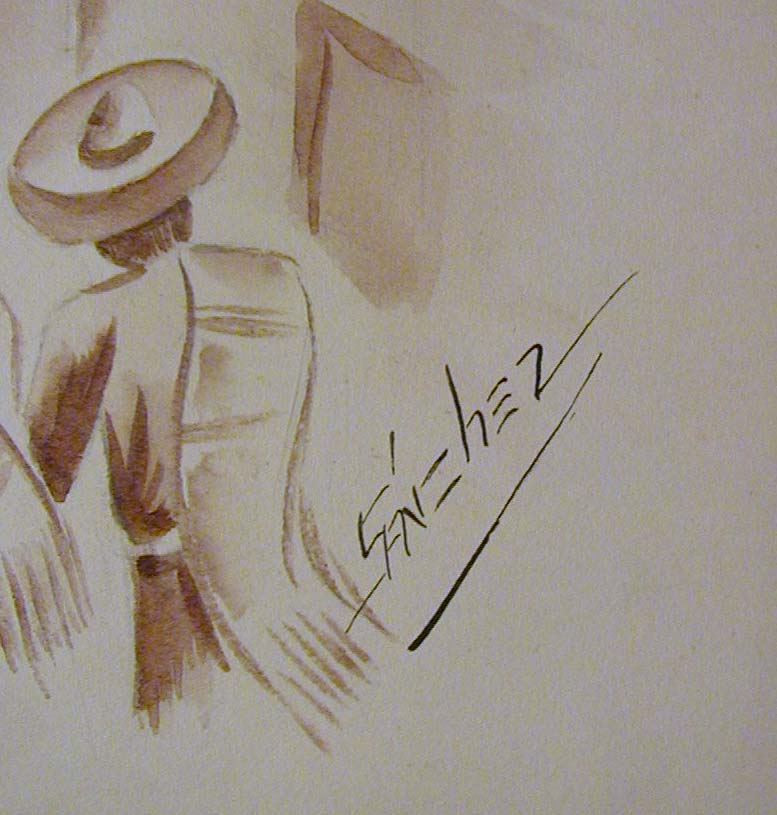
Sanchez signature

unnamed, EK (monogram), 24" x 18", oil
This was an ebay find. It is
signed with monogram "EK" in the lower right. As I
recall, I purchased this from a seller in Tennessee.
It is very dirty, but also varnished, so lots of glare
as seen on the left side of the painting, and it sat
in my difficult painting pile for many months, until I
had time to fuss with getting an acceptable image of
it. In general fairly well done, I think, but the
artist seems to have a problem with painting hands,
which I think are awkwardly done. The artist does a
fair job with light and shadow, though. I don't feel
that there is much of a sense of motion in the
painting, given that the pot is supposed to be
spinning on the potter's wheel. I paid very little for
this one, just tossed out a minimal bid and won it. My
gut says that this may be a work by a student in some
art program, probably at the university level. Not
sure why I feel this way, just an impression. What
appear to be scratches on the painting are actually
glare from the texture of the artist's brush strokes.


unnamed, after Maurice Prendergast, 14.5" x 19.5", watercolor
I found this at a local thrift
shop. It is extremely well framed and sealed, so I
have not taken it apart to look for a signature or
title. No signature is visible on the front of the
painting. This appears to be a loose copy of "May Day,
Central Park", by Maurice Prendergast. It is not an
exact copy, and is not signed where Prendergast's
painting is signed. This may be an homage to
Prendergast by an admiring artist. It was framed by
Beach Arts of Bonita Springs, Florida. The glass was
so dirty that it appeared quite washed out, but I was
surprised at how rich the colors were, once the glass
was cleaned. A pleasant surprise. I looked at it for
several weeks, before deciding to buy it. It is a
painting that grows on you. There is certainly a lot
going on in this painting. I have no real hope to find
out more about it, so just going to enjoy it. I made a
place for it on my wall, even though I have many
other, more sophisticated works looking for a place to
hang.

unnamed, Mary Alice, 20" x 16", oil
The artist signed this painting
simply "Mary Alice". I think that the figure is pretty
well done, and I like the colors. The use of light and
shadow, though understated, is nice, too. It came in
pretty cool frame, as well. Someone, not necessarily
the artist, included a Bible verse using an ink pen on
the back of the dust cover, Galatians 6:9, "And let us
not be weary in well doing, for in due season we shall
reap, if we faint not.". It is hard to to tell how old
this painting is, but probably from the 1970s or
1980s, I'd guess. The seller claimed it came from a
high end estate sale. I suspect that this may be a
piece done by a member of a religious order.
Communities of religious orders often commit extensive
resources to the creation of art, often not religious
based art. This may well be a work by "Sister Mary
Alice".
Any help in identifying his
artist would be appreciated.


"Tartanes A Quai, St. Tropez", T. (or J.) Spisso, 10" x 8", oil, ca 1944
This was an ebay find. The
seller said that his father purchased this painting on
his way back from WWII in 1944. That is all I know
about it. This signature is a bit hard to make out,
but I believe it is Spisso. The person I purchased it
from read it as Sasso. There was an Argentinian artist
named Liberato Spisso, but he was born in 1930 and I
find no evidence that he ever traveled to Europe. Any
help in identifying this artist would be appreciated.
Tartanes were barques, or small ships that were used
on the Mediterranean. I have read that they went out
of use in the late 19th century.

Spisso signature

unnamed, C. M. Agnew, 12" x 10", oil
The only artist that I can find
listed that could possibly be this artist is Clark M.
Agnew, but this is just a guess. Clark Mansfield
Agnew was born in St. Paul, Minnesota on 20 June 1905
a son of William Livingston and Laura Jay Waynick
Agnew. Both his father and brother were employed as
"Advertisers, general practice" in the 1920 census of
Chicago, Illinois. Clark Agnew attended the Art
Institute of Chicago, paying his way by playing the
clarinet in Dixie-land and Chicago style bands. He
married a woman named Gloria about 1929. She ways born
in Hungary. They were living in Manhattan in 1930,
where Clark was employed as an "artist, commercial". He
produced advertising art for several prominent
magazines. Agnew was later a television producer and
wrote a book about television advertising in 1958. Using
Google, I found the following link
that has information about Agnew's life and some
examples of his advertising art. Clark M. Agnew is
listed in Who's Who in American Art, Who Was Who in
American Art, and Davenport's Art Reference and Price
Guide. I was immediately drawn to this painting
because it reminds me of a place where I go hiking.
Clark Mansfield Agnew died on 2 May
1959 in Norwalk, Connecticut. Gloria B. Agnew died on
6 August 1996 in Westport, Connecticut.

Signature

unnamed, Krueger, 10" x 11.75, oil, 1939
This was $9.95 ebay find. The
seller was in Des Plaines, Illinois, but I am not sure
that this is an American artist. It could be a German
immigrant or a souvenir of a trip to Germany. The
signature is rather distinctive, though I don't expect
to find out anything about this artist. I just like
the style of the painting and the colors.

Signature

unnamed, D. Duclair, 11" x 15", watercolor
D. Duclair seems to have been a
fairly prolific Haitian watercolor artist who was
active in the 1950s and 1960s. At least that is how he
has been characterized on various auction web sites
and artprice.com. The value of his work varies wildly
from auction to auction, sometimes selling for tens of
dollars and other times for hundreds of dollars. I
have not had a chance to take this painting apart to
get a good picture of it, and there is a lot of glare
in the photo above, notably around the figures in the
foreground. I was able to use the Gimp to clean up the
glare in the other parts of the photo. I'll get a
decent image of it by and by. Any information on this
artist would be appreciated.


unnamed, unknown, 7" x 6", oil
Another little ebay find. I
like small paintings, because I don't have much free
wall space. So small is among the first things I liked
about this work. Then I liked the colors and motion in
it. And lastly, I liked the $9.99 price, which is what
I paid for it. The signature is close to readable, and
is a good research opportunity. The name looks like
"A. Zosber" or "A. Zesber". It could also be Zesbet or
Zosbet. It came in an interesting frame that makes me
think it is a 1950s, or early 1960s work. Just a
guess. The seller was in Gouldsboro, PA, but this kind
of feels like a California painting to me. Help!


unnamed, unknown, 4" x 6", oil, 1950
This
was an ebay find. It is actually painted on a small,
stretched canvas. I suspect it is a souvenir of a trip
to Europe. For such a small painting, it is nicely
detailed, and I think, very well done. The subject
appears to be a hunter, judging by the shotgun over his
shoulder. His dress probably gives away his nationality,
but I do not know what that might be. The signature is
quite distinctive and appears to be the initials "A L".
It is in what appears to be its original, green painted
frame. I was once a pipe smoker, so appreciate the
beauty of his pipe. I don't expect to find out any more
about this small painting. The seller was located in
Burbank, CA.
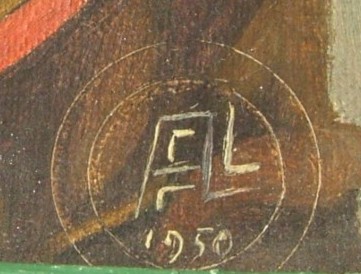

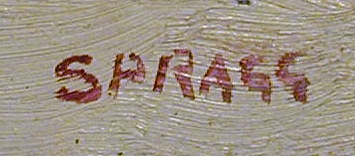
unnamed, Spragg, 12" x 16", oil on board
No idea who this artist is, but
I love this painting, and it is one of my favorites. I
purchased it from a seller in Townsend, MA, who
estimated the board it is painted on to be pre-WWII.
It is a small painting in a really nice vintage frame,
was cheap, and I am a sucker for bleak winter scenes,
especially with a small pop of color like the red in
the woman's shawl.
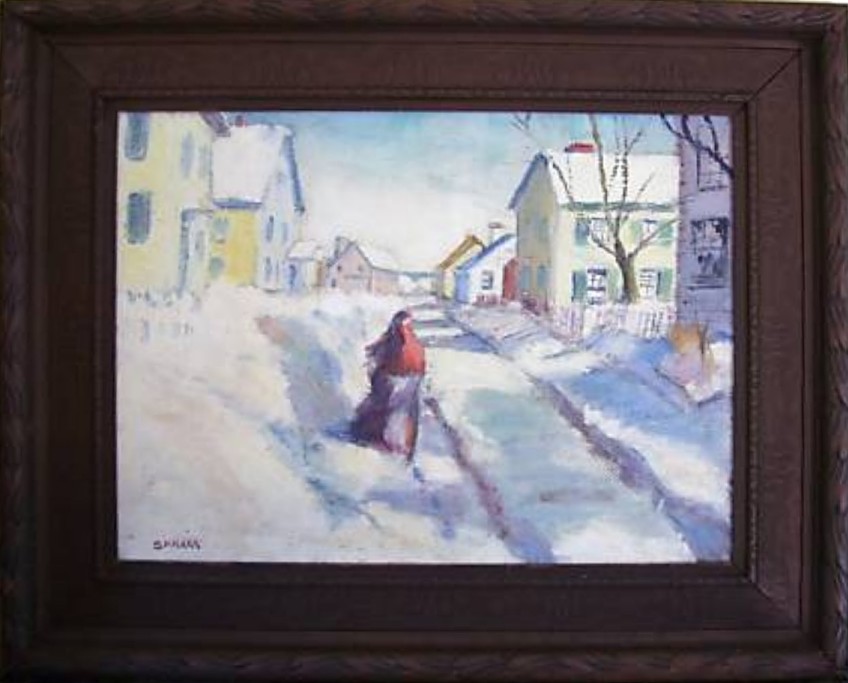
The dark frame really makes this painting pop.
I researched a man named Spragg
who I though might be the artist, but it was a false
lead. What I did learn is the name Spragg is Norwegian
and pronounced the same as the surname "Sprague". Any
help in identifying this artist would be appreciated.

"Snow on Onondaga Road", Peter Shostak, 17" x 29", acrylic, 1977
This painting was sold to the
folks I purchased it from as the work of well known
Canadian artist Peter Shostak. I contacted the artist,
however, and he confirmed that this is not his work.
The painting is signed verso both "P. Shostak" and
"Peter Shostak". The sellers took the painting back to
the people they had purchased it from to ask for a
refund, and they were apparently rudely turned down,
even though I sent them the email from Mr. Shostak,
claiming they had sold it as his work in good faith,
believing it to be a painting by him. The question now
becomes did the original sellers sign the work in an
attempt to pass if off as the work of Canadian artist
Peter Shostak, or were they also duped, or is this
work by another artist also named Peter Shostak? I
like the painting and the cost was very little, so I
decided to keep it and use it as a research
opportunity. The painting depicts the Syracuse Mony
Towers, as they were then known (now the AXA Towers)
as seen from Onondaga Road in winter.
My initial research showed that
there are up to nine men named Peter Shostak now
living in the US. I also found the record of another
Peter I. Shostak 1913-1989 who was born in New
Hampshire, lived in New York state, and died in
Orlando, Florida. His WWII enlistment record shows
that he had four years of college and was working as
an actor at the time of his enlistment. He was the son
of Russian Jewish immigrants John G. and Annie
Shostak. He married Anna Yaroush on 11 October 1964 in
Stratford, CT. There were also several other men by
the same name, who were too old to be the creator of
this painting. I have not been able to find contact
information for the nine living men, but will keep
trying.
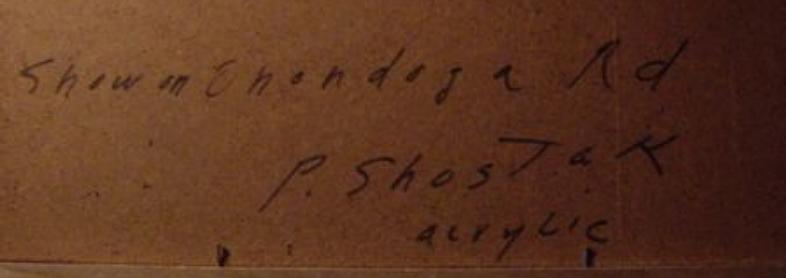
Title verso
The painting is titled verso.
The second seller is from Baldwinsville, NY and the
original sellers live nearby. I tried unsuccessfully
to find an image of the Mony Towers from this
perspective.

Signature verso

unnamed, Esther Meyer (Heyer?), 11" x 14", gouache
I purchased this painting on
ebay from a seller in California, which may indicate
she was a California artist. The seller had a few
paintings by this artist and on some the surname
appeared to be Heyer as opposed to Meyer. I am not
really certain which is correct. The paintings were
all rather well done and in a distinctive style. Three
women named Esther Heyer died in California between
the late 1980s and late 1990s. She may have been one
of these women. There was a prominent California
artist named Esther Meyer (1897-2000), but she appears
to have been a graphic artist working mostly with
engravings and etchings. I have seem a couple of
examples of paintings by her, and they did not greatly
resemble this artist's work, though the subject matter
was very different. This is a pleasant painting,
though, and it appears to be the work of a practiced
artist, so I hope to eventually discover more about
her.


unnamed, M. Considine, 10" x 8", oil on canvas
I
picked this up at a local pawn shop for $15, as I
recall, mostly as a research opportunity. I was never
able to find out anything about this artist, and it may
be one of those sweatshop Mexican paintings. The age is
about right, maybe 1980s. It is a genre painting and I
have seen many done using a similar composition of two
sailing ships in a harbor next to a pier. This one is
maybe a bit better than most of those, I think. Very
colorful an some nice detail in the crowd on the dock.
It actually has pretty good depth and lighting, too, so
not a total waste. Doubt I will ever know more about
this one than I do now.


unnamed, Bale, 3" x 5", watercolor
I found this one at a local
thrift shop and paid very little for it. For such a
small painting, it is very complex and colorful. It
was simply but nicely framed and matted, and I half
expected I would find it was some kind of print when I
removed the cardboard backing to replace it, I have
this one hanging to the right of my kitchen sink, so
get to look at it a lot and never get tired of it. I
have not been able to find out anything about this
artist, though the signature is very unique. I think
this dates from the 1980s or 1990s.


unnamed, Konstantinov, 10.7" x 8.5", oil
I purchased this painting from
a seller in Bulgaria. The seller estimated that it was
painted in the 1920s. The signature is in Cyrillic and
the seller speculated that the artist was Russian.
There are a couple of listed Russian artists by this
name who were active at this time. A search of
Wikipedia for this surname showed that the surname of
Konstantinov was also in use in Bulgaria. I don't
expect to find out much about this one. I liked the
bright colors and loose style of this painting, but
also purchased it to check out this seller. He has a
large inventory of interesting artwork, some at very
reasonable prices. The painting was recently re-framed
in a good frame and cost very little. Even though I
have a pretty extensive collection, I have only a
couple of floral still lifes, so this was a good
opportunity to pick up an interesting one.

I purchased this painting from
an ebay seller in Alhambra, CA. This artist is
identified as a Pasadena, California artist, William
John Clemons, by Edan Hughes in his book on California
artists. Mr. Hughes told me that this was the second
work by Clemons that he had seen in 49 years. The
other is in his possession. I am not convinced that
Mr. Hughes is correct in his identification of this
artist, though he may be. Regardless, I agree with Mr.
Hughes that Clemons was a talented artist and share
his curiosity about the fate of the rest of Clemons'
works. The fact that only two of his paintings have
been found, albeit both in or near Pasadena, and that
his subject matter is so diverse is puzzling.
A search of census and
other records revealed that William
J.Clemons worked as a house painter in Pasadena from
1910 through 1944. He arrived in California between
1900 and 1910. His 1917 WWI draft registration gives
his birth date as 10 August 1875, but not his
birthplace. His description is given as medium height,
medium build, dark hair, blue eyes, and deaf. He
gave his next of kin as Mary Martha "Mamie" Barrus nee
Clements of Athol, Massachusetts. She was living as a
ward of Amos and Lucia Worrick in Athol in 1900, aged
18. She is the right age to be William's sister, but
the birthplace of both parents is given as
Massachusetts, while William consistently gave his
father's birthplace as Massachusetts, and his mother's
as Ireland or Irish Free State in census records in
1910-1930. He may be the William Clemons who was
living as a lodger and employed as a house painter in
the 1900 census of Colebrook, Coos County, New
Hampshire. This man's birth date was given as March
1876, and his and his parent's birth places as
Massachusetts. There is no sign of this man in later
censuses, though, so the discrepancies in the census
could be mistakes. No records that can be identified
as belonging to this William Clemons before 1900 have
been discovered.
There is no record that
indicates that he ever worked as a fine artist, though
it is certainly possible that he did. I have found no
record to indicate that he ever traveled outside of
the United States, especially to South Africa, though
this painting could have been painted from a
photograph. In every census, but one, he was living as
a lodger in a boarding house and did not seem at all
prosperous, though he may have just been thrifty. He
was living in a rescue mission in 1930. California
voter registration records indicate that he voted
Republican and retired from his work as a house
painter between 1942 and 1944. He last appears in
records in the California Death index.
William John Clemons died in Los
Angeles, CA on 4 October 1958.

I found this watercolor at a
local furniture consignment shop. Based on the frame,
glass, and framing materials my guess is that this
painting dates to the 1930s. There were no labels and
the painting is laid down on a card. Despite the age,
there does not seem to be any toning or darkening of
the painting. This may be attributable to the fact
that a piece of dark paper the same dimensions as the
painting was laid down on the back of the card it was
mounted on. I have never seen this done before. This
paper seems to have protected the painting and the
card it is mounted to from the backing material. I was
able to break the card free from around the edges of
the painting, but could not free the painting from the
card. It is thoroughly laid down.
The painting is signed A. Ford. My
feeling until I took the painting apart was that it
was likely English, especially since it has a French
mat, but now I am not so sure. I have disassembled
numerous English paintings of this age and the
materials do not really feel like anything I have seen
on an English painting. The glass is very thin and
flexible. And the frame is thin and in the Arts and
Crafts style. This may be American.
The only listed American artist
named Ford whose first named started with the letter
"A" was Arva Naugle Ford 1890-1979, wife of Vincent
Ford of Dallas Texas. She was married by 1920. She is
listed in Davenports, Mallett's Index of Artists,
Dawdy's Artists
of the American West, and Dictionary of
Texas Artists by Grauer. I have been able to
find only one example of her work and no examples of
her signature. The work I found was an oil, so did not
give much to compare against. Arva was the daughter of
Leonidas L. and Emma L. Naugle. Leonidas Naugle was a
minister in Howe, Grayson County, Texas in 1910.
I like this painting. It has a lot
going on in it and together with the frame and French
mat is nice period piece. I am still researching this
painting and artist.

Here are some artists whose work I really like but have not yet added to my collection:
Michael McKee Michael does beautiful work with pastels.
- On line appraisal service
from John Sewell well known Canadian expert on fine art
and antiques. This is a very reasonably priced on line
service from a well respected expert. Fill out an on
line form and send images of your art objects. No need
to send your art objects through the mails. I am a
satisfied customer! Highly recommended!
- Here is a list of common British art society abbreviations.
- Images
of art works by 29,000 artists. I use this site to
compare works that I am interested in or own to other
works by the same artist. A good place to spend some
time just cruising, too!
California Artists Illinois Artists Indiana Artists New York Artists Ohio Artists
Pennsylvania Artists Texas Artists New England Artists Other Artists
UK Artists Canadian Artists South American Artists Asian Artists European Artists
Unknown Artists Unknown Artists 1 Unknown Artists 2 Unknown Artists 3
HOME